
Your salt comes from the Sun: How climate change is ruining the process
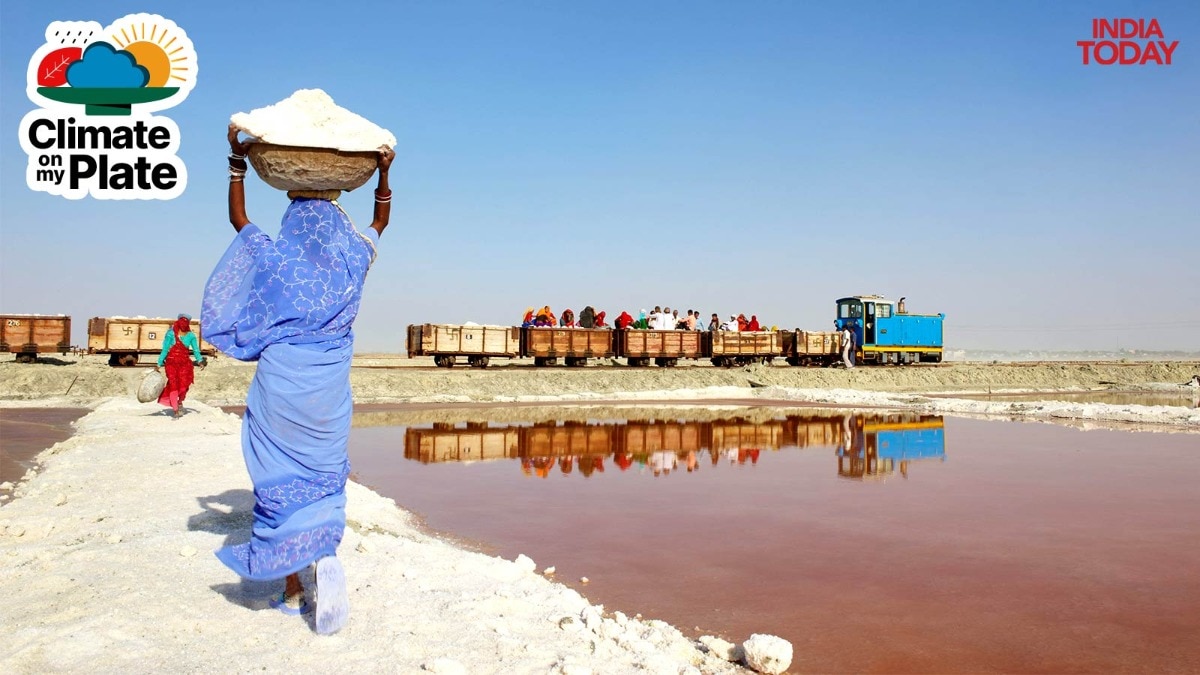
Salt is one of the few things on our plates that does not need to be grown. But somehow, climate change has figured a way out to make it harder to produce.
Across India's salt pans, saline groundwater or seawater is pumped into a series of shallow ponds. Under the sun, water gradually evaporates, and the brine becomes increasingly concentrated. A pot of freshly harvested salt crystals are seen at a salt mine. (Photo: Getty)
When it reaches the right concentration, sodium chloride, or common salt, crystallises and forms a layer that can then be harvested.
That salt-making process sounds simple but it isn't.
The entire process depends on a sufficiently long period of dry weather, along with sunlight, temperature and limited rainfall to produce the desired results.
As climate change makes rainfall more erratic and extreme weather more frequent, these conditions are becoming harder to rely on in some of India's biggest salt-producing regions. A man is seen working in the salt pans at Little Rann in Kutch, Gujarat. (Photo: Getty)
India is the world's third-largest salt producer, with an average annual production of about 30.7 million tonnes.
Gujarat alone accounts for about 87.4% of India's salt production, according to the Salt Commissioner Organisation.
Considering the scale of salt production, the problem, therefore, is not confined to just the Indian borders and can eventually become a global issue.
But how exactly does climate change hurt our salt? A close up of freshly harvested salt in Gujarat. (Photo: Getty) WHEN RAIN SWEEPS AWAY SALT
Much of India's salt is produced through solar evaporation.
In Gujarat's Little Rann of Kutch, salt-makers pump saline groundwater into large, shallow pans. The water is channelled through a series of ponds, where evaporation gradually removes the water and increases the salt concentration.
Once the brine becomes concentrated enough, salt crystals begin to form in the crystallisation pans. These crystals settle on the surface or floor of the pans and are then collected.
This is where climate change can directly affect the food on our plates. A salt lake worker unloads salt from a basin onto a stockpile at a salt pan in Mumbai. (Photo: Getty)
Unseasonal or prolonged rainfall can dilute the brine and interrupt evaporation. Heavy rain after crystals have formed can also wash away the salt.
A 2026 study on salt farming in the Little Rann of Kutch found that changing rainfall patterns and extreme weather are affecting production, while changes in temperature can alter evaporation and crystallisation.
In Gujarat, the impacts of a shifting monsoon are being witnessed as a delayed start of the salt-making season, due to incessant downpours, is affecting production. A woman works on a salt mine in Gujarat. (Photo: Getty)
In some cases, salt-makers have had to spend time building mud embankments to stop freshwater from entering their salt pans.
But efforts to stand up to nature often turn out to be futile.
For salt-makers, this is a problem because there is only a limited window each year in which the weather is dry enough for evaporation and crystallisation.NOT JUST ABOUT A HOTTER INDIA
It only seems logical that hotter weather should help salt production by making water evaporate faster. Workers are seen lifting and transferring salt at a salt mine. (Photo: Getty)
But climate change is not simply making every day hotter. It's also changing when and how rain falls, while increasing the risk of intense weather events.
A late or prolonged monsoon can keep salt pans flooded for longer and delay the start of production. Rain during the production season can then dilute the concentrated brine or destroy newly formed crystals.
Cyclones and intense coastal storms add another layer of risk, particularly in Gujarat's coastal salt-producing areas.
The Central Salt and Marine Chemicals Research Institute has also been working on technologies that can improve evaporation and increase salt yields when weather conditions are unfavourable.
Whether these efforts give way to actual, usable and scalable solutions, remains to be seen. Workers are seen working on a salt mine in Gujarat. (Photo: Getty)
So until that happens, the next time a pinch of salt is added to the food, it should be kept in mind that the white powder has reached your pantry after weathering conditions it has never faced before.
Unlike rice, wheat or mangoes, salt does not depend on a seed, a field or a flowering season. But it still depends on weather, which is now becoming increasingly difficult to predict.
And as climate change alters the weather, it is also efficiently taking away something essential from our kitchens. A basic ingredient without which the food is but a colourless landscape.- EndsPublished By: Aryan Published On: Sep 16, 2026 08:00 IST


:strip_icc()/i.s3.glbimg.com/v1/AUTH_37554604729d4b2f9f3eb9ad8a691345/internal_photos/bs/2025/7/l/0xNXtJQ2uoV1Kh6LbsAg/mecanismo-de-preservacao-preve-que-as-arvores-se-tornem-ativos-edilson-dantas-o-globo.jpg)