Woman’s Leg Goes Numb After Soccer Game, Then Comes Shocking Diagnosis - Newsweek
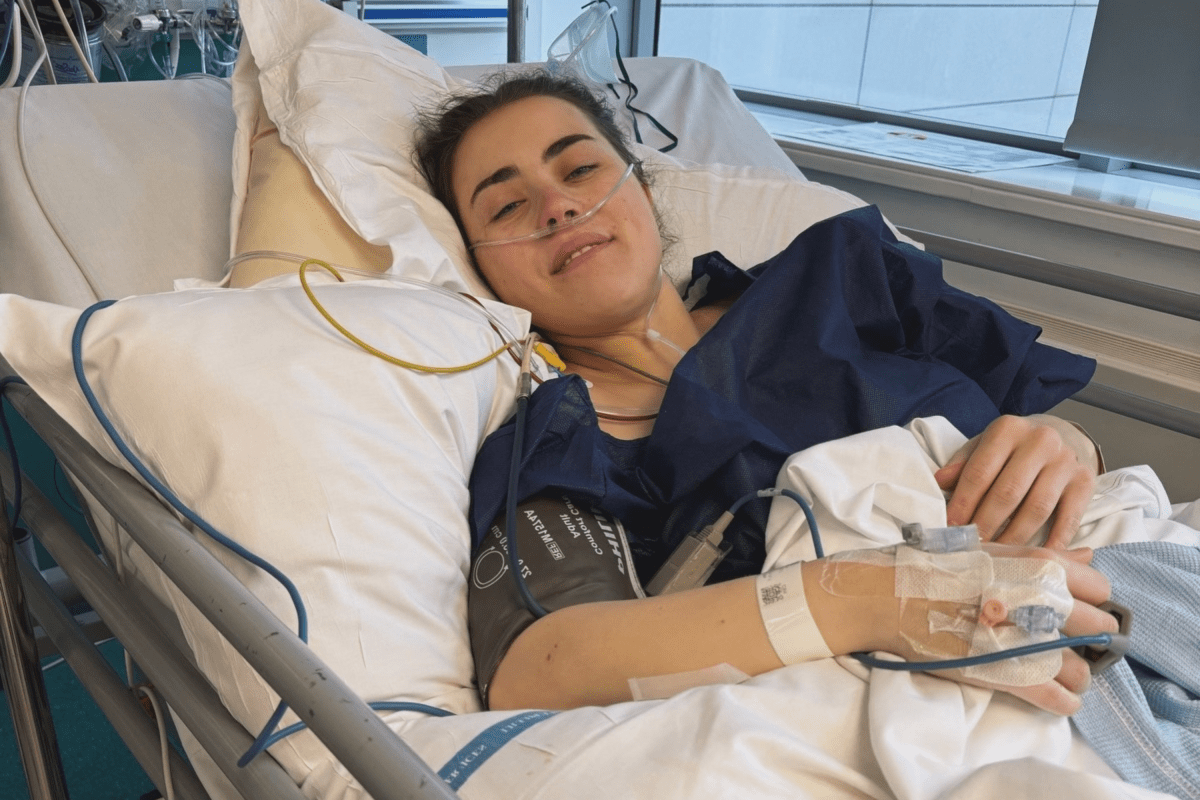
A woman from Northern Ireland went to hospital for a numbing sensation in her leg after a soccer game.
She never could have imagined what came next.
Mia Constantinou, 28, had just finished playing for her local team, the Ballymoney Ladies, when she felt what she described as a “lightning strike” level of pain down the back of her left leg.
“It felt numb and weaker than usual,” Mia told Newsweek. “I also had severe back pain that quite literally took my breath away.”
Having lived with endometriosis and undergone multiple surgeries, she tended to avoid hospital visits unless they were absolutely necessary.
Her partner, Alexs, convinced her to go to the hospital where she had examinations for the sensations in her leg.
The doctor gave her suppository medication for pain relief, and she was sent home.
Afterward, Mia carried on playing soccer and working as a healthcare assistant, but over the following months, her pain got progressively worse.
She managed to get an appointment with a physiotherapist, but despite being in significant pain, the physiotherapist wasn’t convinced an MRI was necessary.
“I remember saying to him, it’s ruining my life, my football, my physical job. I pretty much begged for him to write a referral,” Mia said. “His exact words were, ‘I doubt anything will be on it, but OK.’ I felt like... I was completely overreacting and maybe there was genuinely just nothing wrong with me.”
Despite the initial dismissal, Mia was referred for a spine and lumbar MRI scan in November 2025.
She received her MRI images through a clinic app, and immediately began comparing them with scans she found on Google.
Although she had to wait a week for the official results, she spent that time repeatedly reviewing the images, convinced something looked different.
“I was an anxious mess,” Mia said. “I must have looked at my pictures hundreds of times in the space of that week, saying to myself, that doesn’t look right or that doesn’t look like the normal scans on Google, but I talked myself out of anything being wrong."
Back in the physiotherapist’s chair, Mia assumed they hadn’t found anything of significance on the scan.
The MRI revealed several problems in her lower back, including small fractures in a vertebra, a slipped vertebra, a bulging disc, inflammation in the joints, narrowing around the nerves, and pressure on a nerve on the left side.
It also showed a benign growth within one vertebra and a fluid-filled cyst in the spinal canal.
In April 2026, Mia underwent an L5/S1 spinal fusion, a surgery that permanently joins two bones in the lower spine to improve stability and relieve pain caused by spinal damage.
Mia was scared of how she might feel afterward, but also hopeful that she could return to normal life within a few weeks.
“I extremely underestimated the surgery,” she said. “I remember waking up in the worst pain I’ve ever felt, like a hot pole was stuck to my spine. Every movement felt worse. I remember trying to stay as still as I could just to avoid the pain.”
The next day, hospital physiotherapists encouraged her to walk. Mia’s feet and legs felt foreign to her.
“I just couldn't believe this was happening,” she said. “How, eight or nine months prior, was I so active, fit and healthy? Now I was holding on to people trying to learn how to walk again.”
Mia was discharged from hospital a week later, but at home, everything around her had changed.
Her bed was downstairs, she relied on a recliner chair to help her stand and she used a commode instead of a bathroom.
“My back felt so stiff,” Mia said. “I felt so undignified needing help to go to the toilet, needing help to get dressed. But I was trying to just focus on recovering.”
The next few weeks posed more challenges.
Mia’s pain returned to her leg, and she developed a new pain in her back.
Her neurosurgeon informed her that one of the vertebrae above her spinal fusion had slipped backwards, causing a condition known as retrolisthesis. Retrolisthesis can sometimes occur after spine surgery because procedures that remove or weaken stabilizing structures can create instability that allows the vertebra to slip backward, a 2026 study published in Orthop Surg found.
Mia was booked in for more surgery in July, but her walking had already deteriorated significantly.
“I was in a wheelchair everywhere I went,” Mia said. “I couldn’t walk; my legs didn’t work. I was in constant pain with my back. I felt like I was living in a nightmare.”
She underwent a second operation just weeks after her first, but struggled to walk afterwards and continued to experience severe nerve pain.
Further scans and treatments failed to improve her condition, leading doctors to recommend another major spinal fusion.
“I feel like my story is constant repetition,” Mia said. “I felt like I’d gone through this twice already.”
The next morning after surgery, Mia walked the furthest she had in months with the help of physiotherapists.
“I went up and down the corridor with no neuropathic pain,” she said. “I was so excited that this is maybe how it was meant to feel all along, and I got discharged a week later.”
Currently eight weeks post-operation, Mia still lives in agonizing pain on a daily basis.
She takes morphine medication to manage the pain of her degenerative disc disease, and also works with a community physiotherapist to help improve her walking and regain some independence.
“I feel heartbroken and I grieve the life I once had,” Mia said. “I never thought this would have happened to me, but if there is any advice I can give anyone of any age, please listen to your body. Please don’t take no for an answer when it comes to your health.”