
Will Yemen Become Saudi Arabia’s Vietnam? - Newsweek
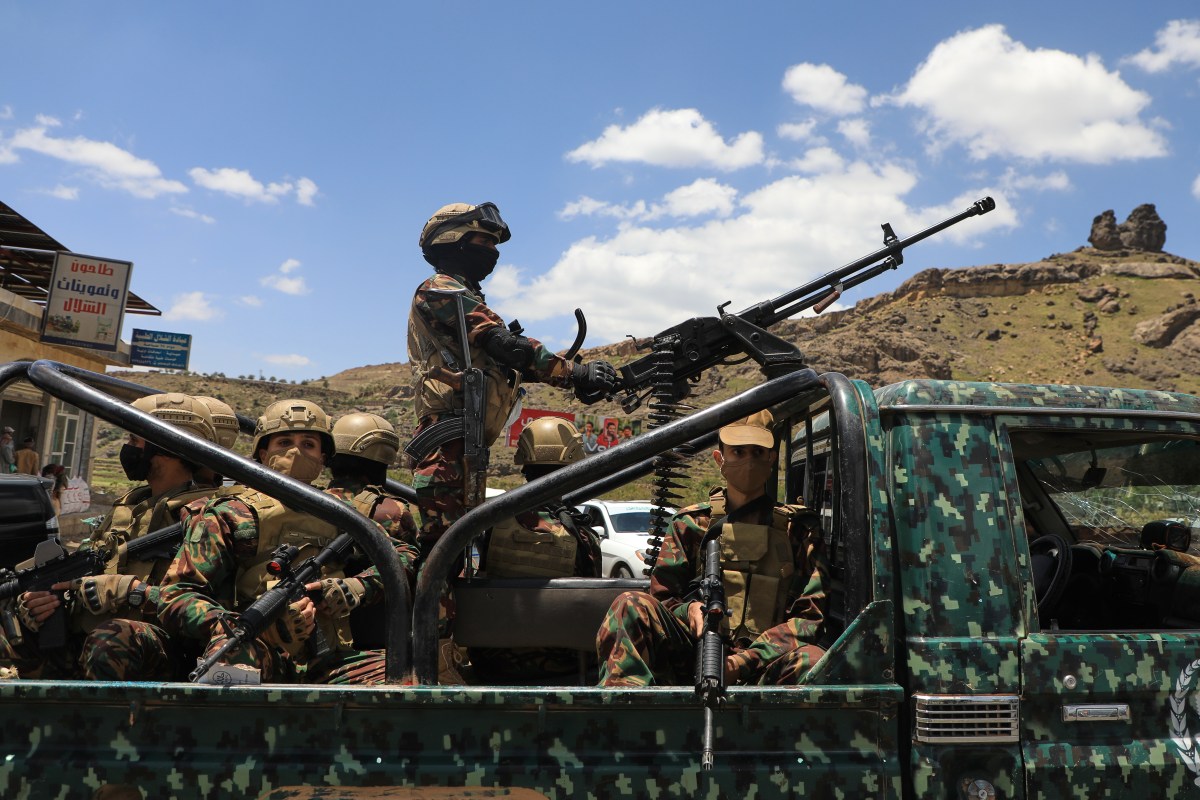
Iran's Yemeni ally Ansar Allah—widely known as the Houthis—has once again stunned the world with its intensified strikes on Saudi Arabia and lightning offensives against rival forces on the ground, putting the Axis of Resistance in control of yet another global energy trade chokepoint.
Ansar Allah, having already demonstrated the capability to disrupt international shipping through past attacks on vessels in the Red Sea and nearby waters, now presides over the Bab el-Mandeb, a vital corridor to the Suez Canal whose strategic importance is magnified by dueling Iranian and U.S. blockades of the Strait of Hormuz.
That's already bad news for both Saudi Arabia, now dealing with a suspected strike from another Iran-aligned faction in Iraq that damaged its East-West pipeline, and U.S. consumers, who are set to feel a new hit in the form of surging fuel costs as the U.S.-Israeli war against Iran continues to sow chaos in the oil and gas market.
But there's an even more dire scenario that limits the options of Washington and Riyadh, particularly the prospect of a full-scale invasion or intervention to rescue Yemen's internationally recognized yet increasingly embattled government.
"Neither country is eager to send their forces to die en masse and instead prefer to rely on superior air power, which has proven repeatedly inadequate as a means of holding territory in Yemen and elsewhere," Annelle Sheline, a former U.S. State Department official serving as research fellow at the Quincy Institute for Responsible Statecraft's Middle East program, told Newsweek.
"In the event that Saudi Arabia convinced the U.S. to lead a multinational coalition to conduct a ground offensive in Yemen, it would quickly face similar dynamics as Iraq and especially Afghanistan, where the terrain allows for insurgency to operate, while the foreign occupier will eventually give up and leave," Sheline said.
It certainly would not be the first time that a foreign power failed to achieve its goals in Yemen.
Saudi Arabia led a coalition to intervene in the country in March 2015 following Ansar Allah's takeover of Sanaa, allowing government forces to regroup in the south but failing to displace the insurgent group from presiding over around a third of the country and 80 percent of its population.
A U.N.-mediated ceasefire in April 2022 largely froze the civil war's frontlines until the latest conflagration, sparked by a Saudi airstrike against Sanaa's airport in July, followed by retaliatory strikes by Ansar Allah and the group's rapid advance against Yemeni government forces along the west coast.
Decades earlier, Egypt, then led by Arab nationalist President Gamal Abdel Nasser, also sought to influence events in Yemen when he sent troops to aid a revolutionary uprising against a Saudi-backed kingdom during a 1960s civil war in what is now the country's north. The campaign proved disastrous, with the stalemated Cairo-backed forces undergoing a coup that eventually resulted in Riyadh recognizing a more moderate republican government.
More than 10,000 Egyptian soldiers were killed in North Yemen between 1962 and 1967, and the strain of the conflict has been attributed as a factor in Egypt's lack of preparedness in the 1967 Arab-Israeli War.
Nasser himself in 1967 would refer to the experience in Yemen as his "Vietnam," where U.S. troops were then attempting to take on communist forces in what became one of the deadliest confrontations of the Cold War. The U.S. withdrew in 1973 after suffering more than 58,000 dead over the course of eight years, leaving North Vietnam and its Viet Cong guerrilla allies to dominate and unite the divided Southeast Asian nation by 1975.
Sheline pointed out that, "certainly the Saudi-backed Yemeni government has parallels to the U.S.-backed government of South Vietnam." And she highlighted an even more recent analogy of the limits of superpower might against a deeply entrenched foe, that of "the collapse of the U.S.-backed government in Afghanistan in the face of the Taliban's advance following the U.S. withdrawal" in August 2021.
The exit put an end to a 20-year intervention—the longest war in U.S. history—that resulted in the deaths of nearly 2,500 U.S. personnel.
"In many ways, I see the Taliban as similar to the Houthis, in their repression of women and minorities, but also that they have tapped into the population's sense of nationalism as the defenders of Yemen's sovereignty in the face of foreign military intervention and occupation," Sheline said.
While war would prove costly, the price of inaction is also high.
Thus far, Saudi Arabia has limited its role to airstrikes against Ansar Allah targets, though no coordinated efforts have emerged toward achieving the Yemeni government's goal of retaking Sanaa.
Meanwhile, over the past week since the new clashes in Yemen began, multiple outlets have cited sources saying that President Donald Trump denied a request for air support from Crown Prince Mohammed bin Salman.
Trump confirmed having spoken with the Saudi leader last week, telling reporters that Saudi officials were "on the balls of their feet" after the East-West pipeline attack. He also alleged that his administration was in direct contact with Ansar Allah.
"The Houthis called us and they don't wanna fight with us. They let us know they don't want to fight with us. They don't want me to go after—they don't want us to go after them," Trump said. "But they've called and they've talked to us and they don't want us to—they would much prefer not having us involved. And they're letting most ships go through."
"There's just one country that they're not too happy with and we'll get that straightened out," the president added. "But I have to say, we've done a great job. We control—as you know, we really very powerfully control the Hormuz Strait, and nobody saw that happening."
Tanker traffic in the Strait of Hormuz remains far below pre-war levels, however, as threats of Iranian attacks persist. Should Ansar Allah opt to blockade the Bab el-Mandeb, the impact on global trade would be amplified dramatically, as would the consequences for the Saudi economy as Crown Prince Mohammed's Vision 2030 development initiative hangs in the balance.
That's why Saudi geopolitical analyst Salman Al-Ansari argues that "the Yemeni government, with Saudi support, may have no option but to launch an all-out war against the Houthis on multiple fronts."
"The Bab al-Mandeb Strait and, more importantly, the people of Yemen cannot be held hostage by this malign, radical, Iranian-backed Houthi militia," Al-Ansari told Newsweek.
"There was indeed a Yemeni military setback in Al Mokha and along the Red Sea coast," Al-Ansari said. "However, this should serve as a lesson learned. The Yemeni government needs a more rigorous vetting process for its military commanders, greater unity within its ranks, and no tolerance for divided loyalties."
As tensions brew, he stated, "I believe the next three months could be among the most consequential in Yemen’s modern history."
And he saw a role for foreign powers to step up as well.
"Riyadh will put the international community face-to-face with its responsibilities," Al-Ansari said. "The question will no longer be what Saudi Arabia and Yemen are prepared to do, but what the international community is prepared to do. Riyadh may well lead from the front to safeguard Yemen and protect the security of international maritime routes."
But Ansar Allah also views itself as preparing for a major confrontation. A source within the group told Newsweek that the Yemeni faction's capabilities go "beyond the comparison" of the Vietnam War.
"We are not only prepared to thwart any escalation or invasion, but, by the grace of God and with reliance upon Him, we are ready and prepared to achieve progress and decisive victory on any front that contemplates action against us," the Ansar Allah source said.
The situation sets a dangerous conundrum before Crown Prince Mohammed, who oversaw the initial intervention in Yemen while serving as minister of defense from the beginning of the campaign in 2015 until months after the ceasefire in 2022.
"Currently, Saudi Arabia faces a dilemma: it seeks to avoid an all-out war with the Houthis—especially given that it now stands alone, unlike in 2015—yet it cannot simply ignore Houthi attacks and their territorial expansion within Yemen," Yemeni writer Abdulnaser Almuwadea told Newsweek.
But he felt it unlikely that Riyadh would commit its own ground forces to the battle. Rather, he envisioned several other scenarios for a Saudi response, including "intensifying support for allied Yemeni forces, particularly in the Marib region," where a major Ansar Allah offensive is predicted to soon manifest.
And while Almuwadea also saw little desire from the White House to deploy troops, he said U.S. air support, intelligence-sharing and special forces capabilities could prove decisive in aiding Saudi-backed forces stage a counteroffensive on the Bab al-Mandeb-Mokha port axis, which holds strategic significance and lacks the kind of mountainous terrain that would provide the group cover from enemy air power.
The U.S. has a history of airstrikes and special forces operations in Yemen, though its record in taking on Ansar Allah is mixed. Trump accelerated U.S. operations targeting Ansar Allah in mid-March 2025 but paused less than two months later in early May citing a peace agreement with the group that would protect U.S. flagged and military vessels.
Saudi Arabia is now set to receive another type of air support from the U.S. in the form of an F-35 fighter jet sale announced Thursday by the State Department. Trump is also expected to soon meet with Crown Prince Mohammed and other Gulf Cooperation Council leaders at the sidelines of the U.N. General Assembly.
Beyond military measures, Almuwadea viewed the potential for Saudi Arabia to escalate the very blockade of Ansar Allah-controlled territory that the group is aiming to break, though he noted that the maneuver would carry risks of Riyadh's foe answering in kind.
"While this measure would be significant and effective, it carries risks," Almuwadea said. "The Houthis might retaliate by expanding their attacks or imposing a blockade on ports held by their adversaries in Aden, Mukalla, and elsewhere."
The Kingdom could also go the diplomatic route, granting Ansar Allah a degree of the legitimacy it desires as the self-proclaimed true government of Yemen, cutting off aid to the internationally recognized government and providing financial incentives to halt the attacks.
But Almuwadea predicted that Riyadh was not yet prepared to grant such sweeping concessions while other options remained on the table.
"At present, however, such a deal appears highly unlikely for the Saudis," he said, "particularly given that they have not yet exhausted all their strategic options against the Houthis."
Sheline, for her part, argued that offering these terms nonetheless would prove "a much quicker way to resolve the conflict" than the pursuit of new military escalations. And she saw potential signs that Trump might be more amenable to talks at a time when he has signaled a desire to extract the U.S. from the ongoing conflict with Iran sooner than later.
"I hope that by the Trump administration refusing to intervene militarily at MBS' request, he will choose to negotiate with the Houthis rather than return to war, which was ineffective against the Houthis for seven years and merely devastated Yemen," Sheline said.
"The quickest way to get Saudi oil through the Bab el-Mandeb would be for the Saudis to lift the blockade on the Houthis' territory," she added, "and Trump seems, for the moment, to understand that."

