
Will new anti-pollution rules make any difference to Delhi's toxic air?
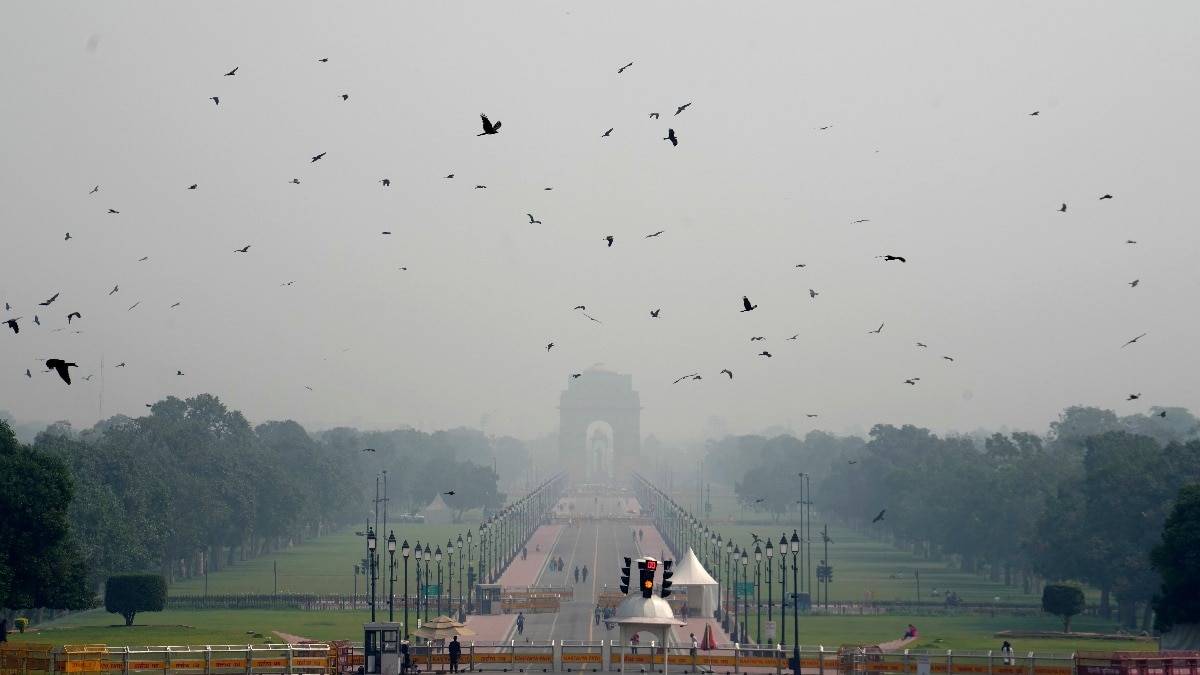
Delhi walked into October with a change in the air that the capital and surrounding regions have grown accustomed to, a change that foreshadows what's ahead.
After monsoon ended, the city is slowly growing toxic as pollutants flood the air, feeding the pollution. For Delhi-NCR, it's an annual episode, almost like another season. What's different this time is a new set of measures that offer hope of clean air. People wear masks while walking amidst smog in New Delhi. (Photo: Getty)
Instead of waiting for the air to turn hazardous, and then imposing restrictions, authorities have announced several measures in advance with the aim of cutting emissions before the weather traps the pollution and shrouds the city in a haze.A GROWING POLLUTION PROBLEM
The new rules follow years of pollution rising to worrying extremes and impacting millions.
Last winter, Delhi went from Moderate on October 13 to a total of 26 "Poor" air quality days, 66 "Very Poor" and 10 "Severe days," with AQI reaching 461 by December 14. A cityscape view of Delhi showing the city under a layer of smog. (Photo: Getty)
This year, the city has recorded an AQI of 166 on October 1, its highest reading for that date since 2022, when it was 186. On October 2 it rose to 174, and on October 3 it hovered at 171, with weak winds keeping pollutants in place.
However, it hasn't been a bad year across the board.
Delhi's September average AQI was 102, its lowest September average in five years. From January to September, the city had 194 days with a daily average AQI below 200, against 187 in 2025 and 188 in 2024.
Average PM2.5 through September 28 matched 2025 and was lower than in 2023 and 2024, per Central Pollution Control Board (CPCB) data.
But those figures stop in September, before the season when Delhi's pollution usually climbs, so they don't prove the coming winter will be cleaner. People walk along a street amid extremely polluted air in New Delhi. (Photo: Getty)
Whether the new system works will depend on what happens between those announcements and the air people breathe in November, December and January.DELHI GOES FROM REACTIVE TO PROACTIVE
Anju Goel, Associate Director of the Air Quality Research Division at TERI, called it a shift from "a reactive emergency model" to "a proactive, pre-announced permanent framework with fixed dates."
To Goel, the new approach makes a lot of sense.
"AQI is primarily a lagging indicator," she said. "By the time AQI reaches a severe category, pollutants have already accumulated in the atmosphere and the population has already been exposed to harmful concentrations." An anti-smog gun is being used to curb air pollution in New Delhi. (Photo: PTI)
Phase 1 of Delhi's winter pollution curb rules took effect on October 1, 2026, enforcing a strict "No PUCC, No Fuel" policy where petrol pumps deny fuel to vehicles lacking a valid Pollution Under Control Certificate (PUCC), tracked via automated cameras.
Phase 2 restrictions will come into play on November 1, 2026, introducing severe entry bans on non-BS-VI out-of-state vehicles, a 50% work-from-home mandate for offices, and doubled parking fees.
Dust-generating demolition and outdoor construction will be restricted from November 1 to January 31, and a complete ban on construction and demolition will follow from December 10 to January 20.
The entire winter action plan will gradually ease by February 28, 2027, depending on air quality levels. An under-construction building is seen with a smog-covered New Delhi in the background. (Photo: Getty)
The plan adds stronger action against open waste burning and pollution hotspots, more monitoring stations, an AI-enabled Command and Control Centre and 334 enforcement teams.
The measures were finalised at a September 28 meeting chaired by Bhupender Yadav, Union Minister of Environment, Forest and Climate Change, and attended by Delhi government and pollution-control officials.
It's a solid plan on paper, and it gives residents some hope that 2026 could be the year Delhi escapes its life-threatening winter haze. But this isn't the first time the city has tried to get ahead of pollution. The India Gate is seen on a smog-covered morning in New Delhi. (Photo: Getty)
For years, Delhi-NCR has relied on the Graded Response Action Plan (GRAP), which brings in tougher restrictions as pollution worsens.
These have included construction curbs, mechanised road sweeping and water sprinkling, limits on certain vehicles and industries and, at higher stages, changes to school and office operations.
Its framework lets authorities act early when forecasts show AQI thresholds are likely to be reached and to stay there.
The Commission for Air Quality Management in National Capital Region and Adjoining Areas (CAQM) has used forecasts, along with current AQI and weather conditions, to decide when to invoke or lift GRAP stages. Commuters stand amidst water being sprayed to curb air pollution, in New Delhi. (Photo: PTI)
So acting early is not new in itself. What's new is the heavier use of fixed, advanced measures alongside the forecast-based GRAP system.
More importantly, the two will work together.WILL EARLY ACTION MAKE A DIFFERENCE?
Dr Palak Balyan, Research Lead at Climate Trends, backs the idea of acting before pollution peaks, but with a condition.
"Pre-emption should be based on robust forecasts and source-specific evidence, not simply on imposing restrictions earlier," she said.
That's hard, because Delhi's winter smog has no single culprit. A dust and smoke collector device installed in Delhi is seen at work. (Photo: Getty)
A CAQM assessment found multiple contributors to the winter PM2.5 levels; 27% secondary particulates, 23% transport, 20% biomass burning, 15% dust and 9% industry, including thermal power.
Construction controls can cut dust and some related emissions. Vehicle restrictions can cut transport emissions. Action against open burning tackles another slice. But none of them covers the whole picture on its own.
"Construction bans or traffic restrictions can reduce some emissions," Balyan said, "but their impact depends on how large those sources are during a particular episode." Vehicles move on a road in New Delhi on a smoggy morning. (Photo: Getty) CAN DELHI CLEAN ITS AIR ALONE?
"Air pollution does not respect administrative boundaries," Goel said.
The reason is that pollution drifts across the NCR from industrial areas, transport corridors, construction, power generation, open burning and other sources.
Weather then decides how long it hangs around.
Keeping that in mind, CAQM is also expanding continuous air-quality monitoring across Delhi, Haryana, Rajasthan and Uttar Pradesh, with 46 additional stations planned across the region.
The same regional thinking runs through World Bank-backed clean-air programmes in Haryana and Uttar Pradesh. An anti-smog gun sprays water droplets to curb air pollution, in New Delhi. (Photo: PTI) LAST WINTER SHOWS HOW FAST THINGS TURN
Last winter, Delhi went from Moderate on October 13 to 26 Poor, 66 Very Poor and 10 Severe days, with AQI reaching 461 on December 14.
A CREA analysis looked at winter 2025-26 and found that October 13, 2025 was the last Moderate day before Delhi slid into a long stretch of bad air, lasting 26 Poor days, 66 Very Poor days and 10 Severe days.
The worst reading was 461 on December 14.
If anything, that analysis showed why enforcing a policy can matter as much as the policy itself.
"The biggest gap [in previous measures] has been enforcement and implementation at the ground level," Balyan said. Announcing a restriction and making it work on the ground are two different jobs. A Delhi Metro train runs amid low visibility due to a layer of smog, in New Delhi. (Photo: PTI) HOW WILL DELHI MEASURE SUCCESS?
For starters, the experts suggested, the pollution should be judged after accounting for the weather.
Goel said Delhi should assess winter pollution using weather-adjusted PM2.5, while source-level monitoring can track changes in traffic, construction and industrial emissions.
Balyan suggested four indicators: ambient PM2.5 and PM10, sector-wise emissions, weather conditions, and policy implementation and compliance. Vehicles move on a road amid smog, in New Delhi. (Photo: PTI)
By February, success will come down to a few questions. Did population exposure fall? Did severe episodes get shorter or less frequent? Did emissions drop? Was the progress seen across Delhi-NCR, and not just at a few monitoring stations?
While that remains to be seen, for now, Delhi has decided to make the first move.
The next few months will show whether this early start cleans up the city's poisonous air, or only changes when, and how many, restrictions get announced.- Ends
Aryan Rai is a sub-editor at IndiaToday.in, working to process and proofread the daily coverage of national and international news. Aryan joined India Today in 2024. He began his career in journalism in 2021 while doing his postgraduate degree in journalism in Boston, US.
Before joining the India Today Group, Aryan worked as a reporter in the US, covering climate change, local and state politics, immigration and food insecurity.
Aryan studied engineering as an undergraduate student but pivoted to journalism because of his love for writing and staying informed on issues. He is particularly interested in political and environmental journalism and is fluent in English and Hindi.
In his free time, he prefers to cook, binge-watch TV shows, read and write fiction, and annoy his dog.


