Will a louder African voice at the UN translate into real power? - IOL
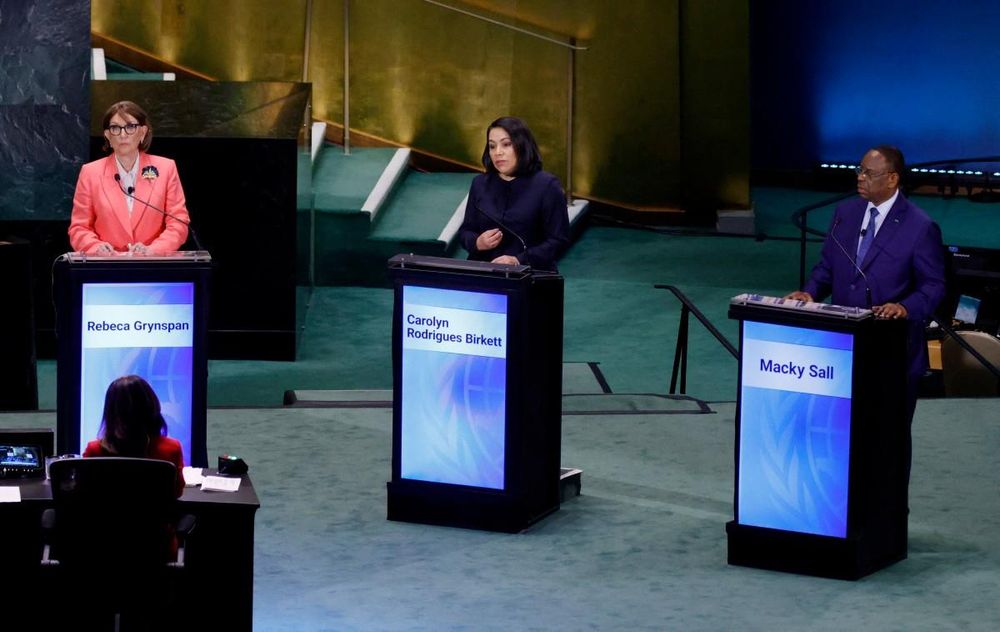
Candidates for United Nations Secretary-General position (from left) Costa Rican economist and Secretary-General of UNCTAD Rebeca Grynspan, Guyana’s former foreign minister Carolyn Rodrigues Birkett and Senegal’s former president Macky Sall participate in a debate at the UN General Assembly Hall in New York, on July 23, 2026. Africa has fared poorly in the race for the next Secretary-General with the African Union failing to endorse a single candidate, says the writer.
The United Nations was never conceived as a chamber of equals.
Founded in 1945 by the victors of the Second World War, its architecture reflected the distribution of political power and leverage at the end of an imperial epoch.
Eight decades later, the same architecture still stands. Five countries — China, France, Russia, the United Kingdom and the United States — hold a veto. That veto allows a single permanent member to block a Security Council resolution, even when the majority supports it.
No African government holds a permanent seat. The continent has three elected members, who serve two-year terms. They can vote, withhold support and bargain. They cannot veto. They cannot block a decision of the five permanent members.
Africa's structural exclusion from the Council's inner chamber, where it makes binding decisions on peace and security, remains untenable. Ahunna Eziakonwa, the UN Under-Secretary-General and Special Adviser on Africa, has argued that the continent must be an engaged co-author of the UN agenda, not a passive recipient.
On 22 September, heads of state and government gather in New York for the general debate of the 81st session of the General Assembly, under the theme "Restoring trust, managing transformation: a United Nations that delivers for all." Security Council reform will again be on the table.
The Council's skewed power structure undercuts Africa's standing. It allows the UN to shape the continent in war and in peace, by declaration or by sanction. It is indefensible that African wars and settlements are decided in a room where not a single African government holds a veto.
Africa has spoken with one voice on what reform must look like. The 2005 Ezulwini Consensus inspired the 2026 African Model on Security Council reform. Earlier this year, the African Union endorsed the Model: at least two permanent African seats, with the veto for as long as the veto exists, and five non-permanent seats.
What is key about this posture is that it seeks structural correction and addresses the unfinished business of historical injustice and an untransformed Council.
A unified, loud and resolute African voice in New York may still not translate into a veto. Charter amendment requires a two-thirds vote in the General Assembly and ratification by all five permanent members.
That consent is not guaranteed, least of all in Washington, which on 4 September cast the only vote against a General Assembly resolution urging maps that show Africa at its true size rather than the shrunken continent of the old Mercator projection.
The continent has fared poorly in the race for the next Secretary-General.
António Guterres's second term ends on 31 December 2026. Africa did not settle on a single name. In March 2026, Burundi, then chair of the African Union, nominated former Senegalese president Macky Sall. In July 2026, Uganda nominated Olara Otunnu, a former UN under-secretary-general. The African Union did not endorse a single candidate. Informal geographic rotation now points toward a Latin American or Caribbean successor, and toward the first woman in the post.
Africa is not a homogeneous mass. However, unity on the positions and postures that matter is how a continent of 55 states powers up and becomes a diplomatic bloc. Two national campaigns, without a common mandate, are a weaker hand than one.
African leaders will walk into that Assembly as their economies labour under debt, extractive value chains and limited access to development finance. The same argument that applies to the Security Council applies to global economic issues.
Africa's weak voice in the institutions that set the terms of trade and development finance is part of the same architecture. A stronger seat at those tables is required if the continent is to break a cycle of neo-colonial dependency.
On peace and security, Sudan's war will not pause for speeches in New York. Neither will the Sahel, the Horn of Africa or the Great Lakes. Sudan remains the world's largest displacement and hunger crisis. It will compete poorly with camera flashes and media briefings.
The food emergency facing Sudanese families will find no resonance at gala dinners. There will be little hard talk of a roadmap for eastern Democratic Republic of the Congo, or of how often Africa's peace processes are still brokered and owned elsewhere.
Growing rivalry among world powers, the Russian-Ukrainian conflict, the war in the Middle East, economic competition between the United States and China, and a heightening scramble for minerals, energy, technology, and consumer markets are increasingly shaping shifting global power dynamics.
Africa cannot afford to be caught in the crossfire. The answer will not be found in loud-hailing at the General Assembly. Shouting is not a strategy. Raising the game is. Africa needs to lift its negotiating power, expand its industrial and infrastructural capacity, and achieve greater diplomatic and institutional influence.
The African Model on Security Council reform illustrates what is possible when the continent speaks as one. A louder African voice, without unity and purpose, is little more than noise. A louder African voice is not power. Power is the ability to change who makes key decisions inside the United Nations — a house in which the continent is still treated as a poor relation.
If that house refuses to transform and become more representative, Africa and the wider Global South will need to ask whether there is a better home in the United Nations of BRICS. Africa cannot forever be sidelined in the global power matrix.
* Kim Heller is a political analyst and author of No White Lies: Black Politics and White Power in South Africa.
** The views expressed do not necessarily reflect the views of the National Media Group.