Why this indie rock star says turning off your phone is a political act
Turning off your phone before the music begins at a symphony orchestra concert may be more than good etiquette – for musician and composer Bryce Dessner, it’s a political act.
Best known as guitarist and songwriter with US indie band The National, Dessner is also a composer of classical music whose output includes works for orchestra, string quartet and solo instruments.
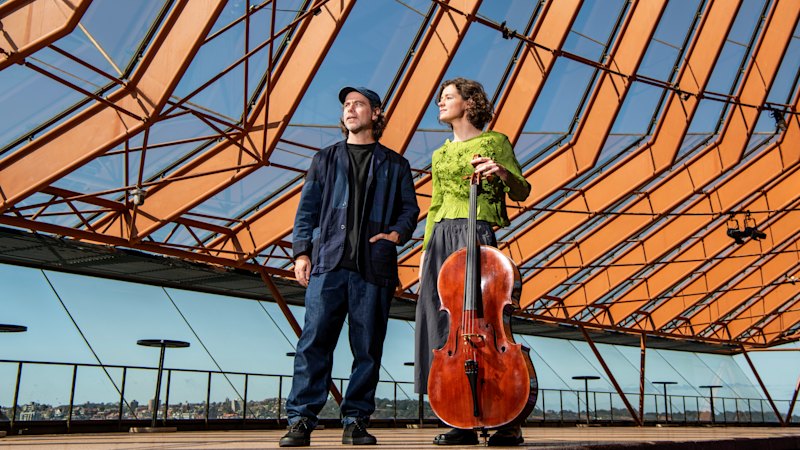
Bryce Dessner and Anastasia Kobekina ahead of the first Australian performances of Trembling Earth.Steven Siewert“I’m not someone who stays out of politics – I get involved in a lot of causes and things – but I think the music often is doing other things, it speaks for itself,” he says.
“The experience of coming into the concert hall – to get off your phone, and just be in the room with music, and to feel those things – in a way is a kind of activism.”
At a rehearsal with the Sydney Symphony Orchestra this week, Dessner – dressed in triple-denim with jacket, jeans and cap – paces the front of the Opera House stage. In his hands is the oversized orchestral score for his new cello concerto, Trembling Earth.
The cello soloist, Anastasia Kobekina, is a picture of poise, her bare feet rooted to the floor, even as her bow threatens to throw off sparks in a tightly wound rhythmic passage.
Co-commissioned by the Sydney Symphony Orchestra, and having its first Australian performances on Saturday and Sunday, Trembling Earth was written especially for Kobekina and already has been heard in Dublin, Berlin and Prague.
Members of The National (from back left): Matt Berninger, Aaron Dessner, Bryce Dessner, Bryan Devendorf and Scott Devendorf. The Washington Post via Getty ImagesThe title takes its name from a painting of an oak forest by Norwegian expressionist Edvard Munch that Dessner recalls seeing in Oslo. He says his musical composition, by turns lyrical and rhythmically intense, is intended to convey the natural world and be a reflection on human folly and destruction.
“It’s not a political piece but it’s an awareness of the tremendous instability and conflict in the world – that nature bears witness to human calamity and catastrophe and mismanagement and bad politics,” he says. “What is the experience of the earth through all of this?”
While his band The National is active in US politics – they backed the presidential campaigns of Democratic candidates Barack Obama and Hillary Clinton – Dessner says he is less overtly partisan in his classical music. An exception was his piece Skrik Trio, which he describes as a scream at Donald Trump’s 2016 election win.
While Kobekina is making her first visit to Australia, Dessner is no stranger to these shores, having previously toured with The National, and partnered on earlier projects with Sydney Dance Company, the Australian String Quartet and the Australian Chamber Orchestra.
He will appear in two separate programs with the Sydney Symphony Orchestra. The first, with full orchestra conducted by Umberto Clerici, will see the local premiere of Trembling Earth and Dessner’s earlier work, St Carolyn by the Sea – a double concerto for electric guitars featuring Dessner and Australian guitarist Zane Banks.
The second program, at Sydney’s City Recital Hall and repeated at Melbourne Recital Centre, includes excerpts from his film score for Train Dreams, and instrumental works Aheym, Impermanence and Garcia Counterpoint, Dessner’s solo guitar tribute to the Grateful Dead’s Jerry Garcia.
Kobekina, who was born in Russia and lives in Germany, has earned accolades for her performances of concertos by Dvorak and Elgar, and last year released a recording of Bach’s monumental cello suites.
The piece was written specifically for Kobekina.Steven SiewertShe says Dessner’s new concerto, written for her, expresses the lyrical side of the instrument, which is like the human voice, but also “this earthy, primal energy”.
“I love both sides, because we all have this in us,” she says. “I like how in this concerto you can experience constantly these contrasts – hot and cold, rhythmic and lyrical … I really feel that this world of sound that Bryce created will embrace everyone in the room.”
Trembling Earth, she adds, will continue to be performed into the future.
“I do believe that this piece will be played in 30 years – it’s just so well written for the instrument, and just expands the repertoire that already exists for cello,” she says.
“It’s not a usual thing that happens to every contemporary piece. I have so many times been asked by my colleagues, ‘Can I have the score, it’s so exciting’.”
Dessner says that while Trembling Earth does not wear its politics on its sleeve, he wants Kobekina’s performance to speak to the audience.
“The experience of coming to the concert hall to hear live music, to hear musicians like Anastasia – who has spent her life perfecting what she does, and to hear the Sydney Symphony Orchestra – it’s a very human form,” he says.
“I don’t think we are going to see robots playing Beethoven any time soon.”
Trembling Earth, Sydney Opera House, September 19 and 20; Bryce Dessner and the Sydney Symphony, City Recital Hall, September 24; Melbourne Recital Centre, September 25.
You have reached your maximum number of saved items.
Remove items from your saved list to add more.