Why the 2026 Midterms Could Hurt JD Vance and Help Marco Rubio in 2028 - Newsweek

Vice President JD Vance and Secretary of State Marco Rubio woke up Wednesday to a political map far less friendly to their 2028 ambitions.
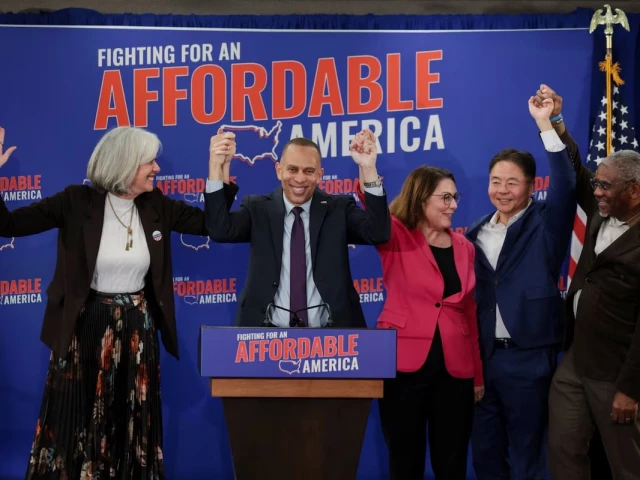
Democrats won control of the House and Senate in Tuesday's midterm elections, flipping Senate seats in Texas, North Carolina, South Carolina, Ohio, Kansas and Iowa. In Texas, Democrat James Talarico defeated Republican Ken Paxton, giving Democrats their first statewide win there since 1994. In Ohio, Vance's home state, Democrat Amy Acton beat Republican Vivek Ramaswamy in the governor's race, while Democrat Sherrod Brown defeated Republican incumbent Jon Husted in the Senate race.
While many expected a strong night for Democrats, few expected such a crushing defeat for Republicans. The results left the party searching for answers. The question now is who will pick up the pieces. Vance and Rubio have emerged as the two leading contenders to take up the MAGA mantle, with President Donald Trump praising them on different occasions.
But Tuesday's results raise a big question about what comes next: Will voters stick with a candidate loyal to Trump and his movement, or will the GOP finally move away from Trumpism?
"Remember that are both young," Marc Hetherington, a professor of political science at the University of North Carolina at Chapel Hill, told Newsweek when asked what he would advise the two men.
Before Tuesday, Vance held the edge. A New York Times/Siena poll of Republican primary voters conducted October 12-19 found that 33 percent would most likely back Vance in a 2028 primary to 23 percent for Rubio, who has said he will defer to Vance. About 26 percent said they did not know.
Vance went all in for Ramaswamy in his home state, defending his gubernatorial run through its ugliest moments—particularly after Ramaswamy faced a wave of backlash over a campaign ad featuring Acton’s estranged mother disputing her daughter's account of her childhood—but still couldn't get him across the finish line.
Rubio, who largely stayed off the campaign trail and has mostly avoided blame for the Iran war, watched his closest rival stumble and blame the party's losses on the conflict.
"If you'd like to argue it was worth it, that losing the Senate for the next 6 years was worth it, then do so," Vance wrote in a social media post on Wednesday. He also pointed to polling of 2024 Trump voters who backed Democrats this year, saying they wanted the war ended, action on costs, an America First agenda and a change in the U.S. relationship with Israel.
Trump said he had spoken with Vance that morning and approved of the post: "I think it was fine. I thought it was good."
Regarding 2028, Trump said he did not know who would run, his vice president included: "Maybe he won't run."
Newsweek reached out to the offices of the vice president and the secretary of state for comment on Wednesday.
Rubio has kept a low profile since the results came in. Experts consulted by Newsweek expect him to keep it that way.
"He has no need to interpret the results to anyone, and as secretary of state, he has a meaningful job to do," Karen Beckwith, a professor of political science at Case Western Reserve University, told Newsweek. "He can draw that line between himself and Vance."
While most of the blame for the war has fallen on Defense Secretary Pete Hegseth and Vance, Rubio has stayed out of the conversation, focusing his foreign policy work toward the Western Hemisphere and Latin America, a region that has defined much of his political career.
"Rubio is as distant as is appropriate for a secretary of state and as useful to his aspirations as a future presidential nominee," Beckwith added.
Henry Brady, a professor of political science and public policy at the University of California, Berkeley, told Newsweek that Rubio has the upper hand because Vance must balance loyalty to Trump with avoiding the appearance of self-interest. Rubio, meanwhile, will likely keep a low profile and remain part of the administration without fully tying himself to it until the right moment to resign.
"Rubio, especially if he resigned, could try [to] emphasize his reputation as an intelligent, thoughtful and relatively principled [politician]," he said.
Douglas Kriner, a professor of American institutions at Cornell University, said that Tuesday was hardest on the vice president.
"If I was a Republican hopeful not currently in the administration, I'd be breathing a sigh of relief and saying I had a good night," Kriner told Newsweek.
Vance and Trump defended Ramaswamy's decision to air the controversial ad calling her a liar. Ohio Governor Mike DeWine, a Republican, called the ad "deeply troubling," and it came off the air days before the election.
"He got his act of contrition in first but no apology for his own conduct in Ohio," Brendan O'Leary, a professor of political science at the University of Pennsylvania, told Newsweek about Vance's post. "The decision to blame the war and Israel will be noted."
Trump gave his vice president some cover. Speaking to reporters at the White House on Wednesday afternoon, he said it was "largely true" that the war cost Republicans, though he put more of the blame on gas prices.
"If I had to do it again, I'd have to do it again," Trump said. "You can't let Iran have a nuclear weapon."
Florida Governor Ron DeSantis, another potential 2028 contender, made a similar case before polls opened. In an interview with commentator Stephen A. Smith that aired Monday on SiriusXM, he called the war a "big, big drag" on Republican candidates.
"If you can't admit that to voters, then you're gaslighting them, and they're not going to listen to you on other things," DeSantis said.
Hetherington sided with Vance on the cause.
"Vance is right," he said. "Republicans voted for the Democrats, and that hasn't happened since 2008 when we were in the middle of a financial crisis and fighting two unpopular wars."
He still called it "a terrible night for JD Vance," warning that "nominating him in 2028 runs the risk of a replay of 2026."
Jon Rogowski, a professor of political science at the University of Chicago, said Vance is "less of a known quantity despite serving as VP," and that drawing a sharper line with the administration "is an effort to define himself for the public and develop his populist credentials."
Beckwith said: "I suspect that Vance's political career is over. He no longer has a base of support in Ohio; and as vice president, he has no policy accomplishments on which he can campaign."
Kriner disagreed: "The vice president is far from finished. He still has a strong argument to make as the leader-in-waiting of the MAGA base, which is still a major force in Republican Party politics."
While Republicans suffered a major setback in Vance's home state, Rubio's home state offered one of the night's few bright spots.
In Florida, Republican Byron Donalds defeated Democrat David Jolly 50 percent to 49 percent in the governor's race, a margin of about 100,000 votes, according to the Associated Press. Senator Ashley Moody, a Republican, held her seat against Democrat Angie Nixon, 51 percent to 48 percent.
Democrats still made gains there, breaking the GOP supermajority in the Florida House. O'Leary said the state, once the party's "banker," "is now a battleground state." Beckwith saw it differently: "Florida is still a Republican-dominated state, and Rubio has a base there."
The Cuban American delegation in Rubio's political backyard of Miami-Dade County also survived, if barely, at a time when Hispanic voters moved sharply away from Republicans. Florida Representative Carlos Giménez beat Democrat Phil Ehr 52.9 percent to 45.6 percent, according to state results, after winning their 2024 rematch by nearly 30 points. Florida Representative María Elvira Salazar led Democrat Eliott Rodriguez 50.3 percent to 49.7 percent, two years after carrying the seat by 20 points. Florida Representative Mario Díaz-Balart led Democrat Nicole Locklin by about 1,800 votes, a result that the state Republican Party declared a win but that has yet to be certified.
Nationally, Latino voters backed Democratic House candidates 60 percent to 35 percent, according to NBC News exit polls. Trump won roughly 48 percent of Latino voters in 2024, according to Reuters/Ipsos data.
In that climate, Rubio's background could be an asset. The son of Cuban immigrants, he speaks fluent Spanish and has played a leading role in the Trump administration's policy toward Latin America, particularly Venezuela and Cuba. Arizona Senator Ruben Gallego, a Democrat, pointed to that potential advantage at a Latino Vote Summit in Washington in June, warning that "if Marco Rubio is the nominee for president, we are in trouble."
Rubio also enters the next stretch with better numbers than Vance. In May, CNN's Harry Enten called Rubio "the most popular Republican in the Trump administration besides the president himself," citing a net approval of -6, compared with -15 for Vance. A YouGov/Economist poll conducted October 23-26 found that 41 percent of registered voters viewed Vance favorably and 53 percent unfavorably.
His tenure at the State Department has won over Trump.
"Marco will go down...as the greatest secretary of state in the history of the United States," Trump said in October 2025, as the Gaza ceasefire deal came together.
Rogowski said Rubio has "benefited thus far from being perceived [fairly or not] as a normie Republican."
For Beckwith, the midterms "change little" for Rubio, "with the exception that the result has placed Vance in a poor position, damaging Rubio's closest competitor."
Her advice: "Congratulate the winners, especially in Florida; do your job as SoS; and position yourself as a mainstream conservative Republican [of whom there are few left]."
John Kane, a clinical associate professor at New York University's Center for Global Affairs, said that on foreign policy, Rubio "more resembles the Bush-era Republican Party than the MAGA, America-first version of the party." Kane expects him to play down the unpopularity of the administration's interventionist policies and focus instead on domestic issues and "failures in 'messaging.'"
But Rubio does not walk away clean. Asher Hildebrand, a professor at Duke University's Sanford School of Public Policy, said voters rejected the war "largely because of its impact on gas prices and their daily lives."
"And whatever his private reservations about the war, Vance and Rubio were complicit in the decision to go to war," Hildebrand told Newsweek.
O'Leary pointed to Rubio's hawkish positions on Iran and, potentially, Cuba.
"The first posture is a proven loser," he said. "The second must now be off the table unless he wants to risk another Bay of Pigs."
Hetherington said Rubio's wing of the party "should benefit, but Rubio is still a central figure in the Trump administration."
Kriner said Rubio's job gives him room to talk about the economy on his own terms. As secretary of state, he can offer his own plans for Americans' economic anxieties while "maintaining some plausible deniability that he is responsible for or intimately tied to the administration's unpopular economic policies," he said.
Whoever runs will face a tougher map in the future. After Tuesday's results, O'Leary said it is "extraordinarily unlikely that Texas will be back in the Republican fold within two years."
Rogowski said: "It is virtually impossible for a Republican to win the presidency without Texas."
Results there, as well as in South Carolina and Mississippi, "should serve as a warning shot to any Republican contender," he added.
Rogowski also pointed to 2006, when Democrats took Congress during George W. Bush's second term.
"No one from the George W. Bush administration sought the presidential nomination in 2008," he said.
Republicans turned instead to Arizona Senator John McCain, a "maverick" who could distance himself from Bush, Kane noted.
"It's not clear that Republicans will have such a candidate in 2028, especially one that can also energize and mobilize the MAGA base of the party," he said.
The primary electorate still leans toward Trump. The Times/Siena poll found that 63 percent of Republicans wanted a continuation of his policies, while more than 80 percent of independents wanted the party to move away from him.
"They have to worry about Republican support right now. They don't have the luxury to reach beyond them," Hetherington said.
Kriner said that winning the nomination "may require going pretty far right in ways that hamstring their abilities to then appeal to independents and any disaffected Democrats," adding that Tuesday "should have emboldened a number of challengers outside the Trump orb."
Brady pointed to governors: "It is Republican governors [those that remain] who might have the best road to the Republican presidential nomination."
Kane said that some independents, and to a lesser extent Democrats, may be willing to cross over "if they view either Rubio or Vance as relatively more moderate."
"If Trump continues to be very unpopular among Republicans in the next two years, wait until 2032 to run," he said.
Hildebrand also suggested looking further ahead: "2032 might be a good year to run for president?"
O'Leary had a more immediate recommendation: "Don't run in 2028. Write your memoirs. Repent at leisure."
Contact Newsweek editors on this story: Jason Lemon and Dave Siminoff.