Why is Ed Sheeran's tour in crisis? All about Macklemore's Palestine remark row
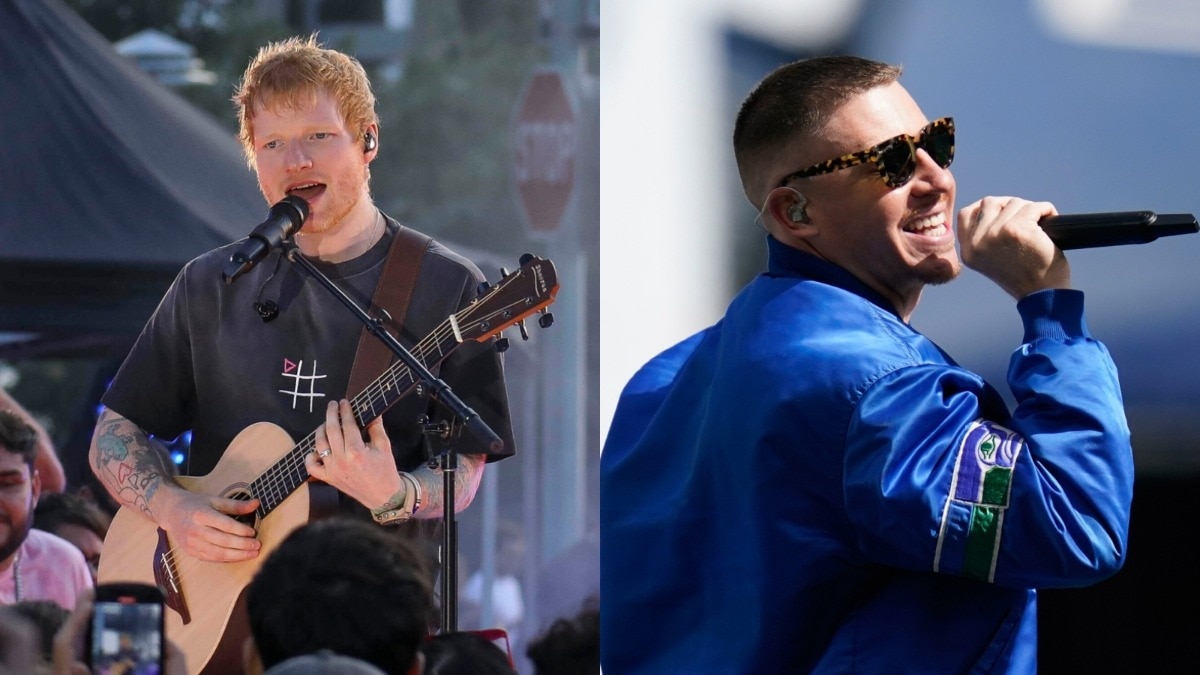
What began with a few minutes of remarks in support of Palestine by rapper Macklemore during an Ed Sheeran concert has now turned into a major crisis for the singer's Loop Tour. Macklemore was removed from the remaining US dates after making pro-Palestinian remarks on stage at New Jersey's MetLife Stadium. He later claimed that pressure from stadium owners, particularly New England Patriots owner Robert Kraft, led to his removal.
Sheeran, in a detailed six-slide statement, denied that the decision was his and said the promoter and venues were responsible. Hours after Sheeran's statement, four troupe members — Finneas, Lukas Graham, Aaron Rowe and Beoga — announced that they were withdrawing from the tour in solidarity with Macklemore.
Here's the full timeline of what happened, what Macklemore said, what Sheeran's response was and why the controversy has now engulfed the entire tour.Macklemore says 'Free Palestine' on stage
The controversy began at Sheeran's September 4 concert at MetLife Stadium in East Rutherford, New Jersey, where Macklemore was performing as an opening act. During his set, Macklemore spoke about the situation in Gaza and the occupied West Bank. He also said "Free Palestine" before performing his protest song, Hind's Hall.
He also directly addressed Jewish members of the audience, making a distinction between criticism of Israel and criticism of Jewish people. "To all of my Jewish brothers and sisters," he said, criticism of Israel, criticism of apartheid and being against genocide were, in his words, not criticism of them.Macklemore has just been kicked off Ed Sheeran's tour for saying these words:“Free Palestine. I want those words to be loud and clear so the people from Gaza all the way to the occupied West Bank know we have not forgotten them...To all of my Jewish brothers and sisters:— Double Down News (@DoubleDownNews) September 14, 2026Macklemore said his message was about peace, love and ensuring that all human beings were treated with dignity, respect and equality. The remarks triggered backlash from some Jewish and pro-Israel groups. An Israeli-American Council petition subsequently called for Macklemore to be removed from Sheeran's tour.Why Macklemore's remarks became a problem for the tour
Macklemore's comments were not new in terms of his position on Palestine. He has been publicly supporting Palestinians for several years and released Hind's Hall in 2024, a song connected to pro-Palestinian campus protests. But the MetLife performance gave those views a much larger platform.
Macklemore was performing in front of a stadium-sized audience as part of one of the biggest tours in the world. His remarks therefore became a live-event issue involving not only the artist but also Sheeran, the promoter and the stadiums hosting the tour. The promoter, Messina Touring Group, later confirmed that multiple venues objected to Macklemore remaining on the line-up and said they would not allow concerts to take place with him performing.Macklemore says he was pushed off the tour
Macklemore addressed the controversy publicly on September 14 after it became known that he would no longer perform on the remaining US dates. His statement was much more than an announcement about leaving a tour. It laid out his version of what had happened behind the scenes.
Macklemore described Sheeran as a friend and said the two had spoken about the controversy. But he also made it clear that he disagreed with the decision to remove him. According to Macklemore, Sheeran told him that Robert Kraft had contacted him about the issue. View this post on Instagram A post shared by BEN (@macklemore)
Kraft owns Gillette Stadium, where Sheeran was scheduled to perform later this month. Macklemore said Sheeran told him that Kraft had made it clear that Macklemore would not be allowed to perform at the venue. Macklemore further alleged that Kraft had approached other stadium owners and that they collectively gave Sheeran an ultimatum: if Macklemore remained on the tour, Sheeran would not be able to use their venues.
That, according to Macklemore, was what ultimately led to his removal. The promoter separately confirmed that multiple venues had refused to host shows with Macklemore on the bill, but the promoter did not publicly attribute that pressure specifically to Kraft.advertisementMacklemore's biggest question: Why now?One of the strongest themes running through Macklemore's statement was that his position on Palestine was not new. He pointed out that he had been making similar statements from stages around the world for nearly three years. That raised a question for him: why had saying "Free Palestine" suddenly become unacceptable now?
Macklemore argued that the difference was the size of the platform. He was now appearing before tens of thousands of people as part of Sheeran's stadium tour. His words could reach an audience far beyond his own concerts. He suggested that the issue was therefore not simply the content of his speech but the fact that it was being delivered from a particularly powerful commercial platform.
Macklemore's statement also attempted to draw a clear line between his criticism of Israel and antisemitism. He rejected the idea that supporting Palestinians or criticising the Israeli government's actions amounted to hatred of Jewish people. That distinction was central to his defence, particularly after Kraft later cited what he described as Macklemore's broader history of anti-Semitic rhetoric and imagery.
Macklemore has denied being anti-Semitic and has argued that criticism of Israel with antisemitism can prevent scrutiny of the Israeli government's actions. He also said he had never asked for another artist to be silenced and was not asking for that now. His position was that he wanted to retain the right to speak about Palestine from his own stage.
Despite his criticism, Macklemore did not present the dispute as the end of his friendship with Sheeran. He acknowledged their personal relationship and said he understood that Sheeran was in a difficult position. But he also challenged Sheeran's decision to maintain an apolitical stance.
For Macklemore, the issue was bigger than whether one artist should be allowed to remain on a tour. He argued that when artists have access to enormous platforms, they should be able to use those platforms to speak about suffering and injustice.
He said he did not regret what he had said at MetLife and would continue to advocate for Palestine.Robert Kraft responds
Kraft subsequently issued his own statement defending the decision concerning Macklemore's appearance at Gillette Stadium. Kraft said the venue had a longstanding commitment to providing a welcoming environment and not giving its stage to hate speech. He said the decision was based on Macklemore's recent actions, material shared during the New Jersey shows and what Kraft described as a broader history of anti-Semitic rhetoric and imagery that he believed had been deeply offensive to the Jewish community.
At the same time, Kraft said his decision was not about denying Palestinian suffering or preventing people from advocating for Palestinians. He said he supported Palestinians and believed that standing with Palestinians while opposing Hamas, antisemitism and hate were not mutually exclusive positions.
Kraft ended his statement by saying he would be willing to meet Macklemore to discuss the issue, arguing that the ultimate goal should be peace, an end to suffering and an end to hate.Ed Sheeran breaks his silence
A day after Macklemore's statement, Sheeran responded with a detailed six-slide Instagram post. He opened by saying he wanted to "set out some facts" about what had happened. The first major clarification was direct: "Macklemore coming off tour was the promoter's decision, it was not mine." That became the central point of Sheeran's defence.
According to the singer, several venues had indicated that they would not host the concerts if Macklemore remained on the bill. Sheeran said he had spent the week speaking to venues and trying to find a solution, but the final decision rested with the promoter and venues.
Sheeran's statement did not suggest that he simply accepted the decision without trying to intervene. He said he had spent the week attempting to mediate and find a way forward. He spoke to the venues and other parties involved and tried to find a solution that would allow the tour to continue with Macklemore. But, according to Sheeran, the venue and promoter decision was ultimately final. "I have spent this week trying to build bridges, to find a solution and unfortunately, was unable to do so," he said.
Sheeran also pointed out that Macklemore's contract was with the promoter, not directly with him. That distinction was important to his explanation. Although the tour carries Sheeran's name, the singer said he did not have unilateral control over the contractual arrangement with the opening act. View this post on Instagram A post shared by Ed Sheeran (@teddysphotos)
Sheeran also brought the fans and touring staff into his explanation. He said he would never want to let down fans who had already made plans for the shows. He also said he would not abandon the touring crew, musicians and other support staff members who depend on the tour for their work and livelihood.
The most detailed part of Sheeran's statement dealt with why he chooses not to make political declarations from the stage. Sheeran said he has personal views about the Israel-Palestine conflict and is deeply affected by the suffering involved. But he said he deliberately does not use his concerts as political forums.
His argument was that his audiences are made up of people from different backgrounds, cultures and political beliefs. People come to his concerts for music, he said, rather than to hear political arguments. Sheeran said he wants his shows to be places where people can come together, describing his approach as one focused on diplomacy, dialogue and keeping conversations open.
He said, "I respect Macklemore's strength of purpose to stand up and shout for what he believes." But Sheeran added that there can be "multiple approaches to the same end: peace." His own choice, he said, was to use his fame and platform as a "place of safety and sanctuary."
Sheeran was also responding to the suggestion that refusing to publicly take a side in the Israel-Palestine conflict made him complicit. "I am not complicit," he said. He argued that choosing not to make political statements at his concerts should not be interpreted as indifference to the suffering caused by the conflict.
His position was that an artist can have personal views while deciding that those views should not become part of the public performance.
Despite the disagreement, Sheeran made it clear that he respects Macklemore as an artist. He said he respected his "strength of purpose" and his willingness to speak about what he believes in. His objection was not presented as being about Macklemore having political beliefs.Then came the mass walkout
Sheeran's statement did not end the controversy. Instead, it was followed within hours by a dramatic development: all four remaining members of the troupe announced that they were leaving the tour. Finneas, Lukas Graham, Aaron Rowe and Beoga - all withdrew from the tour.
Finneas said artists should not be silenced when they speak up for oppressed people and said he stood with Palestine. Aaron Rowe described Sheeran as a friend and acknowledged the impact the singer had on his life, but said he could not stand by while people with enormous financial power could silence voices speaking about the issue. View this post on Instagram A post shared by FINNEAS (@finneas)
Beoga similarly referred to its Irish background and history while explaining its decision. Lukas Graham said money should not determine who gets to speak or which suffering can be acknowledged. The withdrawals are particularly significant because the four people occupied different roles on the tour.
Rowe and Lukas Graham were among those expected to fill the opening slots following Macklemore's removal. Beoga had been performing with Sheeran during the middle of his sets, while Finneas was scheduled to join the South American leg later this year. View this post on Instagram A post shared by aaron rowe (@aaronrowe__) View this post on Instagram A post shared by Beoga (@beogamusic)So, what happens to Ed Sheeran's tour now?
Sheeran's Loop Tour is still scheduled to continue. The North American leg is due to resume in Philadelphia on September 19, followed by stadium dates including Gillette Stadium, Mercedes-Benz Stadium in Atlanta and Lucas Oil Stadium in Indianapolis. But the tour now moves forward without Macklemore and without any of its remaining announced supporting acts.
What began as a dispute over an opening act has therefore become a much wider confrontation involving artists, promoters, stadium owners and questions over political expression.Why this controversy matters
At its core, the Sheeran-Macklemore dispute raises a complicated question about who controls a concert stage. Macklemore believes an artist should be able to use a major platform to speak about an issue he considers urgent. Sheeran believes artists can have deeply held personal views while choosing not to make those views part of their concerts.
The venues, meanwhile, have their own authority over who appears on their stages, while promoters are responsible for putting the commercial and logistical pieces of a tour together.
The result is a situation where the same events are being described very differently by the people involved. Macklemore sees his removal as an example of political speech being restricted. Sheeran sees it as a decision made by promoters and venues that he tried, unsuccessfully, to reverse. Kraft has defended his position as a response to what he considers offensive and anti-Semitic material while also saying that support for Palestinians should not be suppressed.
And now, with all four troupe members having withdrawn, the fallout has moved beyond Macklemore himself.
The immediate question is no longer simply why was Macklemore dropped from Ed Sheeran's tour? It is who gets to decide what an artist can say from a stadium stage — and what happens when the artist, the headliner, the promoter and the venue do not agree?- EndsPublished By: K JananiPublished On: Sep 16, 2026 13:32 IST