Why bank unions are striking this week and how it could impact services - The Indian Express
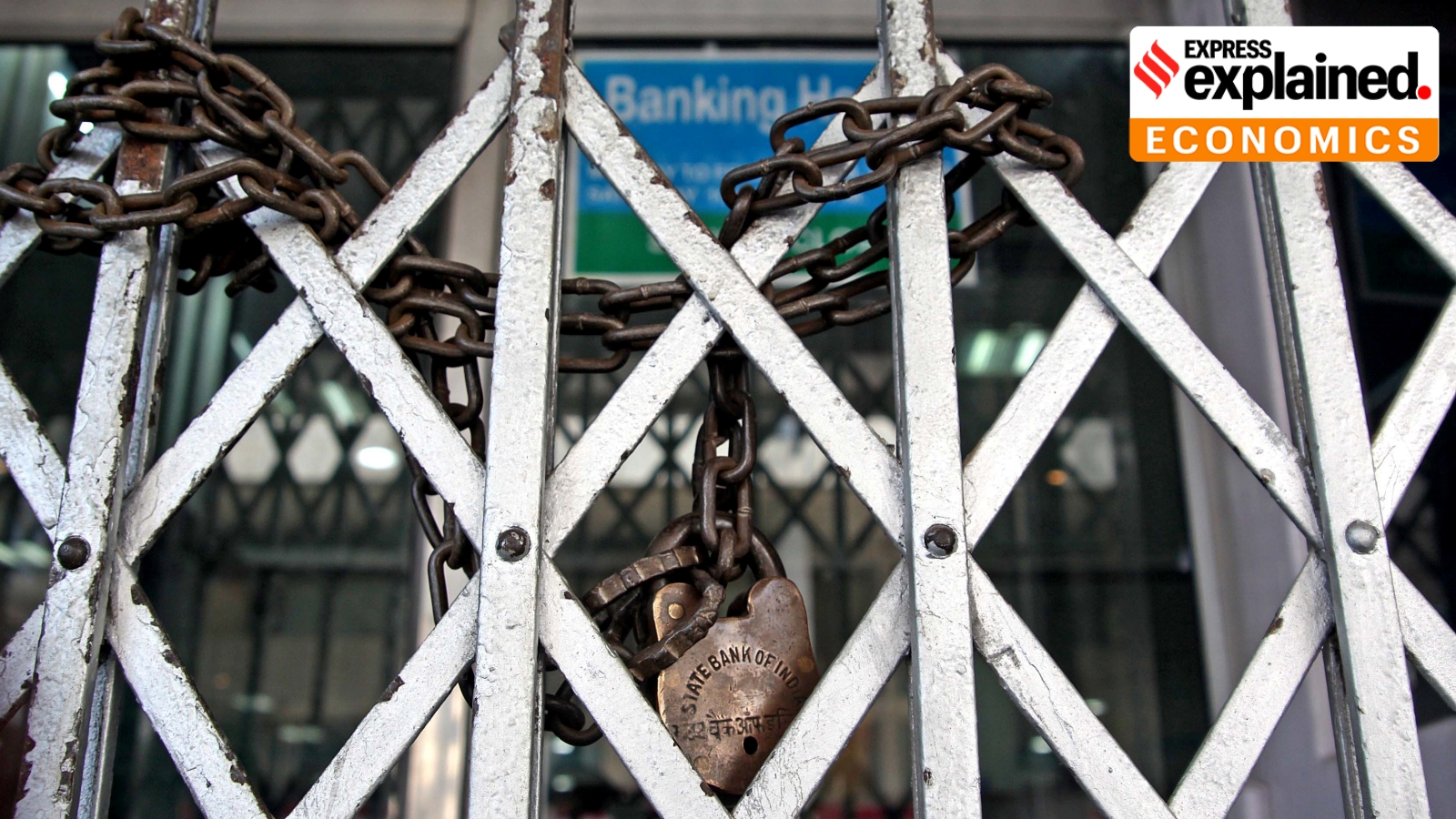
The United Forum of Bank Unions (UFBU), an umbrella body of seven bank unions and eight lakh employees, has called a three-day nationwide strike from September 28 to 30, with an indefinite strike threatened from October 26 if its demands remain unresolved.
The unions say they represent around 90% of the banking workforce. At the heart of the dispute are four demands: implementation of a five-day banking week, changes to the government’s performance-linked incentive (PLI) scheme, bilateral discussions on the scheme and resolution of other pending issues.
The immediate flashpoint, however, is five-day banking. The proposal has been under consideration for more than two years after the Indian Banks’ Association (IBA), a representative body of banks in India, agreed to the demand and sent it to the government for approval.
For bank employees, the five-day week is the principal unresolved demand. At present, bank branches are closed on the second and fourth Saturdays but generally operate on the first, third and where applicable, fifth Saturdays. The unions want all Saturdays to become holidays.
The issue has a longer history. The Indian Banks Association had earlier agreed to the existing arrangement of two Saturday holidays a month. In the wage negotiations, the proposal for all Saturdays to be holidays was taken forward, with the understanding that working hours on weekdays could be increased to compensate. The unions argue that this would not mean fewer customer-facing hours because the additional working time would be accommodated from Monday to Friday.
“From the UFBU, we pointed out that there is no response to our demand for implementation of 5 Days Banking which was agreed and signed in March, 2024 under the last wage revision settlement. Hence, we are going ahead with the strike action,” UFBU said in a letter to various unions and members.
PLI is the second major point of contention. The system was introduced as part of the 2020 wage settlement and was linked to the performance of individual banks. A revised government scheme for senior bank officials has since triggered opposition from bank officers’ associations. The revised PLI covered Grade 4 and above officers, while excluding lower-scale officers, prompting objections over the distribution of incentives.
The timing is particularly sensitive: September 30 is the half-yearly closing date for banks, making it important for reconciliation, provisioning and treasury and market operations. The government has warned that a three-day strike, coming immediately after the weekend, could therefore cause wider disruption.
The biggest impact will be felt at physical bank branches, particularly those of public sector banks. Cash deposits and withdrawals, cheque clearing, account-related work and other branch-level services could face disruption. But this will not amount to a complete shutdown of banking.
UPI, internet banking, mobile banking and ATMs are expected to continue functioning. State Bank of India and other public sector banks have advised customers with time-sensitive branch transactions to complete them before the strike and use digital channels and ATMs during the disruption. Private sector banks are also expected to be less affected because the strike is principally directed at the participating unions and public sector banking operations.
This is where the calendar matters. September 27 is a Sunday — normally a bank holiday. But public sector banks and regional rural banks will open that day ahead of the September 28-30 strike. The reason is straightforward: without this Sunday opening, customers would face the weekend immediately followed by three days of strike action. That could effectively stretch the disruption to five consecutive days.
The Finance Ministry therefore sought to ensure that customers had an additional day to conduct essential branch banking before the strike. The Reserve Bank of India has approved the full operation of bank branches, offices, ATM-linked branches and currency chests on September 27.
The immediate question is whether the government and unions can resolve the five-day-week and PLI disputes before September 28. If not, the three-day strike could be followed by the larger threat of an indefinite strike from October 26.
The government and bank managements have asked the unions to defer the strike and continue discussions. The Finance Ministry has said the five-day banking proposal remains under consideration and that several stakeholders have to be taken into account before a decision is made. At the same time, the government has begun contingency planning. The Finance Ministry has asked public sector banks and regional rural banks to keep adequate cash in ATMs and take steps to maintain essential services during the strike.
IBA and the Department of Financial Services (DFS) had participated in the conciliation meetings of the Labour Ministry. IBA and DFS had agreed to keep the PLI scheme in abeyance.
The DFS representatives submitted that the demand for five-day banking is under consideration but a timeline cannot be given, the government said. “However, apart from the 5 days banking, there are a lot of welfare measures Government has taken in the past for the bank employees and still taking including initiation of the process of 13th bipartite settlement,” the Office of the Chief Labour Commissioner in the Ministry of Labour said in a note.
George Mathew is an Associate Editor with The Indian Express, based in Mumbai. A veteran of financial journalism with nearly three decades of experience, he is one of the country’s most authoritative voices on banking, regulation, and the corporate sector. Expertise & Focus Areas Mathew’s reporting covers the nerve center of India’s economy. His specialized beats include: The Reserve Bank of India (RBI): He has tracked the central bank's policy evolution through the tenures of multiple Governors, offering deep insights into monetary policy, repo rates, and banking regulation. Banking & Insurance: Extensive coverage of public and private sector banks, non-performing assets (NPAs), and key legislative reforms like the Insurance Amendment Bills. Corporate Affairs: Mathew frequently breaks major stories related to India's largest conglomerates, with a specific focus on the Tata Group, documenting boardroom shifts and strategic decisions. Financial Markets: Reporting on the complexities of Foreign Portfolio Investors (FPIs), IPOs, and currency fluctuations. Authoritativeness & Insight With a career dating back to the late 1990s, Mathew possesses a rare institutional memory of India’s financial liberalization and market crises. His work is not limited to daily news; he frequently contributes to the "Explained" section, where he decodes complex financial legislations and market trends for a broader audience. His rigorous reporting has also been featured in scholarly platforms like the Economic and Political Weekly (EPW). Find all stories by George Mathew here ... Read More