
Who landed punches in Round 2? What our columnists saw in last night’s Toronto mayoral debate - Toronto Star
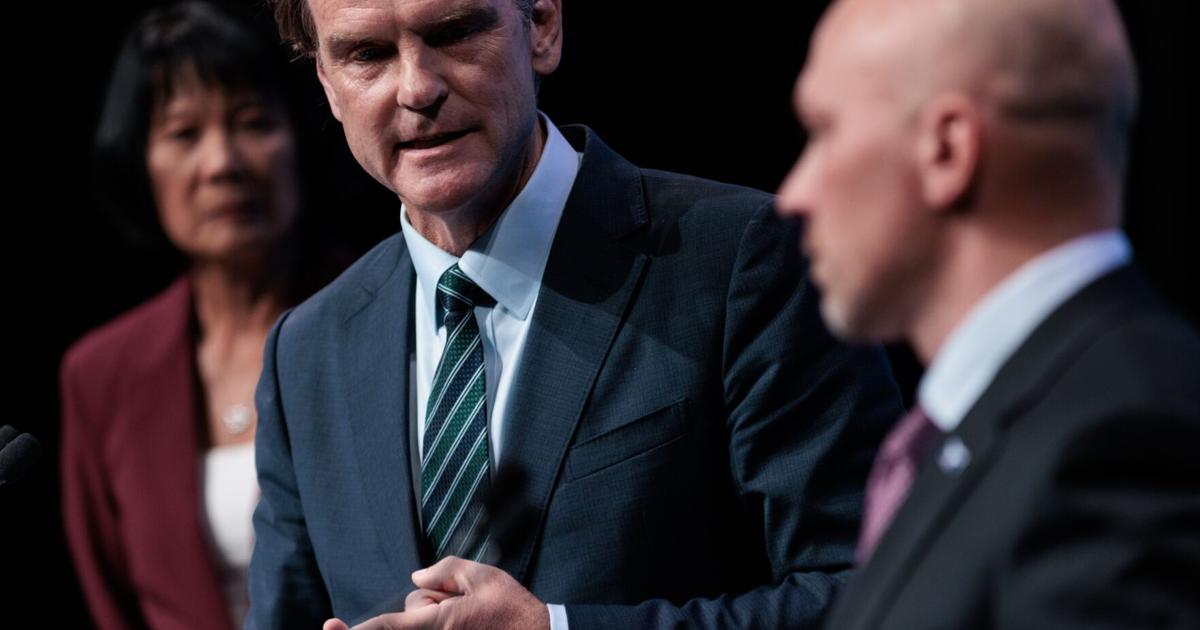
How our panel of pundits saw ups and downs of last night's debate hosted by the Star and Toronto Region Board of Trade.
Former MP Chris Alexander, centre, speaks during Tuesday’s mayoral debate, flanked by incumbent Olivia Chow and Coun. Brad Bradford.
The leading contenders to be mayor of Toronto sparred for an hour Tuesday night over their visions for the future of the city.
It was the second time Olivia Chow, Brad Bradford and Chris Alexander have shared a debate stage during the campaign for the Oct. 26 municipal elections. The debate was hosted by the Toronto Star and the Toronto Region Board of Trade.
Intently watching the political pugilism at the Isabel Bader Theatre was our savvy cadre of political pundits.
Here is who they believe scored the weightiest blows of the night.
If the last mayoral debate was defined by maudlin anecdotes about Toronto residents who may or may not exist, this one was defined by precisely the opposite: actual policy. There was so much talk about taxes and infrastructure, I found myself missing the likes of “Sylvia,“ “Jason” and “Larnetta.” (If you know, you know.) Instead, we got a lively debate about congestion (all candidates are opposed), TTC fare increases, and new housing starts.
Chow, who struggled to make a cogent argument during the last debate, was considerably stronger this time around. The mayor called on her actual achievements — championing traffic agents to fight gridlock; making a deal with the province; supporting the city’s renter class — as opposed to leaning on good vibes alone.
Speaking of good vibes, if Bradford talked about municipal politics the way he talked about his favourite tree on Tuesday night, he might have an easier time closing the seven-point gap between himself and Mayor Chow come election day. In response to the debate’s lone light-hearted question, the Beaches—East York councillor revealed that his favourite tree in the city is the London plane, a large deciduous tree, with a distinct “purple bark” and a lovely “tulip shape.” It was the most at ease he has ever looked in an election cycle where it seems everyone, his own wife included, has been telling him to crack a smile. Brad, if you’re listening, whenever the tax rate gets you down, just think of the London plane.
Emma Teitel is a contributing columnist to the Toronto Star, a senior consultant at Crestview Strategy and a former member of the Toronto Star’s editorial board. Email: emma@emmateitel.ca
Brad Bradford is hungry. That’s my takeaway. His diction is honed, his arguments are practised and he sure can talk the loudest during open debate. Does that mean he’d be a good mayor? His actual ideas seem pretty uninspired. A thorough budget review isn’t a bad idea, but the dream of a wad of cash hiding in Toronto’s finances sounds like Rob Ford’s reheated gravy train sprinkled with John Tory’s executive austerity — both mayoral eras in which my hometown became more cold and selfish.
The biggest surprise was how much I didn’t hate Chris Alexander. I’m nowhere near believing Mr. Barbaric Cultural Practices should lead this special, multicultural city. But if grounded promises of fiscal conservatism are your thing, Alexander’s unsexy offer to talk to Ottawa about funding co-op housing is a nerd point scored. Especially with Bradford ducking questions about why a former budget chair hasn’t produced a costed platform, or the specifics of how to cut expenses, freeze property taxes and increase our biggest line item, police.
Incumbents are always playing defence and Chow rattling off numbers in an attempt to detail her successes on affordability, congestion and economics was confusing and flat. That’s true even when she was right — when Bradford tried to blame her for Toronto’s supposed failure to land a deal at Mark Carney’s investment summit last week, she should have had more verve pointing out the big focus was resource extraction. Please, the roads have enough holes already, let’s not do mines.
I believe Chow loves the city more than the other two, but her view is often filtered through stubbornly rose-coloured glasses. Can she see that Bradford is coming for her lunch?
Denise Balkissoon is executive editor of The Narwhal, a non-profit publication about the natural world in Canada.
The mayoral debate pitted three rivals against one another, but there were just two coherent choices onstage Tuesday night — Chow versus Bradford.
The third wheel, going in circles once again, was Alexander, the failed former federal cabinet minister and faux candidate for mayor who trails the two leading candidates in polling strength and policy depth. Does he have a rare immunity to impersonation syndrome? Alexander keeps saying with a straight face that he’s boned up on this or that city code and found the cure to what ails Toronto.
Chow continued to run a classic frontrunner’s campaign, telling Torontonians what they (don’t) want to hear: “We’ve now turned a corner … There is a lot of optimism in our city.” Give her credit for telling people what they don’t want to hear about taxes, too, saying there are more increases to come. I’m with her on that — call me pro-tax — but that’s a tough pitch in hard times.
Bradford has hit on the classic challenger’s appeal for votes: A tax freeze. And a “change” slogan he keeps repeating: “If you want change in the city, you have to change the mayor.” As he closes the polling gap on the incumbent — but also watches Alexander’s eclectic ego play spoiler — Bradford opted to spend much of this debate night framing the election as a referendum on both Chow and change.
“You can’t run away from your record,” she taunted Bradford at one point, gamely blaming him for all of city hall’s shortcomings. It seemed an oddly double-edged attack line in a two-way match-up embedded in a three-way race.
Martin Regg Cohn is a Toronto-based columnist focusing on Ontario politics and international affairs for the Star. Follow him on Twitter: @reggcohn
I can’t believe I’m saying this, but I think the winner was Alexander. This race has been screaming for a credible third option. And for the first time since he launched his late, longshot campaign, I thought Alexander made a real case that it could be him.
People are obviously not happy with the status quo. They want some kind of change. But every time Bradford gets in front of a camera he reminds me more and more of Pierre Poilievre: a gifted political attack dog; incredibly hard-working; impeccably prepared; but with a foundational problem getting normal people to like him.
I’ve worried, watching the opening weeks of the campaign, that too many voters were going to look at Chow and Bradford as their only options and decide not to vote at all. For every point Bradford tears off Chow with his repetitive, poll-honed attacks, after all, he risks knocking an equal number off his own likeability.
That’s why I think Alexander stood out tonight. Bradford hammered away on his talking points; Chow answered with hers (though she was better tonight than she was last week); Alexander actually seemed to be engaging with the questions. He also had the best moment of the debate — when he incredulously asked Bradford if he thought Blackrock was really going to invest in Toronto transit.
Is he electable? Probably not. But the debate was better because he was there. And I’m beginning to think the campaign is, too.
Richard Warnica is a Toronto-based senior opinion writer for the Star. Reach him via email: rwarnica@thestar.ca.
Opinion articles are based on the author’s interpretations and judgments of facts, data and events. More details

