
When Millions of Votes Do Not Result in DPR Seats
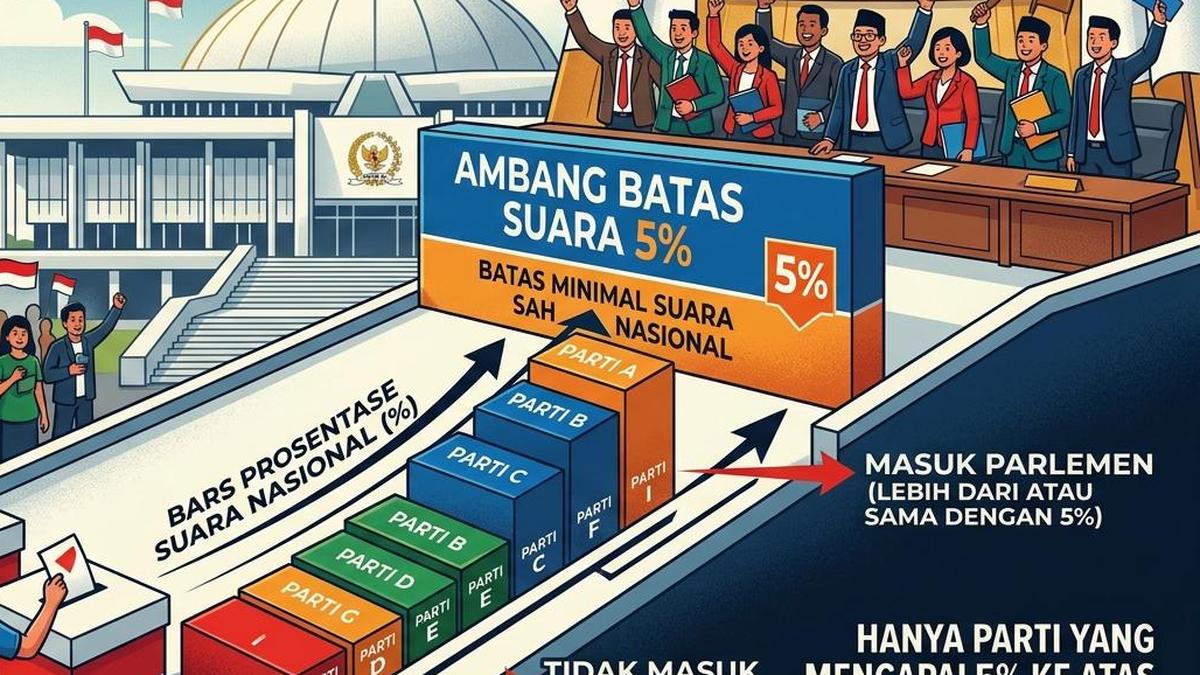
JAKARTA, KOMPAS.com - A proposal suggesting that political parties failing to meet the parliamentary threshold (PT) should be allowed to form a joint faction reignites the debate over unconverted voter ballots into seats in the House of Representatives (DPR).
Constitutional law expert Mahfud MD highlighted this issue in the context of the 2024 elections, estimating that the accumulated votes from parties that did not qualify for the DPR could reach around 17.3 percent.
“For instance, yesterday, PPP received 3.9 percent, just missing one seat. PSI got around 2 percent. Perindo received a similar amount. If we sum this up, it’s 17.3 percent,” Mahfud stated on his YouTube channel on Wednesday (30/9/2026).
Mahfud proposed that parties failing to meet the PT should be able to form a collective faction.
He also mentioned a mechanism called stembus accoord, which allows the pooling of leftover votes from various political parties.
“For parties that did not meet the PT, they could enter an agreement to form a joint faction. This has been done before, and if implemented, there would be no lost votes and they would equally have the right to propose a presidential candidate,” Mahfud added.
This proposal arises as the proportion of votes from political parties that do not reach the PT in the 2024 elections has been recorded as greater than in the two previous elections.
Data presented by Neni Nur Hayati, Director of the Democracy and Electoral Empowerment Partnership (DEEP) Indonesia, indicates that the proportion of votes from parties below the threshold has been steadily increasing over the last three elections.
In the 2014 elections, with the PT set at 3.5 percent, around 2.97 million votes or 2.37 percent of the national vote came from two parties that did not cross the threshold.
This number rose in the 2019 elections. With a PT of 4 percent, approximately 13.59 million votes or 9.7 percent of the national vote came from parties that did not meet the threshold.
In the 2024 elections, the proportion increased again. Based on data from Neni, there were about 26.3 million votes or 17.3 percent of the national vote from parties that did not meet the threshold.
These parties include PPP with 3.87 percent of the votes, PSI with 2.81 percent, Perindo with 1.29 percent, Gelora with 0.84 percent, Hanura with 0.72 percent, Labor Party with 0.64 percent, Ummat with 0.42 percent, PBB with 0.32 percent, Garuda with 0.27 percent, and PKN with 0.22 percent.
“Thus, there is a tendency for the proportion of votes for parties below the threshold to increase from 2014 to 2019 and then 2024,” Neni told Kompas.com on Thursday (1/10/2026).
The larger the votes collected by parties below the PT, the greater the number of votes that cannot be converted into seats in the DPR through the prevailing electoral mechanism.
However, according to Neni, the magnitude of unconverted votes should not solely be viewed through the lens of the parliamentary threshold.
