What's the IceCube Observatory work that Francis Halzen has received Nobel Prize in Physics for

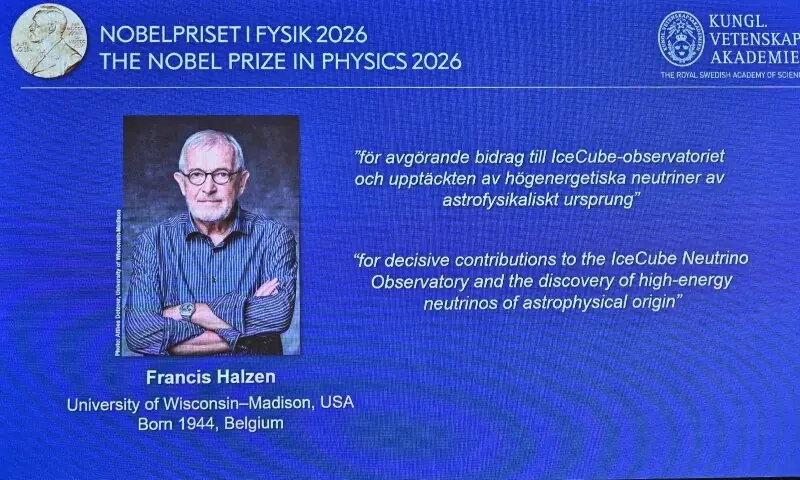
The Royal Swedish Academy of Sciences has decided to award the 2026 Nobel Prize in Physics to Francis Halzen “for decisive contributions to the IceCube Neutrino Observatory and the discovery of high-energy neutrinos of astrophysical origin.”
Nobel Prize in Physics 2026 has gone to Francis HalzenHalzen realised that ice at the South Pole could be used to track particles known as neutrinos, according to the Nobel Prize website, which added that his vision and scientific leadership have been fundamental for the IceCube Neutrino Observatory – a cubic kilometre of ice that is equipped with light sensors.
Using IceCube, researchers can capture neutrinos from extremely energy-rich processes in the distant universe.
“Francis Halzen has led an international team of researchers and engineers who have provided us with a fantastic instrument. His tenacity and scientific vision has paved the way for a new kind of astronomy,” nobelprize.org quoted as saying Mark Pearce, Chair of the Nobel Committee for Physics.
Neutrinos are everywhere, yet they rarely reveal their presence, the Nobel Prize website page announcing the Physics award states. Neutrinos pass through the Earth and our bodies without being noticed. Only on rare occasions does a neutrino interact with an atomic nucleus, creating a detectable signal that scientists with the right equipment can observe.
Scientists have long known that the universe contains natural particle accelerators capable of producing particles with energies up to a million times higher than those achievable in laboratories on Earth. However, much remains unknown about these cosmic accelerators: what they are, where they are located and what processes take place inside them.
Extremely high-energy neutrinos are produced in the same environments as other particles. But unlike other particles, neutrinos can travel to Earth without changing direction or losing energy. This makes them a unique source of information about the universe, providing insights that cannot be obtained in any other way.
In 1988, Francis Halzen first proposed his vision of detecting neutrinos at the South Pole. When a neutrino collides with an atomic nucleus, it produces a flash of light that can be detected by sensors embedded in the clear glacial ice. The South Pole offers several advantages for such an experiment: the ice is free from several forms of interference and the region is geologically stable, with no earthquakes.
Halzen's idea soon won the backing of other researchers. Within a few years, preliminary tests were conducted using sensors placed in the ice.
Because cosmic neutrinos with extremely high energies are exceptionally rare, scientists need an enormous volume of ice to detect enough collisions. IceCube covers an area of one cubic kilometre and was completed in 2011. Researchers soon detected the first high-energy neutrinos and, a few years later, announced the discovery of neutrinos that must have originated far beyond our solar system. The search for the sources of neutrinos across the universe could then begin in earnest.
The neutrino interactions continuously recorded by IceCube are expected to give researchers new insights into the violent environments where high-energy neutrinos are produced. They could also help scientists identify previously unknown cosmic phenomena.
Follow the latest breaking news, major developments and agenda-setting stories from India and around the world with the newsdesk at Hindustan Times. Operating round the clock, the desk brings together experienced editors, reporters and correspondents to deliver fast, accurate and contextual reporting across subjects that influence public policy, governance, business, society and international affairs. The HT News Desk covers politics, elections, government policies, the economy, business and markets, science and technology, the environment, law and order, infrastructure, education, climate issues and geopolitics, while closely tracking developments across states, institutions and global capitals. The team also leads coverage of major breaking news events, policy announcements, court proceedings, natural disasters, public emergencies and significant international developments. Reports published by the newsdesk are based on information gathered from reporters on the ground, official statements, government agencies, court records, regulatory filings, recognised institutions and other authoritative sources. Stories undergo editorial scrutiny and verification processes to ensure accuracy, fairness and relevance, and are updated as events evolve and additional information becomes available. Whether covering a key political decision in New Delhi, an economic policy shift affecting millions, a landmark court ruling or a major global event, the HT News Desk aims to provide readers with reliable, fact-based journalism that delivers not only the latest developments but also the context and analysis needed to understand their wider implications.Read More