What is fuelling school protests in France?
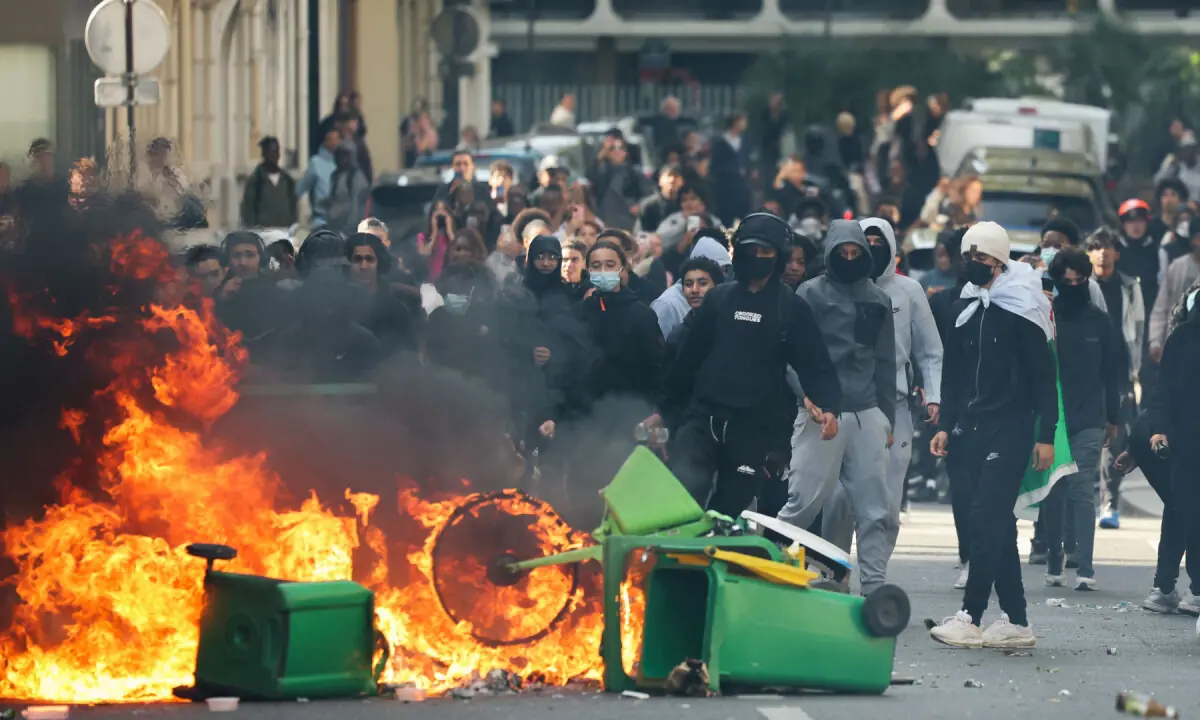
Protests by teenagers outside their schools have shaken France in recent days, with students blockading entrances to their institutions and security forces on occasion responding with tear gas.
The government has said that while the grievances may be legitimate, violence is not and has accused the hard-left of whipping up the movement.
Critics have meanwhile accused some police of heavy-handed force against protesters, who are legally still children.
More than 5,000 people have been arrested since Monday, according to the interior ministry, while about 735 educational establishments were affected on Friday, the education minister said.
While the weekend may see a lull, a major new day of protest is planned for Tuesday.
AFP looks at the origins of the movement.
Multiple grievances
The protests affect lycees, the schools where French teens have their last years of school, aged from 15-18, the equivalent of high school in the United States and sixth form in the United Kingdom.
The students’ grievances are numerous, but chief among them are teacher absences, conditions in classrooms, overloaded school timetables and a school day that can be as long as 8:00am to 6:00pm, which some say is excessive.
“High-school students — particularly those from low-income neighbourhoods — feel they are receiving an inferior education,” said French sociologist Valerie Becquet.
Origin of the movement
The movement began two weeks ago on Sept 17 at the Saint-Exupéry high school in the Paris suburb of Créteil, in support of teachers striking over a lack of staff and resources.
It gained momentum, gradually spreading across the country over the last week.
Ironically, as tensions raged elsewhere in France, the situation at the Saint-Exupery high school returned to normal after educational authorities agreed to send additional staff, including a deputy principal and a nurse.
“Our grades were slipping. If we had not rallied now it would have augured very badly for the future,” said pupil Abderrahmane, who expressed “enormous” pride at taking part in the inception of the movement.
Role of social media
The protests are being further fuelled by the spread of dramatic images and videos on online platforms, notably TikTok.
Students themselves hold up their phones to record scenes such as burning trash cans or police deploying tear gas. Numerous channels, seeking to boost their reach, spread this footage and edit together the most dramatic moments.
“With social media, they can offer a narrative different from the one presented in traditional media — a narrative that is not manufactured,” said sociologist Becquet.
Social inequality
France offers all students access to the lycee but in reality there is a vast spectrum, ranging from vocational schools to elite institutions.
Despite numerous diversity initiatives, the latter remain dominated by students from white, affluent families with university-educated parents.
“There are glaring inequalities among different students and schools, and this is a real problem,” said Becquet.
Political exploitation
The protests have become a major issue of political tension just over half a year ahead of presidential elections, with the government accusing the hard-left France Unbowed (LFI) of being behind the movement.
Senior LFI official Manuel Bompard has rejected the government’s accusations, saying it was “descending into conspiracy theories”.
Veteran LFI presidential candidate Jean-Luc Melenchon — who is currently polling at over 40 per cent among 18-25-year-old voters — has strongly supported the protests, while calling for non-violent methods.
Police response
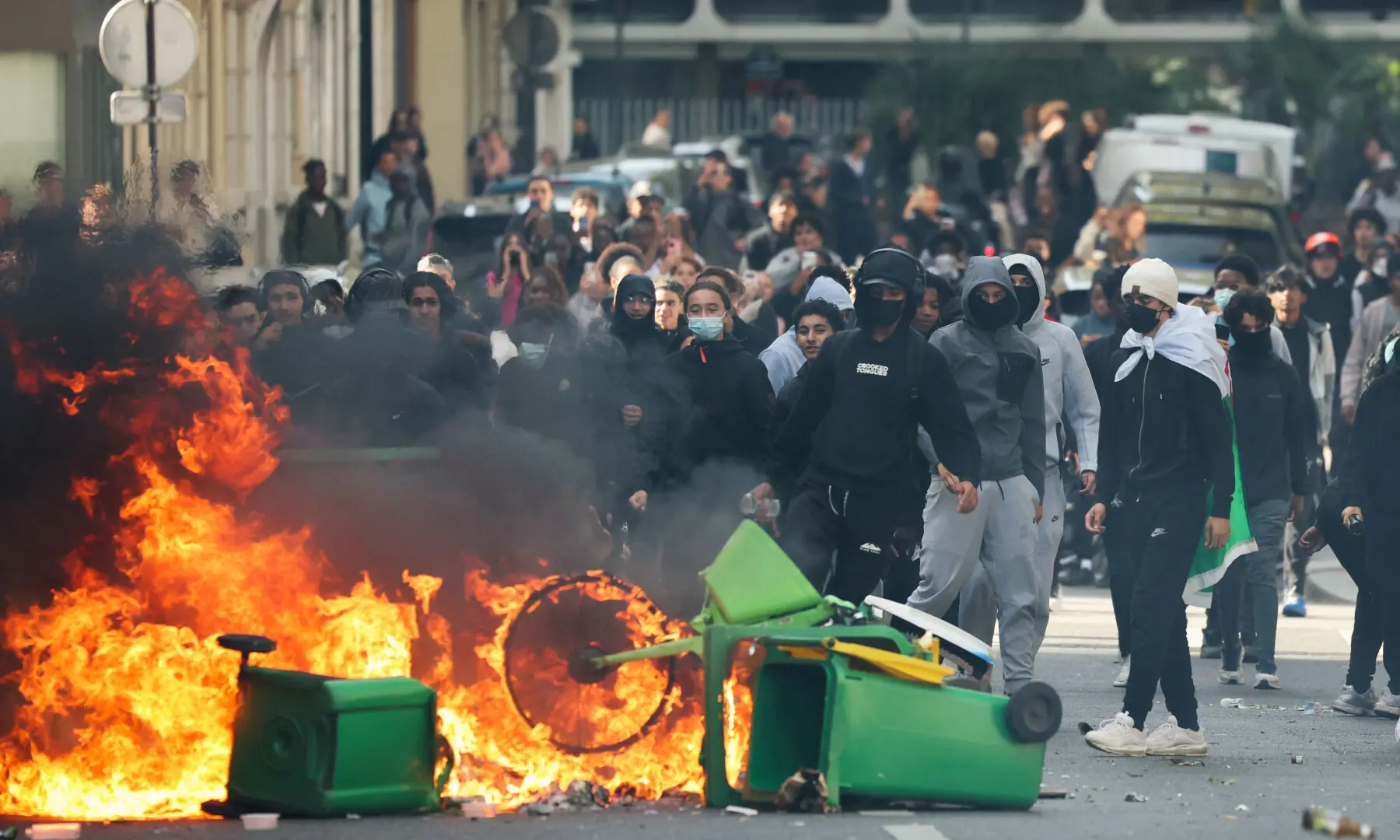
Protesters have blockaded schools, set fire to bins and other objects and hurled projectiles at police.
But police have also moved to disperse some of the protesters, notably firing tear gas canisters, using rubber bullets and sometimes beating them with batons.
After students clashed with police Wednesday in Tours in central France, one young man wounded lost the use of his right eye, the city’s prosecutor said.
Numerous videos have gone viral showing alleged brutal conduct by security forces — such as a police officer placing his arm around the neck of a girl during her arrest.
But police have also been targets, notably an officer who was chased and beaten and kicked by a group of youths from a school in the eastern city of Belfort.
Header image: French high school students block access to the Lycee Paul Eluard high school as they protest to demand the hiring of substitute teachers, increased resources and better learning conditions, in Saint-Denis, near Paris, France, on Sept 30, 2026. — Reuters