Vivek Ramaswamy vs. Amy Acton Poll Shows Decline in Support for Republican - Newsweek
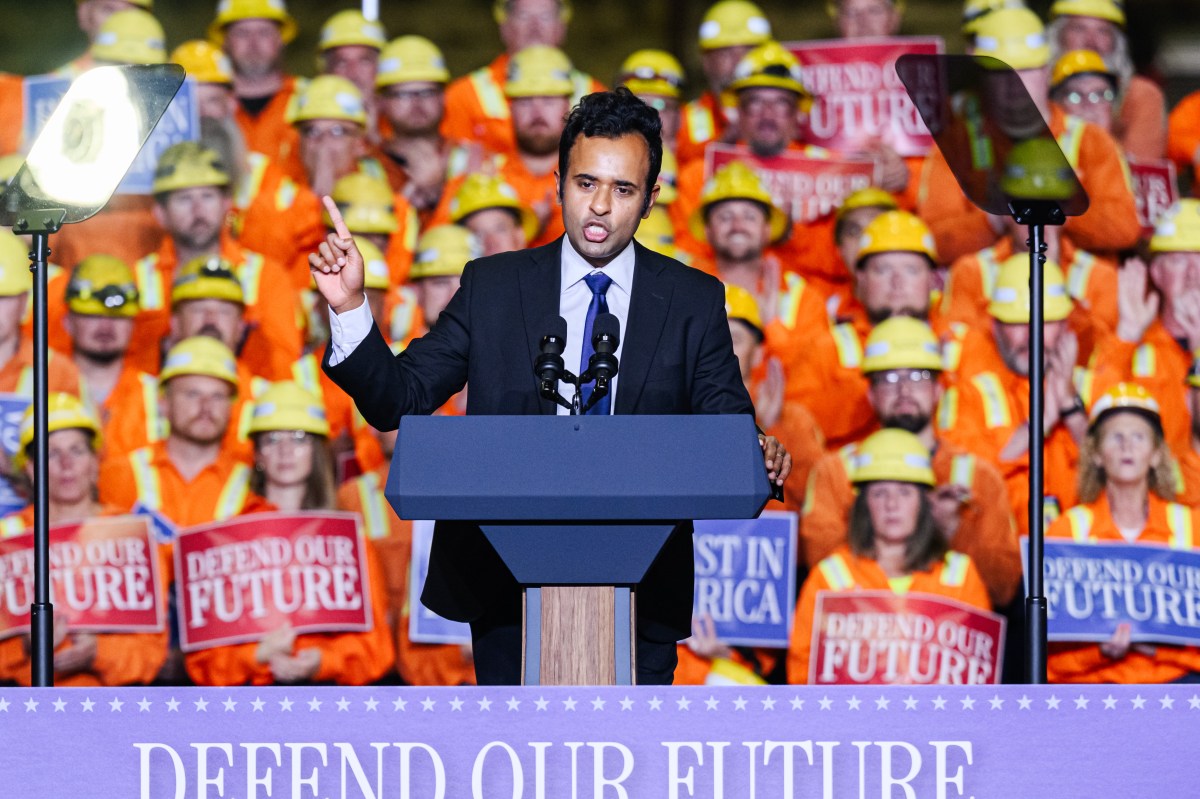
Republican Vivek Ramaswamy, a former GOP presidential candidate and Trump administration official, falls behind Democrat Amy Acton in Ohio's governor's race, according to a new poll released less than 50 days before Election Day.
The survey shows the contest remains highly competitive, with Acton holding a narrow advantage within the poll's margin of error as both candidates vie to succeed term-limited Republican Governor Mike DeWine. Compared with a similar poll conducted by the same pollster in April, Ramaswamy's support has slipped by 1 percentage point.
Ohio’s gubernatorial race is one of 36 gubernatorial contests taking place nationwide this year, a cycle that includes several other high-profile races in states such as Michigan, Alaska, Iowa, Wisconsin, and Texas.
Trump carried the state by about 11 percentage points in 2024, an improvement over his 2020 and 2016 performances, when he won by about 8 points each time. But Ohio was viewed as more competitive for Democrats not long before. Former President Barack Obama narrowly carried Ohio in 2008 and 2012. It has shifted as Trump performed well among the state’s working-class voters.
Despite that Republican trend, Ohio has a history of electing Democrats statewide. The state's most recent Democratic governor was Ted Strickland, who served from 2007 to 2011. Ohio has elected only Republican governors since then, including current Governor Mike DeWine, who won reelection in 2022 but is now term-limited.
"This poll showcases what we see every single day across Ohio; Ohioans are ready for change,” Acton campaign manager Philip Stein told Newsweek.
“Dr. Acton is the only candidate in this race who will lower costs, tackle the cost of corruption, and build a state where all of us can get ahead. Vivek Ramaswamy just doesn’t get our state; Ohioans are seeing right through his policy scams and false promises,” the statement continued.
Newsweek reached out to Ramaswamy’s campaign for comment via email on Wednesday.
A new Bowling Green State University/YouGov poll of 1,000 likely Ohio voters found Acton ahead of Ramaswamy, 48 percent to 45 percent. Her lead is within the poll’s margin of error of plus or minus 4 percentage points. About 4 percent said Libertarian Don Kissick, while 3 percent said someone else.
Despite trailing in the ballot test, Ramaswamy remained the candidate voters believe will be the eventual winner. Sixty-two percent said they expect him to win the governorship, while 36 percent said Acton would prevail.
Both candidates posted net-negative favorability ratings. The poll found 41 percent of voters viewed Acton favorably and 42 percent unfavorably, while Ramaswamy's ratings stood at 36 percent favorable and 47 percent unfavorable.
In an April Bowling Green State University/YouGov poll of 1,000 registered Ohio voters, Ramaswamy was ahead in the general election, 48 percent to Acton's 47 percent. The poll had a margin of error of plus or minus 3.9 percentage points.
John Feehery, a partner at EFB Advocacy, told Newsweek about the race, "Brown has a huge name id advantage but he is also seen as the incumbent in a state that has overwhelmingly vote for Republicans over and over again. Could Brown win? Absolutely. But the Republicans have shown an ability to win consistently there and that shouldn’t be discounted."
A Wedgewood Poll of 800 likely voters conducted between August 11 and 13 found a tight race for the governor’s mansion, with Acton ahead by 1 point, 47 percent to Ramaswamy’s 46 percent. Seven percent of the participants were undecided. The poll has a margin of error of plus or minus 4 percentage points.
A Fox News poll conducted August 6 to 10 among 1,008 registered voters put Ramaswamy ahead, 50 percent to 48 percent. The survey has a margin of error of plus or minus 3 percentage points.
Tulchin Research found Acton leading 46 percent to 44 percent in a survey sponsored by John Kulewicz, the Democratic candidate for Ohio attorney general. The survey, conducted July 29 to August 4 among 660 likely voters, had a margin of error of plus or minus 4 percentage points.
A New York Times/Siena College poll of 601 likely voters, conducted June 15 to 28, had the candidates tied at 47 percent. Its margin of error was plus or minus 4.7 percentage points.
An AARP survey conducted June 14 to 16 by Democratic firm Impact Research and Republican firm Fabrizio, Lee & Associates gave Acton a 47 percent to 44 percent lead among 800 likely voters. Its margin of error was plus or minus 3.5 percentage points.
The Cook Political Report rates the race as a toss-up after moving it from the Lean Republican column in a July update. Explaining the shift, the forecaster wrote that “it’s an inescapable law of politics: Money can only propel a campaign so far when its candidate’s flaws act as an anchor.” Sabato’s Crystal Ball rates the race as likely Republican.
The state's most recent Democratic senator was Sherrod Brown, who served from 2007 until his defeat by Republican Bernie Moreno in 2024. Brown is now seeking a return to the Senate in a 2026 race against Republican Senator Jon Husted, who was appointed to fill the remainder of Vice President JD Vance's term.
Brown, who represented Ohio in the Senate for 18 years, is now facing Husted for the full-term Senate seat.
The same Bowling Green State University/YouGov poll found Brown leading 48 percent to Husted’s 45 percent. About 3 percent said they would vote for independent Greg Levy and 2 percent for someone else.
However, despite Brown’s lead in preference, more voters believe Husted will become the state’s senator, 53 percent to Brown’s 45 percent.
An August Fox News poll found Brown leading Husted by 8 points, 53 percent to 45 percent, with about 2 percent undecided. Brown leads among independents in Ohio by 38 points, 66 percent to 28 percent for Husted. The poll of 1,008 registered Ohio voters was conducted August 6-10.
A Wedgewood Poll of 800 likely voters conducted between August 11 and 13 found Brown with 48 percent to Husted’s 44 percent. About 8 percent of voters were undecided. The poll has a margin of error of plus or minus 4 percentage points.
Forecasters like the Cook Political Report and Sabato’s Crystal Ball view the race as a toss-up. Sabato’s Crystal Ball shifted it from Lean Republican earlier in June after Brown and Husted formally won their parties’ nominations.
Democrats are eyeing a narrow path to reclaiming control of Congress' upper chamber, where Republicans currently hold a 53-47 majority, and are hoping to put the traditionally Republican state in play. To take back the majority, Democrats must defend their current seats—including in two states President Donald Trump won in his 2024 White House bid—and flip four others.
"Democrats are running competitive Senate races in Ohio and Texas, a real indication that Republicans nationwide face significant headwinds," Matt Klink, owner and president of Klink Campaigns, told Newsweek.
Democrats argue that voter concerns about the economy, Trump's declining approval ratings and the war with Iran could create openings in several competitive state races. Despite Democratic optimism, Republicans contend that they will maintain their Senate majority and retain control of Congress.
“Momentum is clearly on the Democrats' side. And Trump's historic low approval ratings certainly give more wind to the Democrats' sails. But Democrats shouldn't be popping the champagne yet. There is still a lot of work to do,” Doug Gordon, a Democratic strategist and co-founder of UpShift Strategies, told Newsweek.
He continued, “With the exception of North Carolina and Georgia, Democratic candidates still aren't cracking 50 percent in polls. The wave is building, but it hasn't hit yet.”
However, Bernadette Breslin, national press secretary for the National Republican Senate Committee (NRSC), told Newsweek on Wednesday, “Summer polling has flattered Democrats in reliably red states before, only to be proven wrong in November.”
She continued, “Sherrod Brown and James Talarico enabled Joe Biden’s border policies, and voters won’t forget the price hikes and fentanyl deaths that followed.”
Nationally, 34 percent of voters approve of Trump's job performance while 60 percent disapprove as of Wednesday, leaving him underwater with a net approval rating of -26, according to Civiqs' rolling online tracking poll of registered voters. As of Wednesday, the survey had garnered around 130,300 responses since January 20, 2025, when Trump was inaugurated for a second term.
Alex Patton, owner of strategic public affairs firm Ozean Media, told Newsweek, “Yes, the environment continues to decline for the GOP, yes the map is expanding, and yet the Democrats will still need a near perfect night to flip the Senate.”
He concluded, “It's possible, becoming more probable, but uncertainty abounds.”
Nate Silver’s Silver Bulletin model gave Democrats a 58.6 percent chance of winning the chamber on September 14, up from 50.6 percent on September 6.
Ohio is one of several closely watched Senate battlegrounds that could help determine control of the chamber in 2026. Other highly competitive races are unfolding in Georgia, where Democratic Senator Jon Ossoff is defending his seat; Michigan and New Hampshire, which feature open-seat contests following retirements; and Maine, where Republican Senator Susan Collins faces another competitive reelection bid. Republicans are also defending seats in states such as North Carolina and Texas.
Ohio's voter registration deadline is October 5, with early in-person voting beginning October 6. Voters will head to the polls on November 3 to decide races for governor, the U.S. Senate and the House of Representatives.
Contact Newsweek editors on this story: Jason Lemon and Sam Wilson.