US midterm elections: The ‘blue tsunami’ leaves Japan jittery over Trump’s next foreign policy moves - The Straits Times
Tokyo braces for security shifts and market turmoil after Democratic midterm victory.
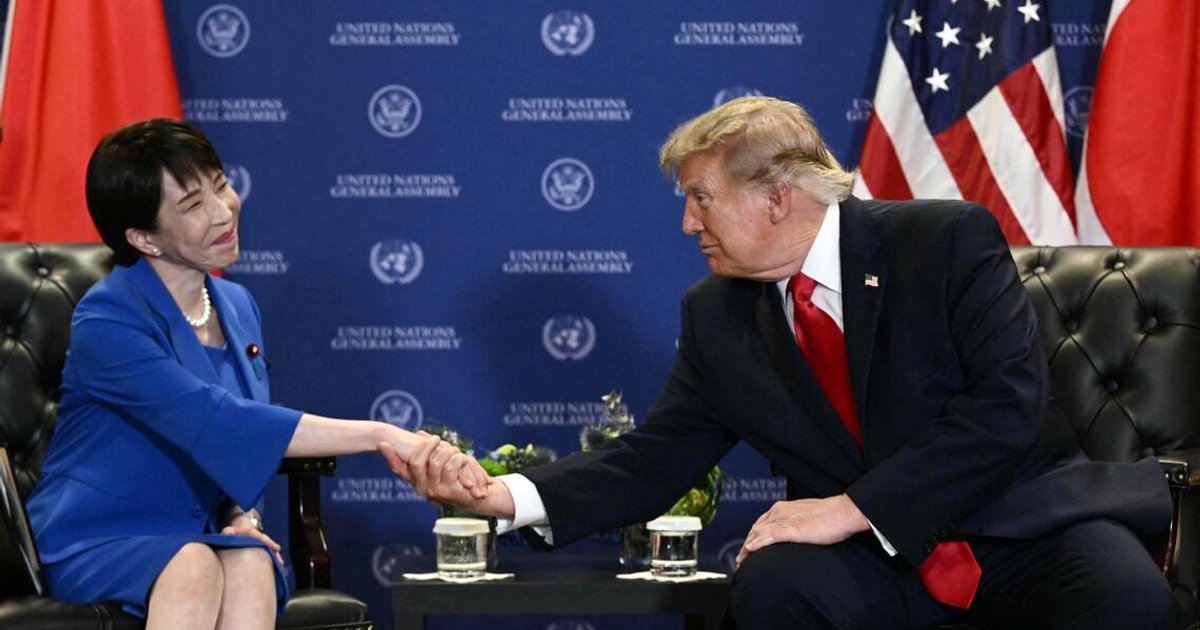
US President Donald Trump at a bilateral meeting with Japan’s Prime Minister Sanae Takaichi on the sidelines of the UN General Assembly in New York on Sept 22.
TOKYO – Chastened and humbled by a historic midterm reckoning, or defiant and emboldened by it?
United States security ally Japan is watching with palpable unease over how President Donald Trump will react to the decisive “blue tsunami” that swept Democrats back into control of both chambers of the US Congress following elections on Nov 3.
Will a politically constrained White House turn its gaze abroad to chase legacy-defining breakthroughs in foreign policy, national security and trade – areas where the presidency retains broad discretionary authority? And will protracted domestic gridlock in Washington leave a dangerous vacuum in Indo-Pacific deterrence?
Officially, Japan insists the alliance remains unshakeable, regardless of what happens in the US.
Chief Cabinet Secretary Minoru Kihara said on Nov 4 that the bilateral partnership “remains the cornerstone of Japan’s foreign and security policy regardless of the outcome of the elections” and is vital to “maximising its national interests”.
With China’s military buildup, North Korea’s missile arsenal and Russia’s assertiveness firmly in mind, Tokyo has sought ever-closer alignment with Washington. Prime Minister Sanae Takaichi hopes the personal rapport she has cultivated with Trump will ensure Japan is neither sidelined nor disadvantaged by any deals he might attempt to strike with these countries.
Yet, given how heavily Tokyo relies on the US nuclear umbrella and regional troop presence, Japanese observers are jittery over how an embattled Trump could pursue high-stakes deals over the interests of traditional allies.
Media editorials across Japan’s political spectrum have urged vigilance.
The conservative Sankei Shimbun warned that Japan stood at a “critical juncture”, given Trump’s track record of conciliatory overtures to Moscow and Beijing.
The liberal Asahi Shimbun argued that Tokyo must prioritise multi-directional diplomacy with like-minded partners, protect the rules-based international order, while pushing back against unreasonable demands from Washington in areas such as defence and trade.
“Japan cannot envision a future for its diplomacy if it is solely preoccupied with its relationship with the United States,” the newspaper bluntly said, alluding to perceptions that Tokyo has been overly deferential to Washington.
“The Japan-US alliance is a crucial cornerstone of security, but prioritising the alliance is different from blindly following the Trump administration.”
Tosh Minohara, chairman of the Research Institute for Indo-Pacific Affairs think tank, told The Straits Times that Japan’s greatest vulnerability lies in how Beijing, Moscow and Pyongyang interpret Trump’s diminished domestic authority.
“Trump’s weakness will lead to global instability because these countries will think, ‘Why not take advantage of that?’” he said. “They might think that if they are going to make big moves, they might as well do so while Trump is still President as the US is consumed with domestic issues because the next administration will most likely push back much harder.”
Minohara stressed that Tokyo must urgently deepen defence and diplomatic networks with partners such as South Korea and Australia, as well as across ASEAN and Europe, to ensure regional resilience if Washington becomes paralysed by domestic strife.
Satoru Nagao, a non-resident fellow at the Hudson Institute, agreed that political uncertainty makes diplomatic diversification necessary, but offered the contrarian view that Trump’s mercurial reputation continues to serve as a strategic check.
“His unpredictability itself is deterrence,” Nagao observed. “Moscow, Beijing and Pyongyang cannot move freely because they cannot predict what the American reaction will be.”
Nagao pointed out, however, that the most immediate risk for Japan is budgetary gridlock on Capitol Hill, where defence expenditure will face fierce scrutiny.
Under the split legislature, the Pentagon will inevitably demand that treaty allies shoulder a heavier financial and operational load. That will put renewed pressure on Tokyo to bridge regional capability gaps and accelerate its own defence spending commitments, he said.
There are also potential friction points in bilateral trade, despite Japan having committed US$550 billion (S$702 billion) in investments to the US in 2025 in exchange for setting “reciprocal” tariffs at a baseline 15%.
Agriculture is one simmering flashpoint. Trump has repeatedly pressed Japan to open up market access for US fresh potatoes, but Tokyo has moved slowly amid displeasure from domestic farming lobbies, while also citing its strict phytosanitary inspection regimes.
Analysts observe that a divided US government could grant Japan much-needed breathing room on agricultural demands. However, broader uncertainties loom over tech-centric sectors, where Democrats are expected to apply tighter scrutiny to artificial intelligence and data centre expansion.
On Nov 4, the benchmark Nikkei stock index plunged as much as 4.8% intraday amid fears that Japanese component suppliers could be hit if US tech infrastructure plans stall.
In this climate, corporate leaders are bracing for turbulence. The Nikkei newspaper reported concerns among top executives at Japan’s five largest trading houses over the unpredictability in global energy, currencies and investment markets.
Mitsui & Co chief executive officer Kenichi Hori was quoted as saying on Nov 4: “We need to remain broadly prepared and maintain a wide range of options so that we can respond to continued high volatility.”
Walter Sim is Japan correspondent at The Straits Times. Based in Tokyo, he writes about political, economic and socio-cultural issues.