
US midterm election fallout adds uncertainty to US Iran policy - CGTN
By continuing to browse our site you agree to our use of cookies, revised Privacy Policy and Terms of Use. You can change your cookie settings through your browser.
The US midterm elections have reshaped the political landscape in Washington, with Democrats regaining control of both chambers of Congress and significantly narrowing the Trump administration's room for maneuver over the next two years.
The Republican Party's losses have triggered an internal blame game, with the conflict with Iran emerging as a major point of contention. US Vice President JD Vance has openly acknowledged that the war has cost Republicans politically, while Defense Secretary Pete Hegseth's political future has come under growing scrutiny.
The election outcome has also raised questions about the future direction of Washington's Iran policy: Will the US resume military strikes, pursue negotiations or seek a way out of the conflict?
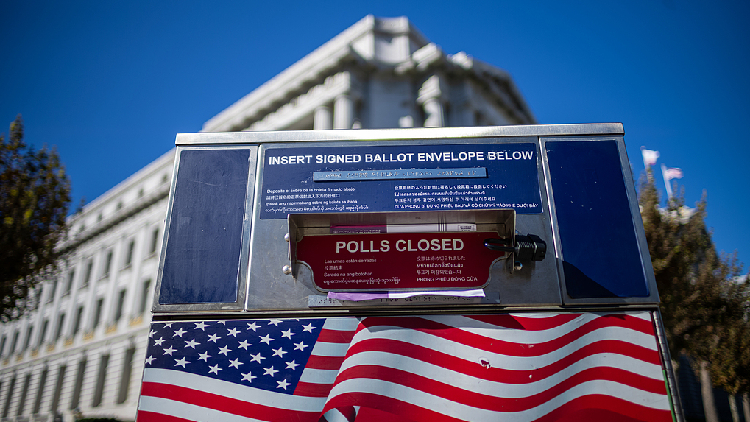
A ballot is stuffed into a locked mail slot marked "Polls Closed" on a ballot box outside San Francisco County's election operations facility inside City Hall in San Francisco, California, US, on November 4, 2026. /VCG
According to CNN's vote count reported Thursday, Democrats secured 253 seats in the House of Representatives, compared with 157 for Republicans as of end of Thursday. CNN projected that Democrats would achieve their largest House majority since 2008.
In the Senate, Democrats won 54 seats, while Republicans secured 44, according to the reported results.
The shift is expected to intensify congressional scrutiny of the Trump administration and make it more difficult for the president to advance his policy agenda.
Public sentiment also reflects widespread concern about the political outlook. A Thursday poll found that 72.1% of respondents were pessimistic about the country's post-election political situation, expecting intensified partisan conflict and greater policy uncertainty. Only 14.2% believed the overall political situation would remain stable.
US President Donald Trump speaks after signing an executive order in the Oval Office of the White House in Washington, DC, US, on November 5, 2026. /VCG
The conflict with Iran has become a major source of tension within the Republican Party.
In a lengthy social media post on Wednesday, Vance attributed the party's election losses largely to the war, arguing that many voters who supported Republicans in the 2024 presidential election had become dissatisfied with the current situation and switched their support to Democrats.
Citing polling research, Vance said these voters were primarily concerned about ending the war, addressing the rising cost of living and inflation, maintaining an "America First" policy and reassessing US relations with Israel.
"The reason we lost is the war," Vance said on X. "If you'd like to argue it was worth it, that losing the Senate for the next 6 years was worth it, then do so."
US Vice President JD Vance speaks at a campaign rally at Griffiss International Airport in Rome, New York, on November 2, 2026. /VCG
His remarks have drawn attention in Washington, with some US media interpreting them as an effort to distance himself from the Trump administration's approach to Iran ahead of a possible 2028 presidential bid.
Vance's post also drew a mocking response from Iranian Parliament Speaker Mohammad Bagher Ghalibaf, who heads Iran's negotiating team with the US. He suggested that if Vance believed the war was a bad idea, he should convince Trump to end it rather than double down.
"Losing gambler energy, can't walk away from the table. Boss is prepping the next war phase while America teeters on an Israel-First cliff. Skip the TED talk. Why not say this to your boss?" Ghalibaf wrote in English in a reply to Vance's post on X.
Meanwhile, Hegseth has become a target of Republican criticism over the handling of the conflict.
US media reported on Wednesday that some Republican lawmakers and aides were placing responsibility for the election setback on the defense secretary. They accused him of overestimating the likelihood of a quick and decisive military victory, failing to provide the White House with a clear postwar withdrawal plan and underestimating the domestic political and economic consequences of the conflict.
A House vote on articles of impeachment against Hegseth could come as early as next week, according to the reports.
Hegseth reportedly intends to remain in office and is prepared to fight any impeachment effort.
On Thursday, Trump publicly reaffirmed his support for the defense secretary.
"I have every intention to keep him," Trump said.
Trump acknowledged receiving calls from people unhappy with Hegseth, but said, "I get these calls, you know, about him. I don't understand why."
US Secretary of War Pete Hegseth attends Halloween on the South Lawn at the White House in Washington, DC, US, on October 29, 2026. /VCG
In an interview with China Media Group (CMG), Su Xiaohui, an expert at the China Institute of International Studies, said the possible impeachment of Hegseth reflects growing pressure within the Republican Party.
"Hegseth's future is a dilemma for Trump," Su said. Removing the defense secretary could help deflect criticism and ease divisions within the party, but could also shift attention to Trump himself, Su noted, adding that the possibility of renewed military action against Iran makes a change in defense leadership more complicated.
Su said the US still has military options on the table as it weighs a possible exit strategy from the conflict. Previous threats of renewed strikes failed to secure concessions from Iran, while further military action could bring new risks. Washington has very limited room for maneuver, she pointed out.
The midterm elections are unlikely to mark a turning point in US policy toward Iran, Su told CMG. She stressed that the US remains concerned about navigation through the Strait of Hormuz and continues to demand that Iran hand over its stockpile of highly enriched uranium.
These differences will make future negotiations difficult and could keep the risk of renewed confrontation alive, she added.


