UPI MDR vs credit card, net banking: Do you pay extra for using them?
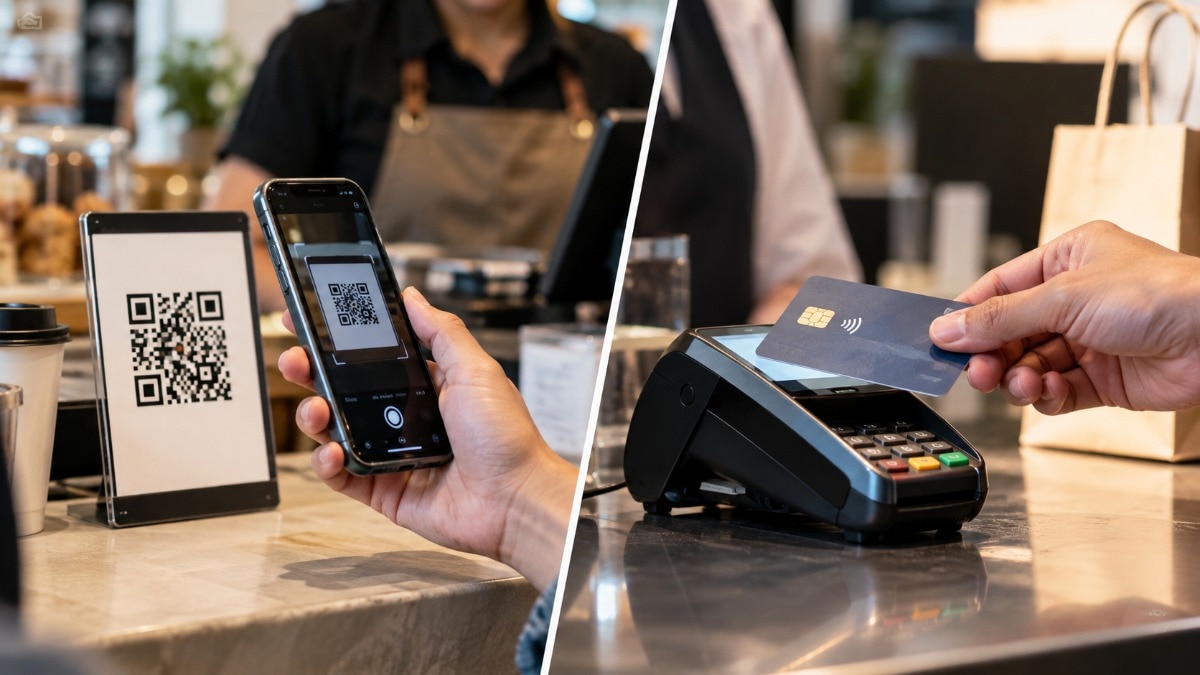
From October 15, paying a merchant through UPI for more than Rs 2,000 will carry a new Merchant Discount Rate (MDR) of 0.4%, subject to a cap of Rs 300 for transactions of Rs 75,000 and above.
But there is an important catch: the customer is not supposed to pay this MDR.
The charge will be levied within the merchant payment ecosystem, while banks have been advised to ensure merchants do not pass it on to customers. UPI app providers have also been barred from imposing platform fees or hidden charges on UPI payments.
This raises a more interesting question for consumers, which is, if UPI remains free, how does it compare with credit cards and net banking?
And when you see a "convenience fee", "platform fee" or other payment charge while booking a flight, buying a ticket or making an online purchase, does the payment method really make a difference?
The answer is more nuanced than simply saying that one payment mode is cheaper.WHAT DOES THE NEW UPI MDR MEAN?
The new 0.4% MDR applies to specified person-to-merchant UPI transactions above Rs 2,000 from October 15.
A Rs 5,000 payment would mean an MDR of Rs 20 for the merchant. A Rs 50,000 payment would mean Rs 200. Once the transaction reaches Rs 75,000, the MDR is capped at Rs 300.
The government has said this does not change the cost for consumers. Person-to-person UPI transfers remain free regardless of the amount, while payments to merchants up to Rs 2,000 remain free. Small merchants receiving up to Rs 1 lakh a month through UPI QR codes also remain under the zero-MDR framework.
The government estimates that around 96% of P2M transactions will remain unaffected by the new MDR.
There are also special rates for some categories. Payments above Rs 2,000 to sectors such as railways, telecom, insurance, fuel and agricultural inputs will attract a flat Rs 5 MDR, while capital-market transactions will attract 0.02%, capped at Rs 300.
So, for a customer standing at a shop and paying Rs 10,000 through a UPI QR code, the 0.4% MDR does not mean an additional Rs 40 will be deducted from the customer's bank account.CREDIT CARD MDR IS ALSO NOT A CUSTOMER CHARGE
This is where the comparison gets interesting.
Credit-card transactions also involve MDR. But the merchant, rather than the customer, generally bears that cost.
ICICI Bank, for instance, explains that merchants typically bear credit-card swipe charges. It says these can be around 2% for physical transactions and 2.3-2.5% for online transactions, although the actual rate depends on the arrangement.
SBI's current account information shows negotiated or concessional domestic credit-card MDR rates ranging from 1% to 1.6% across certain account tiers. Its Platinum Current Account, for instance, lists 1.20% for domestic credit-card transactions, subject to the specified conditions and monthly limits.
HDFC Bank says MDR for card payments is generally around 2-3%, while also noting that merchants can negotiate rates depending on their expected transaction volumes.
The important point for consumers is that the MDR a merchant pays is not automatically a fee that appears on the customer's bill.
For a normal Rs 10,000 credit-card purchase, a customer would generally see a Rs 10,000 transaction rather than Rs 10,000 plus a separate 2% "MDR charge".
However, merchants can have different pricing or fee policies, and the cost of accepting cards can also indirectly influence the prices businesses charge.THEN WHY DO CUSTOMERS SOMETIMES SEE A PAYMENT FEE?
This is where the story should go beyond MDR.
A merchant can have other charges associated with a transaction that are separate from MDR.
These could include a convenience fee, booking fee, platform fee or other service-related charge, depending on the product and the platform.
RBI's framework for payment gateways and aggregators specifically distinguishes MDR from other charges such as convenience fees and says such charges, if levied, should be displayed to the customer before payment.
RBI's credit-card rules also define a convenience fee as a fixed or percentage-based charge associated with using cards as an alternative payment method and require such fees to be disclosed transparently before a transaction.
MDR: generally a cost in the merchant-payment ecosystem.
Convenience fee: a separate charge that can be imposed on the customer for a particular service or transaction, subject to applicable rules and disclosure.
Platform/service fee: another possible charge associated with using a particular platform or service.
So a customer may not be paying the merchant's MDR, but could still pay a separate convenience or service fee.NET BANKING CAN ALSO BE CHEAP — SOMETIMES FREE
Net banking complicates the "UPI is cheaper" argument even further.
RBI has directed banks not to levy charges on NEFT funds transfers initiated online by savings-bank account holders.
That means if a consumer is simply transferring money from a savings account using online NEFT, the transaction itself may not cost anything.
The actual cost can depend on the bank, account type and payment route.
And this is where net banking differs from UPI. A net-banking transfer is primarily a bank-account transfer, while UPI is designed to work as a merchant payment interface as well.
So a customer may have a Rs 0 direct transaction cost with both UPI and online NEFT, but the experience and availability at checkout can be very different.advertisementLOOK AT THE PAYMENT PAGEA useful example comes from IRCTC.
Its published payment-provider charges show that the customer-facing cost can vary substantially by payment method.
In one listed arrangement, UPI transactions carry no transaction charge, while domestic credit cards attract a percentage-based charge and net banking carries a fixed Rs 10 charge, with applicable taxes. The exact charge varies depending on the payment provider.
This demonstrates why consumers cannot simply compare MDR percentages and conclude that one payment method always costs less.
The merchant may be absorbing the MDR. But a platform can separately charge the customer for providing a payment or booking service, depending on its terms.
Air India provides another example of a different kind of charge. It says its convenience fee is charged on bookings made through its website, app or call centres and applies across payment modes, rather than being tied specifically to UPI or credit cards.
That distinction is important because a customer could switch from a credit card to UPI and still pay the same convenience fee.
So which payment method is actually cheaper?
There is no single answer because there are two different questions: what does the merchant pay, and what does the customer pay?
For a straightforward shop purchase, UPI can remain a zero-direct-charge option for the customer even after October 15, because the new MDR is not supposed to be passed on.
Credit cards can also have zero direct transaction charges at checkout, even though the merchant pays MDR.
Net banking can also be free for certain online bank transfers, particularly NEFT initiated online by savings-account customers.
The difference emerges when a platform adds a customer-facing charge.
A customer booking a ticket could therefore see a convenience fee irrespective of whether UPI or a credit card is selected. Another platform could charge a fixed payment fee for net banking but nothing for UPI. A third could have different charges for different card types.CREDIT CARDS HAVE ANOTHER COST THAT UPI DOES NOT
There is also a cost that does not appear at the moment of payment: the cost of borrowing.
If a customer pays a credit-card bill in full by the due date, the purchase itself does not necessarily attract interest. But if the customer carries an outstanding balance, credit-card interest and other applicable charges can make the payment substantially more expensive.
RBI requires card issuers to disclose interest rates and the methodology for calculating finance charges, including examples for situations where only part of the outstanding amount is paid.
Credit cards can also carry annual fees, late-payment charges and charges for certain services. These are costs of having or using the credit facility rather than MDR.
This means a consumer comparing payment modes should not look only at the fee displayed on the checkout page.DON'T CONFUSE MDR WITH YOUR PAYMENT COST
The new UPI MDR changes the economics for merchants, but it does not currently turn UPI into a paid service for consumers.
A customer paying a merchant Rs 20,000 through UPI will not suddenly see an additional Rs 80 MDR deducted from their account. The merchant bears the MDR under the new framework, and banks have been advised to prevent the cost from being passed on.
But consumers can still encounter convenience fees, platform fees or other service charges depending on the merchant and the transaction. Those charges are separate from MDR and need to be checked before payment.
Credit cards, meanwhile, can offer rewards, cashback or payment flexibility while the merchant bears the MDR. Net banking can be free for certain bank transfers but may attract a payment fee when used through particular merchant platforms.- EndsPublished By: Published On: Sep 16, 2026 11:10 IST