
Ukraine updates: EU to send united front to potential peace talks
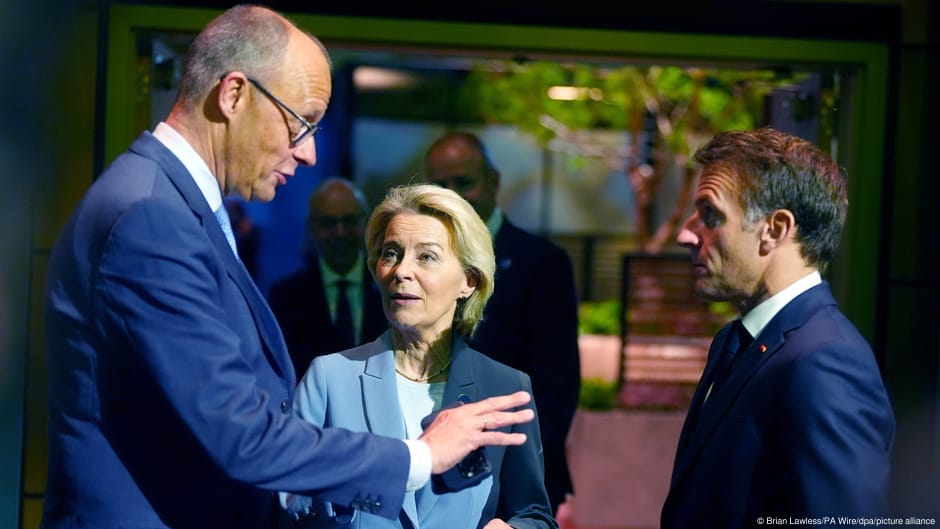
European Council President Antonio Costa on Friday said the EU will take part in future peace talks aimed at ending Russia's invasion of Ukraine, and will be jointly represented by Ukraine's allies France, Germany, Italy, Poland and the UK.
European and Ukrainian leaders have long insisted on the format, while Russia has rejected the idea and the US appeared indifferent under the Trump administration.
The situation appears to have changed slightly, with US envoy and presidential son-in-law Jared Kushner saying late Thursday, "We cannot conclude this deal without the Europeans being at the table," adding that Russian President Vladimir Putin "is willing to give it a try."
Despite consensus about wanting peace after nearly five years of Russia's war of aggression, Europe lacks unanimity as to who should be representing the interests of the continent and member states.
Russia and the US have called for one single representative to be present, whereas several nations have called for a diplomatic team.
The question of who will represent the EU itself remains unresolved.
The bloc's foreign affairs boss Kaja Kallas — a staunch critic of Russia and its war — said Friday, "I'm the one who is representing Europe in the foreign and security policy." Adding, "I know that the Russians don’t want me, but, you know, do we have a say, who is representing Russia?"
With frustration growing over Russian aggression on Europe's doorstep, Latvian Prime Minister Andris Kulbergs put things in perspective. Pointing to the fact that Europe is more populous, richer and more militarily powerful than Russia, he said Friday, "We as Europe, have to grow some bigger balls."
Ukrainian President Volodymyr Zelenskyy said no clear explanations have been given for recent speed issues with Starshield.
The Ukrainian president said on Thursday that Ukraine's military faced new "systematic restrictions" to tech billionaire Elon Musk's Starshield satellite internet.
Zelenskyy doubled down on his comments on Friday, saying the issue remained unsolved.
He said the connections were only working when devices were moving slower than 161 kilometres (100 miles) per hour.
"This makes it impossible, in particular, to use interceptors against jet-powered 'Shaheds.'" he added. The Ukrainian president also said he instructed his ministers to step up contacts with the US side.
The Starshield military communications system — the military-grade version of satellite-based communication network Starlink — is operated by Musk's SpaceX and plays a key role for frontline communications.
Ukraine first flagged issues with Starshield last month after a dispute between Zelenskyy and US President Donald Trump over a US deal allowing more Russian diesel into global markets.
The Wall Street Journal reported that Musk "capped the speeds at which Ukrainian hardware could stay connected to the satellite-based network."
Tech billionaire and US president both denied throttling Ukrainian access, but Musk later accused Ukraine of using the service for military purposes while Trump said Musk had "put it back."
German Chancellor Friedrich Merz on Friday asked US President Donald Trump to not make any "surprises" on Ukraine with the Russian President Vladimir Putin.
Trump is expected to meet with Chinese President Xi Jinping and Russian President Vladimir Putin at an APEC leaders' summit in China next week.
Speaking on the sidelines of the European Union meetings in Dublin, Merz said that "some here in fear this could turn into a 'second Anchorage moment'."
The Russian and US presidents held talks in Anchorage, Alaska, last summer, the outcome of which European side views as favoring Putin.
"I therefore want to state our message to the United States very clearly: Please, no surprises. Continue to play as part of 'Team Europe' and 'Team Ukraine'," Merz said.
He also stated that Europe does not need to talk about security arrangements with Russia.
"Russia wants to talk about questions of a European security architecture. We do not need to discuss that, it already exists," he said.
Merz also said it was a "given" that his country would involved in the next round of Ukraine talks.
Kyiv residents are bracing for another difficult winter as Russian airstrikes continue to target the Ukrainian capital’s energy infrastructure. Long and unpredictable power and water outages are disrupting daily life, forcing families to rely on batteries, portable power stations and improvised routines.
European leaders are under pressure to put forward a name to represent them in Ukraine peace talks after US envoy Steve Witkoff told reporters that the Europeans will be present at the next meetings.
When asked by DW during the European Political Community summit in Dublin why Europe should only get one seat at the table while the US gets two, EU foreign policy chief Kaja Kallas responded with a wry, ironic laugh ― clearly a sign of the frustration felt by European leaders about being sidelined thus far.
The summit of 47 European leaders in Dublin comes in the wake of a diplomatic tour by two Donald Trump administration advisers, the president's son-in-law Jared Kushner and special envoy Steve Witkoff, to talks in Abu Dhabi, followed by a meeting with Russian President Vladimir Putin in Moscow.
The pair then hot-footed their way to Dublin to debrief Ukrainian President Volodymyr Zelekenskyy.
Zelenskyy and Kushner also said Thursday that Europeans would be at the table for the next talks with Russia on ending the war.
Kallas is one of the figures tipped as most likely to represent the EU in any future talks to end Russia's war against Ukraine, alongside EU Council President Antonio Costa. As yet, the EU hasn’t been able to land on one central figure to send ― many of the national leaders want to be present themselves.
Kremlin spokesman Dmitry Peskov told reporters that Russia needs clarity on the European Union's "real intentions" for joining the Ukraine peace talks before making a decision on whether to expand the trilateral format.
US negotiators said on Thursday that President Vladimir Putin had agreed to an EU seat at the table, but Peskov's remarks indicate that the Kremlin has not yet agreed.
"Once we understand their real intentions and their willingness to contribute to the peace process, then we can make a decision on holding talks in an expanded format," Peskov said.
"If the Europeans really do have someone who is at least authorized in some way to talk, and if the Europeans really do have the desire to do so, then, of course, we will be ready to talk to them," he said.
Speaking after the latest trilateral meeting in Abu Dhabi on Wednesday, Russia's lead negotiator, Vladimir Medinsky, claimed that "Russia did not receive single concrete peace proposal from European countries."
The European Union (EU) foreign affairs chief, Kaja Kallas, said Russia did not want "anybody strong" at the negotiating table because "they want to push through their maximum demands."
Arriving at an EU summit in Dublin, Kallas told reporters that Moscow had no say over who represented the European Union in the US-mediated Ukraine-Russia peace talks.
"First we need a ceasefire. If we start to talk about what Russia is asking regarding the security architecture, we actually walk into the traps that Russia is setting us, which is that we divert the attention away from that there is no ceasefire," she said.
EU leaders are under pressure to put forward a name to represent the European Union in Ukraine peace talks after US envoy Steve Witkoff told reporters that the bloc will be present at the next meetings.
Kallas is one of the figures tipped as most likely to represent the EU in any future talks to end Russia's war in Ukraine, alongside EU Council President Antonio Costa.
As yet, the EU hasn't been able to land on one central figure to send ― many of the national leaders want to be present themselves.
Overnight drone attacks killed several people in both Ukraine and Russia.
In the southern Ukrainian city of Odesa, authorities said two people had been killed and five others injured. One person was reportedly injured in an attack on a hospital, according to reports from the capital city of Kyiv.
A Russian attack on Zaporizhzhia in the southeast killed a 17-year-old boy, acting regional governor Mykhailo Semikin said.
Meanwhile, In the Russian city of Volgograd, four people were killed and two others injured, regional government said.
Russia's Investigative Committee has launched an inquiry into the explosion of a car belonging to an exiled Ukrainian political aide in Moscow, media reported.
The car reportedly belonged to Sergei Zavorotniy, a former spokesman for Mykola Azarov, who served as Ukraine's prime minister from 2010 to 2014. He fled to Russia from Ukraine amid anti-government protests in 2014.
According to the Russian newspaper Kommersant, Zavorotniy was hospitalized. Both Ren TV and the 112 Telegram channel reported that he lost his left arm in the attack and sustained a concussion, rib fractures, and other injuries.
Meanwhile, Azarov told Russia's TASS state news agency on Friday that he does not know anything about the explosion except that Zavorotniy survived.
This is the second reported car explosion in Russia following the death of a Russian serviceman in a car explosion in Saint Petersburg on Thursday.
There was no immediate comment from Ukraine.
EU leaders are set to convene in the Irish capital, Dublin, for an informal European Council meeting on Friday. They are under pressure to nominate someone to represent the European Union in the Ukraine peace talks.
In other news, a car bomb exploded in Russia, targeting a former aide to the pro-Russia Ukrainian politician Mykola Azarov.
Follow along for the latest updates on the peace talks and other news from Ukraine.

