Trump’s New Texas Border Wall Faces Challenges Before Midterms - Newsweek
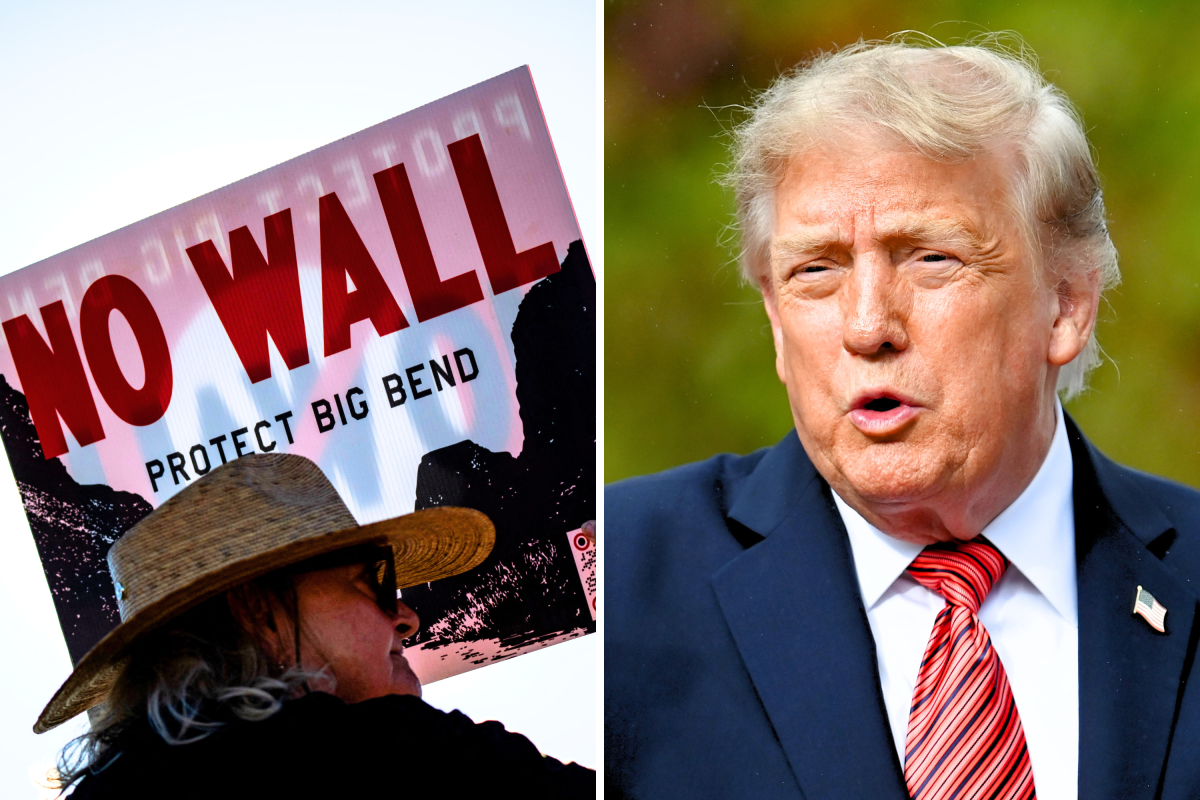
President Donald Trump’s Texas border wall could be left with gaps because of landowner resistance in the Big Bend region as construction advances before the midterms, campaigners opposing the project have told Newsweek.
Although construction inside Big Bend National Park is temporarily paused, crews have begun installing wall panels elsewhere in the region.
Thirty-foot steel panels are being installed for Big Bend 1, a 47.3-mile project in Hudspeth County.
That work is separate from ground-disturbing activity on the Big Bend 2 and Big Bend 4 projects, which the federal government agreed to pause through September 30 for further public engagement.
The No Big Bend Wall Coalition, an advocacy group opposing the expansion of border infrastructure in the area, estimates that hundreds of landowners have properties fronting the Rio Grande where U.S. Customs and Border Protection (CBP) is seeking construction access, communications director Clara Bensen told Newsweek by email.
Bensen said that owners who have not granted construction access are creating what she called a "patchwork effect" along the proposed route.
"Putting together a significant, contiguous stretch of wall will still be a lengthy process across hundreds of landowners," Bensen said.
Land access presents a practical test for an administration that has federal funding, contractors and expedited construction authority, but does not yet have permission to work on every privately owned parcel along the planned route.
A lawsuit filed by Conserve Big Bend and six landowners on September 14 adds a legal challenge.
Its plaintiffs dispute the federal finding that the 517-mile Big Bend Sector is an area of "high illegal entry," a determination used to accelerate barrier construction and waive procedural requirements.
Coalition members had seen signs of impending construction before the first panels appeared.
Bensen said residents in several counties reported steel bollards being moved toward the border during the previous week.
Hudspeth County has the highest proportion of owners who have granted access, according to the No Big Bend Wall Coalition.
Others have declined, potentially leaving crews free to build on one property but unable to continue through the next.
Bensen described narrow "ribbon" or strip parcels extending toward the Rio Grande, which she linked to Spanish colonial and Mexican land-allocation systems.
More than 200 owners have joined the coalition's property-rights campaign, according to the court complaint as of September 14.
Bensen said it would be "unwieldy" for the government to take hundreds of landowners to court to obtain property rights for construction, particularly in a state where private-property rights carry political weight.
"With billions at play, contractors are highly incentivized to proceed with construction ahead of the midterms, whether or not it makes sense," she told Newsweek.
Newsweek has contacted CBP to ask whether access refusals have affected the timetable and whether any construction targets are tied to November’s elections.
The Big Bend 1 project is outside Big Bend National Park and accounts for 47.3 miles of primary wall in CBP’s published plans.
CBP Commissioner Rodney Scott announced on August 17 that the agency was pausing construction inside the national park for an "on-the-ground evaluation" and consultation with local leaders and community members.
Court documents later extended a pause on ground-disturbing activity for Big Bend 2 and Big Bend 4 through September 30.
CBP says it does not plan to install 30-foot bollard walls inside Big Bend National Park, Big Bend Ranch State Park or the Black Gap Wildlife Management Area.
Its current plans for those protected areas instead call for cameras, sensors and, in limited locations, low-profile vehicle barriers.
The agency’s map lists three Big Bend primary-wall projects totaling 165.8 miles.
Its broader Smart Wall program combines physical barriers with roads, cameras, lighting and detection equipment, supported by $46.5 billion in federal funding.
The federal case names the Department of Homeland Security, CBP, Homeland Security Secretary Markwayne Mullin and Commissioner Rodney Scott as defendants.
Plaintiffs are seeking declaratory and injunctive relief.
Their complaint argues that the government exceeded its authority by categorizing Big Bend as an area of "high illegal entry."
It also alleges that officials failed to establish that fencing was the most practical and effective means of maintaining operational control.
Those claims have not yet been resolved by the court.
CBP’s published figures show that apprehensions in the sector declined from 11,823 in fiscal 2023 to 3,096 in fiscal 2025, a reduction of 74 percent.
The agency attributes the change to enforcement policies, personnel and detection capabilities, including 55 autonomous surveillance towers.
Big Bend Sector Chief Patrol Agent Lloyd M. Easterling said the decrease was evidence of "strong border policy" and the work of agents and partner agencies.
Bensen identified flooding as the coalition’s most immediate physical concern.
She said vegetation and debris could become trapped against wall structures during monsoon storms, potentially obstructing water draining toward the river.
Newsweek asked CBP via email what hydrological assessment, drainage design and debris-management plan have been completed for the project.
Campaigners also say construction could affect Indigenous cultural sites and the region’s tourism economy.
Several questions will determine the project’s direction: how much of Big Bend 1 is currently accessible, whether federal authorities pursue additional land through eminent domain and whether the lawsuit results in an order affecting construction.
The September 30 pause is limited to specified ground-disturbing work on Big Bend 2 and Big Bend 4.
Unless it is extended or replaced by another court or agency decision, that date will bring renewed attention to what activity may resume around the national park.
For Big Bend 1, crews have begun installing wall panels, but whether those sections eventually connect may depend on hundreds of individual decisions by the people who own the land ahead.
Newsweek’s reporters and editors used Martyn, our AI assistant, to produce this story. Learn more about Martyn here.