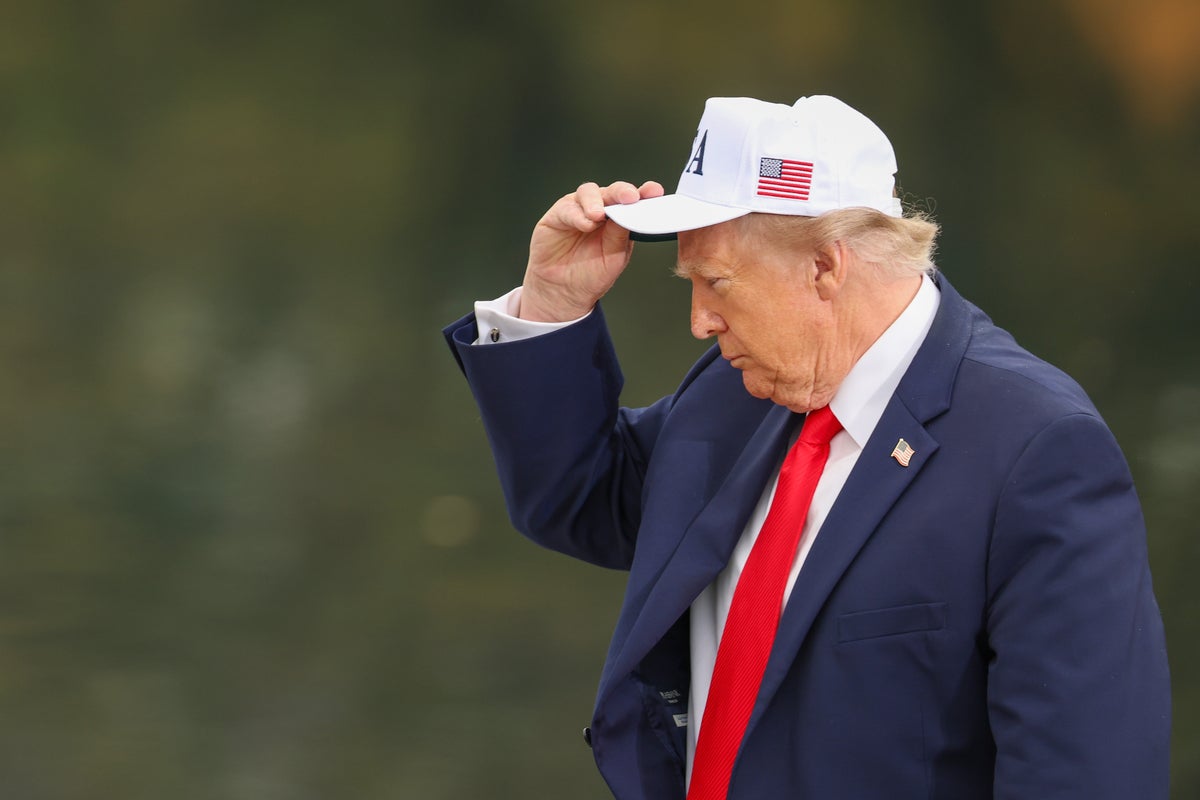
Trump’s midterm wipeout

WHILE YOU WERE SLEEPING: Donald Trump’s Republican Party suffered a night of crushing losses in the U.S. midterm elections as Democrats swept back to power in both branches of Congress, POLITICO’s global politics bureau chief Jack Blanchard writes from Washington.
Blue tsunami: Voters across America delivered a devastating verdict on the first two years of Trump 2.0, handing Republicans dramatic losses right across the electoral map. Dems secured the U.S. Senate and are poised to win the House of Representatives, where latest projections suggest they will hold a commanding majority.
FAFO: The result is nothing short of a catastrophe for Trump, who had urged voters to pretend he was on the ballot. The result can thus be seen as a referendum on his premiership — and the message from America was crystal clear. This was a GOP defeat of historic proportions, with Dems winning Senate races in states they haven’t won in decades, even Kansas.
Trump promised to bring down the cost of living, then launched a deeply unpopular war that sent gas prices through the roof. It really is as simple as that. But he wasn’t apologetic: “I wasn’t on the ballot — if I was on the ballot, we’d have won easily,” Trump told POLITICO’s Dasha Burns in a call to our livestreamed election night show. The decision to go to war in Iran, Trump told her, was “absolutely the correct one.”
Coming attractions: The president now faces two years of political deadlock in Washington, where he will have to cut deals with Democrats to get things done. He also faces two years of aggressive congressional inquiries into his administration as Democrats take control of powerful House and Senate committees. But get ready — because there’s surely a reaction brewing.
How will that impact Europe? Some seasoned observers think it’s not only possible that Trump takes out his frustration on the continent but highly likely. Yet a Democrat-controlled Congress could help to give Ukraine some more breathing space. Jamie Dettmer lays out five things European capitals need to monitor here. We’ll have more on what it means through the day, so stay tuned.
— Canada pledged €500 million for Ukraine, but Brussels says it’s not going into the pot of money everyone thought it was.
— An NGO that deals with homelessness has waded in to the spat over the Commission’s move north.
On today’s Brussels Playbook Podcast: Zoya and Sarah break down what the U.S. midterm results mean for Europe, NATO and Ukraine.
**A message from HEINEKEN: What does it take to build a more competitive Europe from the ground up? On 4 November, Beyond the Glass: Brewing Local Competitiveness will bring together policymakers, business and hospitality leaders to explore how long-term investment and strong local value chains can help Europe’s businesses and communities thrive.**
BRUSSELS GETS TO SET THE TABLE: After months of demanding a role in Ukraine talks, this afternoon Brussels hosts officials from Kyiv, NATO, the U.S. and the E3 powers — France, Germany and the U.K. — to discuss Ukraine’s reconstruction and prepare for next week’s peace talks with Russia in Abu Dhabi, three EU officials and diplomats told Nick Vinocur.
The meeting itself represents a win for the EU, which has long pushed for a presence in the negotiations — despite internal clashes about who should lead such discussions. “Europe must [have] and wants to play a role in this process,” German Chancellor Friedrich Merz said yesterday after meeting Ukraine’s President Volodymyr Zelenskyy in Berlin.
Now the EU not only has a seat — it’s providing the table for others to sit around. “Brussels is the right place to discuss Ukraine’s security guarantees and reconstruction,” said David McAllister, chair of the European Parliament’s foreign affairs committee.
The German conservative lawmaker, pointing out that the EU and its members are Ukraine’s “largest providers of economic, financial, humanitarian and military support,” argued that the meeting should deliver “concrete proposals” on how to shore up Ukraine’s economy in the longer term.
“It’s a very good initiative,” echoed Thijs Reuten, spokesperson on Ukraine for the center-left Socialists and Democrats group in the Parliament.
Guest list: For the European side, Bjoern Seibert, chief of staff to European Commission President Ursula von der Leyen, will represent the Commission, while Anna-Maria Boura — fresh from holding the pen on an EU-Canada joint declaration — will represent the European Council, according to two EU officials granted anonymity to discuss the sensitive negotiations. Neither the U.S. nor Ukraine has named its negotiators.
The huddle in Brussels hints at more positive dynamics between Washington and Brussels after weeks of Donald Trump appearing to side with Vladimir Putin by signing a deal to purchase Russian diesel and blasting Zelenskyy.
But the good vibes only go so far. The EU has rejected an idea floated by American negotiators, first reported by the Wall Street Journal, to restart European purchases of Russian gas via a pipeline through Ukraine. And Europeans are still fuming about U.S. envoy Steve Witkoff calling Putin a “humanitarian” — especially in the wake of strikes on an aid hub in southern Ukraine Monday that killed 31 people.
Resetting the clocks: “It’s about what Europe wants,” said the S&D’s Reuten. “It cannot be the case that we start a negotiation process based on the maximalist demands of one side and disregard the legitimate demands of the other. There needs to be a balance.”
EXCLUSIVE — ENLARGEMENT REPORT CARD: EU hopefuls get their grades today as Brussels unveils its annual enlargement package. And there’s bad news for Ukraine: Its membership bid is set to be effectively decoupled from that of Moldova, which is moving faster. Top marks, meanwhile, for Montenegro, which could sign an accession treaty as early as June 2027.
SLIMMING THE 2027 LEGISLATIVE AGENDA: The European Commission will today announce which initiatives it plans to drop next year as it prioritizes competitiveness, deregulation and economic security. My colleagues lay out the key initiatives in the Work Programme here.
Tech tax survives? While a stalled proposal for a tax on large tech companies made the “kill list” in a copy of the plan seen yesterday, Tax Commissioner Wopke Hoekstra is pushing to keep it off — and there is a good chance he’ll succeed, two Commission officials told Gregorio Sorgi. That’ll be good news for France, which is pushing Brussels to introduce the levy to generate fresh revenue in the EU’s next long-term budget.
PARLIAMENT HAS ENTERED THE CHAT: Want the latest on the political battles unfolding in the European Parliament? Join our new WhatsApp channel for intel and insights straight from reporter Max Griera’s notebook.
UNPACKING CANADA’S UKRAINE PLEDGE: When Mark Carney said Canada would contribute €500 million to Ukraine at the conclusion of the EU-Canada summit, EU officials wondered what he was talking about.
The Canadian PM presented it as his country’s “initial participation” in the EU’s Ukraine €90 billion support loan. But that cash has nothing to do with the €90 billion — and is instead money to help close Ukraine’s projected budget shortfall in 2027, a senior EU official told Zoya Sheftalovich. “We aren’t talking about the same money,” the official said.
Reminder: The EU last year agreed a €90 billion loan for Ukraine for 2026 and 2027, intended to cover about two-thirds of its funding needs. Other countries, including Canada and the U.K., were expected to provide the remaining third — although much of that money has yet to materialize. To join that loan, Ottawa first needs to agree financing terms with the EU, which it has yet to do (though Carney said it intends to).
Two pots: Ukraine has since said it needs an additional €70 billion in 2027, on top of the money that’s coming from the support loan, and the EU wants partners outside the bloc to contribute. The €500 million is a welcome start, but Brussels wants more from Canada, as well as from allies including Japan, the U.K. and Norway, per a Commission official granted anonymity to discuss negotiations around the funding.
Ottawa’s pledge of €500 million is “a concrete demonstration of our close cooperation and shared commitment to supporting Ukraine,” a Commission spokesperson told Playbook. “It also underscores the importance of international burden-sharing in addressing Ukraine’s substantial financing needs.”
Tight timeline: The Commission is preparing a proposal on Ukraine financing ahead of a Nov. 26 summit at which the EU’s long-term budget and Kyiv’s needs will be discussed, the senior EU official said, adding that Brussels wants clarity over its partners’ contributions ahead of that.
**Read the newsletter. Then read the room. This newsletter, and every other one we write, now has a second home in the new POLITICO app. Every name and story we mention links straight to the reporting behind it, so the story in paragraph three is one tap from everything behind it, and Pro subscribers can open the official it mentions, their record and their team. Every Playbook, from Washington to Brussels, London to Sacramento and Berlin to Canberra, sits side by side, alongside our podcasts and breaking alerts. Read it on the metro/tube, pick it up again at your desk, and keep the thread between what you read this morning and what happens next. Get the new app.**
The Eurogroup, the informal forum of eurozone finance ministers, said the deadline for nominations to replace Christine Lagarde as European Central Bank president is Nov. 6 … but who makes the final choice? Eurozone finance ministers will discuss the candidates at a meeting three days after that deadline and make a recommendation. But the ultimate decision will be taken by the European Council’s eurozone members. The leaders’ choice will be put to the ECB Governing Council and the European Parliament, which will give their opinions but can’t block the candidate from getting the job.
TALK TO PLAYBOOK: WhatsApp us on +32 491 050629 and listen from 7 a.m. to hear if we give you a shout-out.
SAFETY FEARS OR STIGMA? The head of an NGO dealing with homelessness has said Commission staff don’t want to relocate to the area near Gare du Nord because they might “encounter vulnerable homeless people on their way to and from work,” Mari Eccles reports.
Freek Spinnewijn, director at FEANTSA, wrote on LinkedIn that a recent intervention by a union representing EU staffers resisting the move north equated “street homelessness with disease, violence, and crime.”
The context: Cristiano Sebastiani, of the Renouveau et Démocratie EU staff union, wrote to Commission chiefs in September saying there was “serious concern” among EU agency staffers about the relocation. “The health, safety and security of staff must … remain a primary responsibility of the institution and be placed at the heart of any decision concerning their place of work,” he argued.
Among those leaving the EU Quarter are the European Education and Culture Executive Agency (EACEA) and the European Research Executive Agency, as well as some Commission lower management and admin staff.
“What I find unhelpful,” Spinnewijn told Playbook, “is the way vulnerable homeless people are implicitly pictured as a nuisance, a danger or a source of disease.” He added that the area already hosts the most offices in Brussels after the European Quarter. “Referring to the staff working there as second-class employees is a bit much, no?”
But, but, but … Sebastiani told Mari: “Had our communication been intended in any way to express a wish to avoid contact with homeless people, it would plainly have been reprehensible and unacceptable. That was not the case.” Employees he represents are “expatriate staff who work very late into the evening,” he said, pointing out that the entrance door of a building occupied by an EU agency “had previously been struck by a bullet.”
SPAIN’S TRANSPORT MINISTER QUITS: Óscar Puente, a close ally of Spanish Prime Minister Pedro Sánchez, resigned last night just over a week after the rail disaster that has shocked the country and overshadowed this month’s snap election.
SUPERMARKET CHAIN THAW MASSACRE: Two major cyberattacks on supermarkets in a matter of weeks have exposed the vulnerability of the EU’s critical infrastructure — and cyber experts say it may be part of Russia’s ongoing hybrid warfare against Europe.
BALKANS CALL FOR BACKUP: Montenegro and Albania are calling on NATO to send experts to fight Russian disinformation as Moscow ramps up social media campaigns targeting the two countries.
AI GETS ITS OWN EU SUMMIT: European Council President António Costa has sent invitations for the EU’s first leaders’ summit dedicated to artificial intelligence, set for next week. On the guest list: Mistral AI CEO Arthur Mensch to talk competitiveness and AI sovereignty, and AI pioneer Geoffrey Hinton to discuss risks to society, security and democracy.
JOB MOVE: Bart Szewczyk, formerly an attorney at Covington, is starting a new job as deputy head of policy planning in the Office of the Secretary-General of NATO.
SPOTTED: Swedish climate activist Greta Thunberg on the 92 tram, heading in the direction of Schaerbeek.
JOURNALISTS TAKE CENTER STAGE: If reading the news isn’t enough, tonight you can watch journalists perform it live. Live Magazine takes over BOZAR at 4 p.m. and 8 p.m., with journalists, photographers and filmmakers telling never-before-published stories through words, images and music. No recordings, no replays — miss it and it’s gone.
SOMETHING TO DO AFTER WORK: WIELS in Forest opens its doors, as it does on the first Wednesday of every month, for its Free Nocturne. There’s no charge for entry, though guided tours are €5. From 6 p.m. to 9 p.m.
TUNNEL VISION: Night owls and late commuters, beware: The Leonard Tunnel on Brussels’ R0 ring road will close in the direction of Waterloo from 9 p.m. until 5:30 a.m. Thursday for technical tests.
Berlin: Friedrich Merz is lunching with the women in the CDU/CSU parliamentary group as a decision on who should become Germany’s next federal president approaches.
Paris: Edouard Philippe is under growing pressure to accept a presidential primary to unite the right and center, as another poll put him behind Jean-Luc Mélenchon.
Madrid: Óscar Puente’s resignation as transport minister last night was met with relief among Socialists — but the opposition is still demanding accountability from PM Pedro Sánchez.
London: Andy Burnham is straddling a fine line at the Commonwealth Heads of Government Meeting in Antigua, moving toward a formal apology for the slave trade without offering reparations.
Read more from our Playbook family: Washington … Ottawa … Canberra.
**At 2 p.m. GMT / 3 p.m. CET POLITICO’s policy reporters and editors will unpack the EU-Canada Summit’s key outcomes, from AI and energy to critical minerals, and explore what closer cooperation could mean for Europe’s strategic autonomy and the wider policy landscape for U.K. organizations. Register now**
— The European Commission hosts talks on Ukraine with representatives from Ukraine, the U.S., France, Germany, the U.K., NATO and the World Bank.
— The Commission presents its 2026 Enlargement Package, its annual assessment of progress by countries seeking to join the EU. Press conference with High Representative Kaja Kallas and Enlargement Commissioner Marta Kos at 3 p.m. Watch live.
— The College of Commissioners meets in Brussels. Followed by a press conference on the European strategy on sustainable tourism; and a press conference on the 2027 Commission Work Programme and the 2026 annual overview report on simplification, implementation and enforcement. Watch live.
— Coreper II meets at 9 a.m. in Brussels.
— Commission Executive Vice President Teresa Ribera is in Madrid, where she meets Sergio Díaz-Granados, executive president of the Development Bank of Latin America, attends the opening ceremony of the Ibero-American Summit of Heads of State and Government and attends a dinner hosted by King Felipe VI and Queen Letizia.
— NATO Secretary-General Mark Rutte meets North Macedonia’s President Gordana Siljanovska-Davkova.
— Commission Executive Vice President Henna Virkkunen meets Ireland’s Justice, Home Affairs and Migration Minister Catherine Ardagh and delivers a keynote speech at the launch of the European Chip Design Platform.
— Humanitarian Aid Commissioner Hadja Lahbib meets Estonian Interior Minister Igor Taro and delivers the closing remarks at the Civil Protection Forum at 4:15 p.m. Watch here.
— Kallas meets Burkina Faso’s Foreign Minister Karamoko Jean-Marie Traoré in Brussels.
— Financial Services Commissioner Maria Luís Albuquerque receives Association of German Public Banks President Thomas Groß.
MEPs Virginijus Sinkevičius, Hanna Gronkiewicz-Waltz and Zsuzsanna Borvendég; former MEPs Agnes Jongerius and Traian Băsescu; ADPA’s Pierre Thibaudat; former Finnish PM Matti Vanhanen; former Australian PM Tony Abbott.
Playbook is brought to you by POLITICO’s EU Politics team: Gerardo Fortuna, Nicholas Vinocur, Gabriel Gavin, Zoya Sheftalovich, Max Griera, Mari Eccles, Hanne Cokelaere, Lucia Mackenzie, Gregorio Sorgi and Sebastian Starcevic. And: reporters Milena Wälde and Daria Zakharova, editors Alex Spence and James Panichi, and producers Dean Southwell and Hugh Kapernaros.
**A message from HEINEKEN: Europe’s competitiveness not only depends on emerging industries and innovation hubs, but also on the farms, breweries, supply chains, cafés, pubs and restaurants rooted in communities across the continent. At Beyond the Glass: Brewing Local Competitiveness on 4 November, HEINEKEN and POLITICO will bring together HEINEKEN Europe President Glenn Caton, MEP Tomáš Zdechovský, Sybren Fennema of Steward Redqueen and hospitality entrepreneur Pedro Ruiz Ocejo to discuss what it takes to support local businesses and strengthen Europe's competitiveness. Moderated by POLITICO’s Julia Wehrle, the discussion will examine what businesses need to keep investing, how hospitality contributes to prosperity and social connection, and how policymakers and industry can create practical, responsible conditions for long-term growth.**
SUBSCRIBE to the POLITICO newsletter family: Brussels Playbook | Brussels Playbook Capitals | London Playbook | London Playbook PM | Playbook Paris | Berlin Playbook | Madrid Playbook | Sunday Crunch | EU Influence | London Influence | D.C. Playbook | D.C. Influence | Decoded | Canada Playbook | POLITICO Forecast | Canberra Playbook | All our POLITICO Pro policy morning newsletters