
Trump welcomes Xi for a White House summit set to be high on pageantry, low on substance
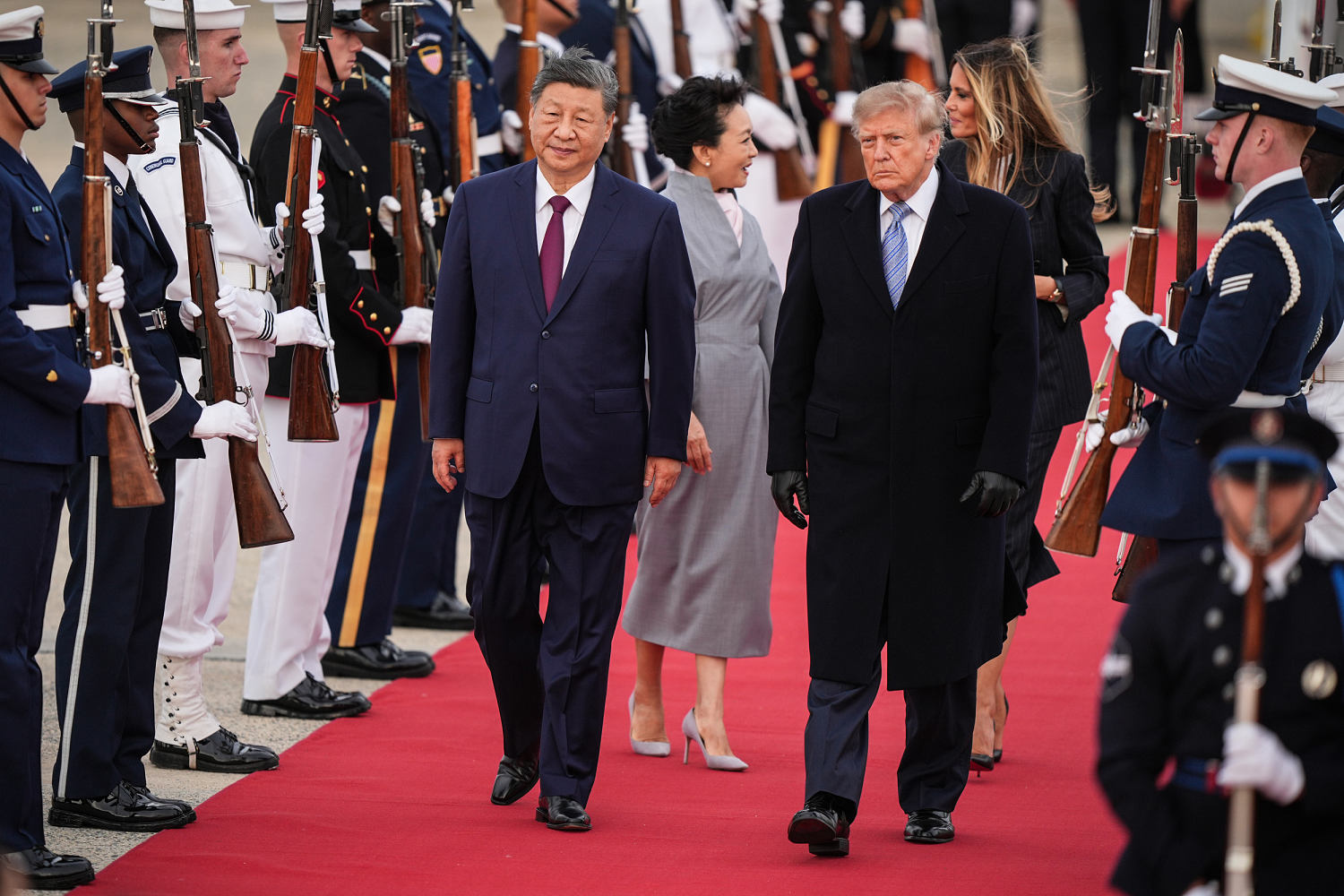
President Donald Trump and first lady Melania Trump greet Chinese President Xi Jinping and his wife Peng Liyuan as they arrive at Joint Base Andrews, Md., on Wednesday.Mark Schiefelbein / APShareAdd NBC News to GoogleSept. 23, 2026, 11:03 AM EDT / Updated Sept. 23, 2026, 4:49 PM EDTBy Jennifer Jett and Janis Mackey FrayerHONG KONG — President Donald Trump’s strong rapport with Xi Jinping is set to be on display in Washington this week as the Chinese leader makes his first U.S. state visit in more than a decade. But below the surface-level pageantry at the White House, little is likely to be resolved as the world’s two biggest economies continue to spar over trade, Taiwan, AI and more.
Since a trade war shook the global economy last year, U.S.-China relations have been at an effective standstill, experts say, buying both sides time to reinforce their strengths and address their vulnerabilities.
Trump, who usually meets with foreign leaders at the White House, will be on the tarmac to greet Xi and his wife, Peng Liyuan, when they arrive at Joint Base Andrews, Maryland, outside Washington on Wednesday, senior administration officials said.
Trump will be greeting Xi in a weaker position than when they last met four months ago, said Allen Carlson, an associate professor of government at Cornell University, as he faces mounting inflation, falling approval ratings, an unpopular war with Iran and a potentially disastrous midterm election result for his Republican Party.
That means even the main question at Thursday’s summit — whether to extend a fragile trade truce that Trump and Xi agreed to last fall — could end up being decided later. U.S. officials have indicated that the two sides may not be ready to extend the truce, which expires Nov. 10, amid disagreements over how long to prolong it.
Another key issue is artificial intelligence, which is increasingly at the center of U.S.-China competition. Warnings from American AI leaders that the technology could pose an existential threat have raised fears about the ability of the world’s two leading AI powers to work together to contain its potential dangers.
Treasury Secretary Scott Bessent said Sunday after preparatory talks with Chinese officials that the U.S. had proposed exchanging safety alerts with China for AI-related incidents that could affect national security. But experts say it’s unlikely that this week’s summit will produce any major security agreement on AI.
Add to GoogleBessent meets with Chinese official on AI safety01:48That leaves the focus on the White House visit itself, Xi’s first since 2015.
Trump, who has referred to the U.S. and China as the “G2,” often touts his personal relationship with his “good friend” Xi, and the two leaders appeared warm and friendly at their last meeting in Beijing in May.
“It was quite astounding to see the chemistry between those two. And it’ll be even more astounding when Xi comes to the White House,” said Orville Schell, the director of the Center on U.S.-China Relations at the Asia Society, a global nonprofit based in New York.
As he meets with Xi this week, Trump wants “the ability to declare victory, regardless of the substance,” Carlson said.
That has raised concerns about what Trump might offer Xi in exchange for a perceived win, particularly when it comes to the Beijing-claimed island of Taiwan. Trump has described a pending $14 billion U.S. arms package for Taiwan as a potential “negotiating chip” with Xi, who has ramped up military pressure on the self-ruling island democracy.
Ideally, China would like the U.S. to end Taiwan arms sales and express clear opposition to Taiwan independence. But “we’re realistic,” said Zhao Hai, vice president of the Chinese Institute of Hong Kong, a think tank that serves as a branch of the Chinese Academy of Social Sciences, a Chinese government research institution.
“So far, the outcome has been quite good for China, which is the pause on U.S. export of military equipment,” he said. “If we can extend that pause and even cancel some of the more offensive weaponry, that would be better.”
Writing Wednesday in the Chinese Communist Party’s official People’s Daily newspaper, China’s ambassador to the U.S., Xie Feng, said Taiwan was one of China’s “red lines” in any discussions with the U.S., along with human rights.
A senior administration official told NBC News that Trump will make a determination about a new Taiwan arms package “in a fairly short time.”
The official also noted that Trump approved $11.1 billion in arms sales to Taiwan in December, the largest arms package Taiwan has received.
Trump approved more arms sales to Taiwan during his first term than any other president in history, the official said.
U.S. flags hang in Taipei on Wednesday ahead of Trump's meeting with Xi.Daniel Ceng / Anadolu via Getty ImagesTrump’s comments on Taiwan have unnerved key U.S. allies in Asia who depend on Washington for security in the face of growing Chinese aggression. In a joint statement Monday, the U.S. reiterated its commitment to the defense of South Korea and Japan, and the three countries expressed support for Taiwan.
Xi has his own domestic problems, especially an economy weighed down by slowing growth, a property crisis and sluggish consumer spending. But on the international stage, Carlson said, he “doesn’t have to do anything to be in a stronger position because the American position keeps on eroding” as Trump alienates long-standing allies.
In the weeks leading up to his U.S. visit, Xi has had his busiest foreign travel schedule since before the pandemic, shoring up ties with countries from Kyrgyzstan to Egypt to India. His flurry of diplomacy comes as he tries to portray China as a more stabilizing global influence than the U.S., whose war against Iran has caused an international energy crisis.
The Iran war, now in its seventh month, has significantly depleted U.S. munitions — underscoring Washington’s dependence on Beijing, which has a near-monopoly on the rare-earth and critical minerals that are crucial for replenishing U.S. weapons stockpiles and is using it as leverage.
“The United States doesn’t hold all the cards — in fact, maybe not even the preponderance of the cards,” Schell told NBC News last month.
Schell, who was in Beijing for the May summit, said Trump, who campaigned on aggressive levies against China, has gone “from bullying mode into pander mode.” That reflects the “power shift” that has occurred between Beijing and Washington since Trump’s first term in office, he said.
“China has chokeholds now,” Schell said, citing rare earth minerals, electric vehicle technology and other strategic areas that Beijing dominates. “And I think Trump recognized that.”
White House spokeswoman Anna Kelly told NBC News that the Iran war had not significantly depleted U.S. munitions.
“The United States Military has more than enough munitions, ammo, and stockpiles to serve all of the Commander-in-Chief’s strategic goals and beyond,” she wrote in an email message.
Trump’s openness to diplomacy with Beijing is increasingly reflected in American public opinion. According to poll results released Monday by the Chicago Council on Global Affairs, more than half of Americans support cooperation and engagement with China, including 4 in 10 Republicans.
There remains strong unease, however, around Chinese investment in the U.S., particularly Trump’s suggestion that he would not oppose Chinese automakers’ building cars in the country. On Monday, more than two dozen Democratic lawmakers urged Trump to maintain a ban on Chinese automakers in the U.S. market, which their American rivals are pushing to tighten.
Members of the U.S. delegation during Trump's visit to Beijing in May. Alex Wong / Getty ImagesIt’s unclear whether Xi will be accompanied by business leaders as Trump was when he went to Beijing. On the U.S. side, Nvidia’s Jensen Huang and Apple’s Tim Cook, both of whom were in Beijing, are among the executives expected to attend a state dinner for Xi on Thursday.
Chinese companies are strongly interested in U.S. investment, Zhao said, and U.S. Trade Representative Jamieson Greer said Monday that China was making progress on its May pledge to buy 200 Boeing jets, the American plane maker’s first major Chinese deal in almost a decade. But little progress has been made on the board of trade and board of investment that Trump and Xi agreed to establish in May.
“It’s very unpredictable for Chinese investment at this point,” Zhao said. “So without a political guarantee, I don’t see there’s any potential of large-scale investment.”
Experts say Trump and Xi may feel less pressure to make major commitments at this week’s summit because they are set to meet two more times this year: once in November when China hosts the Asia-Pacific Economic Cooperation summit, and again in December when the U.S. hosts the Group of 20 summit.
“I think best-case scenario is it’s a blip,” Carlson said, “and we move on, and the broader sort of issues that both countries are confronting continue to unfold.”
Jennifer Jett reported from Hong Kong and Janis Mackey Frayer from Beijing.
Jennifer Jett is the Asia Digital Editor for NBC News, based in Hong Kong.
Janis Mackey FrayerJanis Mackey Frayer is a Beijing-based correspondent for NBC News.


