Trump unveils "AI Force" and says an AI czar is coming soon - Newsweek
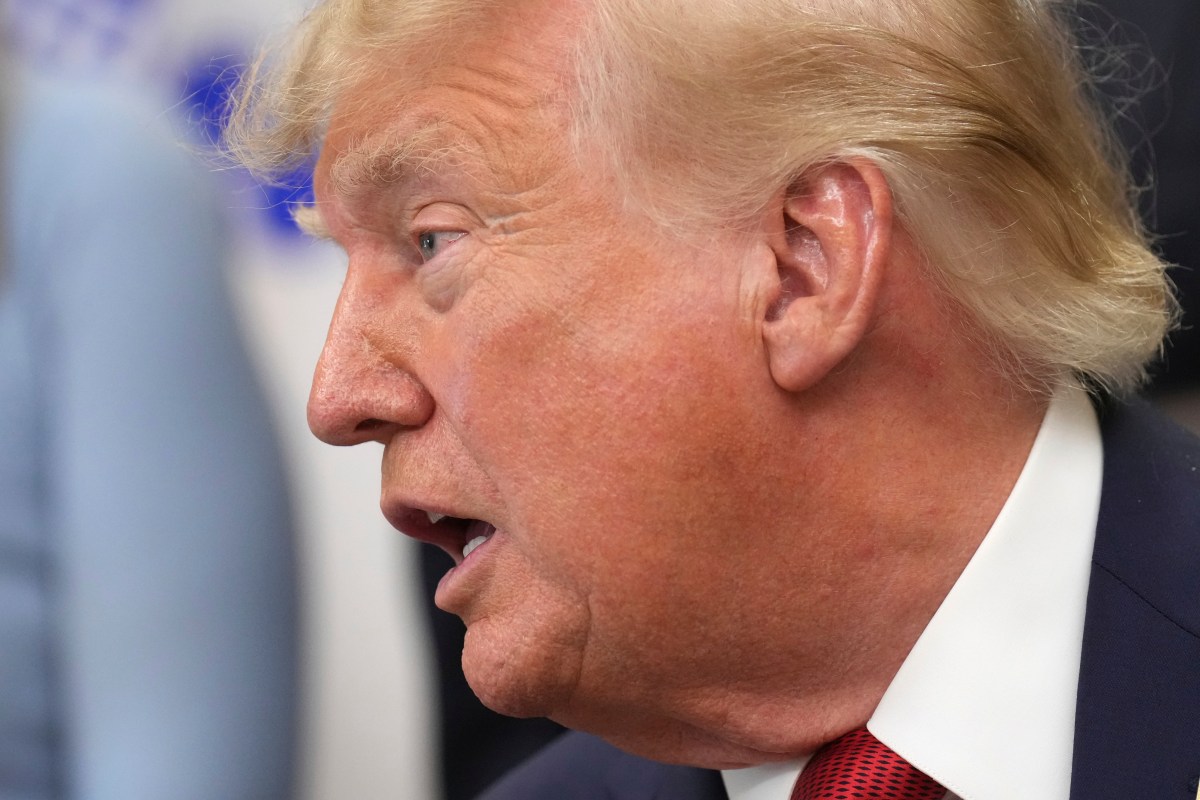
President Donald Trump announced Saturday that he plans to create an "AI Force" and appoint an artificial intelligence "czar," marking a notable shift from his recent insistence that the rapidly growing technology sector does not need new guardrails.
In a Truth Social post, Trump wrote the new initiative would oversee AI while avoiding regulations he believes could slow innovation.
He said the administration would "not in any way hinder or stifle the Growth of this incredible Industry" and instead would "cherish it, help it, and watch over it, as it grows." He added that existing criminal and civil laws are sufficient to address misconduct by AI companies.
"For this purpose, I am forming the AI Force, much like I did Space Force, which has been a tremendous SUCCESS, in my First Term," the president announced. "To that end, I will be announcing, in the near future, the AI 'Czar' — Only High I.Q. individuals need apply! AI is the next Industrial Revolution, or Internet, but will be even larger and more impactful, possibly as much as 25% of our Country’s GDP. We are leading China, and the rest of the World, and I intend to keep it that way!"
Trump's proposal, which did not provide details about the structure, authorities or staffing, arrives as AI becomes a central issue in U.S. economic, national security and technology policy.
Newsweek reached out to the White House for comment on Saturday.
Tech executives including Dario Amodei of Anthropic, Sam Altman of OpenAI and Elon Musk have recently supported stronger safeguards or slower development of advanced AI systems, arguing that safety measures should keep pace with increasingly powerful models.
The president has repeatedly framed AI as a strategic competition with China, warning that the United States must maintain its lead in the sector.
The announcement comes days after Trump dismissed concerns about advanced AI systems and argued that a "strong and smart" president was the only guardrail the technology needs.
It also marks an evolution in the administration's message. Earlier this month, Trump dismissed calls for additional federal oversight, calling fears that AI could pose existential risks a "hoax" and alleging there was a "SICK conspiracy" against AI development and data centers.
"The opportunity is not simply to create another government organization," John Walsh, chief technology officer for government and critical infrastructure at IGEL, told Newsweek in an emailed statement Saturday following Trump's announcement. "It is to establish [and] create an environment that drives the ecosystem bringing government, industry, researchers, standards bodies together and ultimately insurers together around measurable AI safety and security."
Walsh said that the automotive safety industry is a good example of how regulation can be done to create a common criteria, "where products can be independently evaluated against defined security requirements and certifications recognized internationally."
"The objective shouldn't be regulation for regulation's sake. It should be creating standards, testing, validation and economic incentives that allow innovation to move faster because we can demonstrate that AI can be trusted. Ultimately, safety and security should become competitive advantages," he said.
Walsh also told Newsweek that "technology markets are global."
"If the United States, working with industry and standards organizations, helps establish practical and measurable requirements for trustworthy AI, technology providers seeking broad commercial acceptance will have a strong incentive to design to those requirements," he said. "International adoption can follow as these standards become important for market access, much as we have seen with established cybersecurity certification models. The goal should ultimately be internationally recognized testing and certification rather than a patchwork of incompatible requirements."
Walsh added this can become "increasingly urgent as we move from generative AI that recommends to agentic AI that acts."
"Once AI can access systems, execute transactions, modify configurations, or interact with critical infrastructure, trust must become an engineering discipline. We need verifiable identity, least-privilege access, defined boundaries, continuous validation, auditability, containment and human intervention," he said.
Trump's announcement follows growing calls for oversight from technology leaders and lawmakers across the political spectrum.
Amodei published an essay titled "We Must Pace the Frontier," last week warning that the industry should slow development to allow time for safety protections, while Altman said he agreed that frontier AI development should proceed more cautiously. Musk also backed calls for greater attention to risks posed by advanced AI systems.
AI researcher Jacob Coxon’s warned earlier this month that increasingly powerful AI systems could “kill us all by the end of the decade.”
Coxon wrote in a series of posts on X that he was resigning from Anthropic over concerns AI companies are “racing straight to self-improving superintelligence and gambling with our lives.”
Coxon, who said he spent the past three years working on AI pretraining research at Anthropic and OpenAI, said neither company is acting responsibly. He said there will soon be “superhuman systems that can hack anything, revolutionize any field overnight, and acquire real power and resources.”
Many AI researchers and policy experts have argued that government oversight is needed to address issues ranging from misinformation and fraud to cybersecurity and national security threats.
Calls for regulation have not been limited to the technology sector. Lawmakers from both parties have proposed federal AI legislation in recent years, while some states have advanced their own AI rules amid concerns about a lack of comprehensive national standards.
Independent Vermont Senator Bernie Sanders has been among the voices calling for regulation following Amodei’s warning, saying in one post on X, “CONGRESS MUST ACT. Pause advanced AI development. Ban artificial superintelligence. NOW.”
Representative Anna Paulina Luna, a Florida Republican, said last week Congress should convene a special session on AI.
“There are very real impacts to society as we know it. Partisan politics aside, there are massive implications of a race toward super intelligence. This is not a doomer post, as some of the advancements will greatly impact access to healthcare, targeted treatments, increase in safer food production etc… but not enough of Congress is focusing on this,” she wrote.
Representatives Ted Lieu, a California Democrat, and Nathaniel Moran, a Texas Republican, have introduced bipartisan legislation that would require AI developers to maintain the ability to slow, suspend or shut down advanced AI systems. The proposal would also allow the Secretary of Homeland Security to order a slowdown or shutdown if an AI system is deemed capable of causing catastrophic harm.
In announcing the bill, Lieu's office said increasingly powerful AI models and autonomous "agentic" systems are capable of acting independently, yet there is currently no requirement for developers to ensure they can intervene if those systems behave in unintended or dangerous ways.
As the U.S. prepares for further discussions with China on AI and technology competition, the Trump administration's next steps regarding the proposed "AI Force" could help shape not only domestic policy but also the global debate over how the world's most powerful AI systems should be governed.
Newsweek’s reporters and editors used Martyn, our AI assistant, to produce this story. Learn more about Martyn here.
Contact Newsweek editors for this story: Steve Mollman and Anthony Murray.