Trump to Campaign in Nebraska as GOP Faces Close Senate Race in Red State - Newsweek
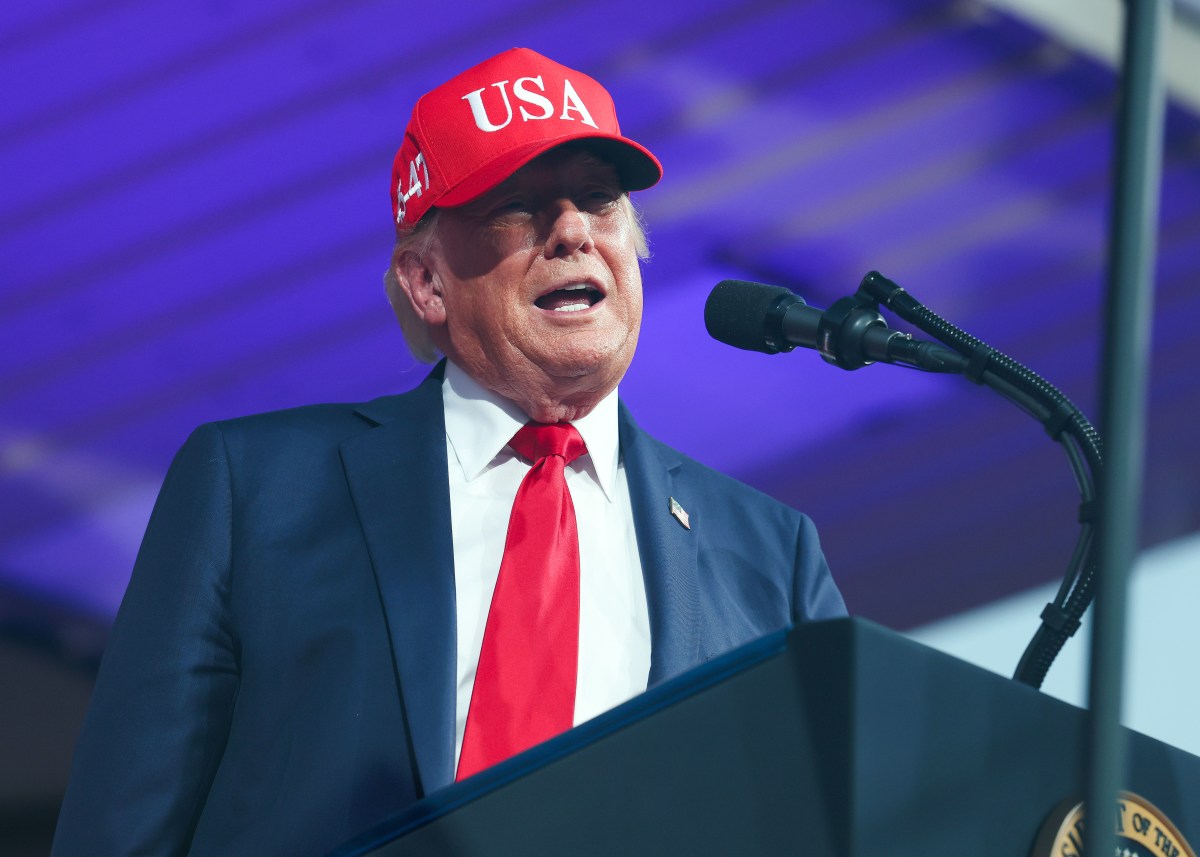
President Donald Trump is campaigning in Nebraska next week, as Republican Senator Pete Ricketts faces a competitive challenge from independent Dan Osborn in the traditionally conservative state.
Nebraska backed Trump by more than 20 points in the 2024 election, so it is not the kind of state that would ordinarily be seen as competitive. But the race is viewed as tighter than the GOP would like ahead of November's midterm elections.
Osborn, a labor leader who has said he would not caucus with either party if elected, is viewed as a uniquely strong candidate after his showing in the 2024 Senate race against Republican Senator Deb Fischer. His 7-point loss was seen as an overperformance given the state’s Republican voting record and Trump’s significant victory on the same ticket.
Republicans are also facing tougher headwinds this year, as Trump’s national approval rating has fallen due to voter frustration with the economy, cost of living and gas prices as a result of the continuing war with Iran. Historically, when the president is unpopular, his party suffers losses in the midterms, and Democrats have sought to make this year's elections a referendum on Trump.
Trump is set to campaign in Grand Island on Monday.
Republican National Committee spokesperson Natalie Baldassarre told Newsweek the president “looks forward to rallying in support of Senator Pete Ricketts, a proven business leader and public servant who will always put Nebraskans first.”
She noted that Trump “will be barnstorming the country ahead of the midterms.”
The rally is set to be held at Nebraska State Fair's Pinnacle Bank Expo Center, and doors will open at 2:30 p.m., according to The Omaha World Herald. Trump is expected to speak at about 6 p.m., the newspaper reported.
It comes as Republicans try to avert losses in the midterms, as polling suggests their majorities in the House and Senate are at risk. An Osborn victory in Nebraska would complicate their path to holding onto the majority, so the GOP is working to motivate their base to ensure Ricketts holds onto the seat.
Newsweek reached out to the Ricketts campaign for comment via email.
The rally could help Ricketts “energize the Republican base and motivate them to go out and vote,” Kevin Smith, a political scientist at the University of Nebraska-Lincoln, told Newsweek on Tuesday.
The fact that Trump is in Nebraska campaigning for an incumbent conservative member of the GOP is “perhaps a sign of a tough electoral environment for Republicans,” he said.
“A Republican running in a ruby red state like Nebraska should be a layup, not something that requires an all-hands-on-deck push by party leaders to secure the win.”
The rally is the second recently announced event for Trump in a solidly conservative state. He is also set to appear in Durant, Oklahoma, on October 1. Oklahoma is even more conservative than Nebraska, giving Trump a 34-point victory in 2024.
During a news conference on Tuesday, Senate Majority Leader John Thune, a South Dakota Republican, was asked how Trump campaigning in Republican areas is “helpful” for the party.
“I think that the president and his team, as they look at the electoral map, are figuring out where they think he can make the biggest difference,” he said. “Obviously, all across the country, we need the president to turn out voters that are his voters.”
He said there are “a lot” of voters who may not be inclined to vote in the midterms, and that Trump rallying in red states could help turn them out.
Osborn responded to the announcement in a statement to Newsweek, saying that Ricketts is “begging the party bosses to come save this election for him.
“In 2024 the president campaigned on no forever wars, standing up to China, lowering the cost of groceries, and securing the border. I’m still running on that same platform two years later. Ricketts has abandoned those principles,” he wrote.
Polling of the Nebraska Senate race is limited, and most of the public surveys are Osborn internals.
A SurveyUSA poll gave Osborn a 4-point lead, 46 percent to 42 percent, with 4 percent preferring another candidate and 7 percent being undecided. It surveyed 503 likely voters September 8-13.
Osborn and Ricketts were tied in a recent poll from Impact Research, a Democratic polling firm. They each received 47 percent support in the poll, which surveyed 600 likely voters August 9-13.
A Tavern Research poll from May showed Osborn with a 5-point lead over Ricketts, 47 percent to 42 percent. It surveyed 1,165 likely voters May 8-11 and had a margin of error of ±3.5 percentage points.
There is no Democratic candidate in the race. Democrats in the state have largely coalesced around Osborn’s candidacy.
Smith said the race is more competitive than he expected it to be.
“Osborn was always expected to perform decently given his result against Fischer, but the massive party registration advantage for Republicans would have made anyone reluctant to bet against Ricketts six or seven months ago,” he said. “If those polls are in the ballpark, though, this is certainly closer than I expected and Osborn’s chances as a dark horse seem more real with every poll that's come out.”
Ricketts, a former governor, was appointed to the seat after former Senator Ben Sasse resigned to become president of the University of Florida in 2023. He won a special election in 2024 and is now seeking a full term.
Nebraska’s Second Congressional District is one of the most closely watched House races of the midterms and could be a bellwether for how the nation votes as a whole. The district, based around Omaha, is represented by Republican Don Bacon, though it narrowly backed Vice President Kamala Harris in 2024. Bacon is retiring, leaving open a key seat.
Democrat Denise Powell, co-founder of the group Women Who Run, is running against Republican Brinker Harding, an Omaha city council member. The SurveyUSA poll gave Powell a 4-point lead, 46 percent to 42 percent. The Cook Political Report classifies it as Lean Democratic.
Nebraska’s First District, which backed Trump by 13 points, has also garnered some national attention. Republican Representative Mike Flood is facing a challenge from Democrat Chris Backemeyer, who served as the deputy assistant secretary of state during the Biden administration.
That race is considered Solid Republican by Cook, which noted that it would "take a combination of high turnout in Lincoln and anemic turnout in the surrounding rural counties for Flood to have another competitive race."
Smith said that Flood is a “pro and a good politician” who has a “long and respected track record at the state as well as national levels.”
“I still think he's in the drivers seat in that race, but I'm getting the sense this is going to be a more competitive race than it has been in the past,” he said.
Osborn has cast himself as a true independent who aligns with neither party on all issues. He told CNN in August that if elected, he does not plan to caucus with either party.
“I plan on remaining an independent,” he said.
However, Republicans have sought to cast doubt on his independence. They have pointed to past remarks made by Osborn, including that Trump’s wall along the U.S.-Mexico border is a “symbol of racism,” to tie him to Democrats, who are not popular in the state.
“Democrat Dan Osborn is a grifter who wants to raise taxes on Nebraska families and work with the radical left to open our borders. Nebraskans will reject Osborn again,” National Republican Senatorial Committee regional press secretary Nick Puglia said in a statement in July.
Osborn faces a tough climb in Nebraska, where Republicans hold a substantial advantage on the voter rolls.
As of September, there were 619,984 registered Republicans and 327,935 registered Democrats across Nebraska. There were only 282,473 people who are nonpartisan and 28,277 Nebraskans registered with other parties, according to registration numbers from the Nebraska Secretary of State's Office.
The state backed Trump in all three of his presidential runs, though his margins were narrower than Republican victories earlier in the century.
Trump won Nebraska by just over 20 points in 2024 after winning it by 19 points in 2020 and 25 in 2016. The state also voted for Republicans by 22 points in 2012, 15 points in 2008, 33 points in 2004 and 29 points in 2000. Democrats haven’t carried the state presidentially since 1964.
Nebraska’s vast, rural regions keep the state Republican, despite a few blue dots in cities such as Omaha and Lincoln.
Issues such as rising diesel prices and Trump’s plan to import foreign beef could be shaping the Senate race in Nebraska, which has a large agricultural industry.
“The Nebraska cattlemen were not happy about the beef imports, and high fuel costs and their connection to the war in Iran is a bipartisan concern,” Smith said.
Nebraska’s Senate race is going to be closely watched as both parties compete for control of the Senate. Republicans currently hold a 53-47 majority, so Democrats must flip four seats to secure a majority because Vice President JD Vance would serve as the tiebreaker in a 50-50 Senate.
An Osborn victory in Nebraska would make it easier for them to flip Congress' upper chamber by denying Republicans a seat in a solidly conservative state.
Contact Newsweek editors on this story: Samantha Beech and Dave Siminoff.