Trump says top tech firms have signed accord to 'self-police' AI development

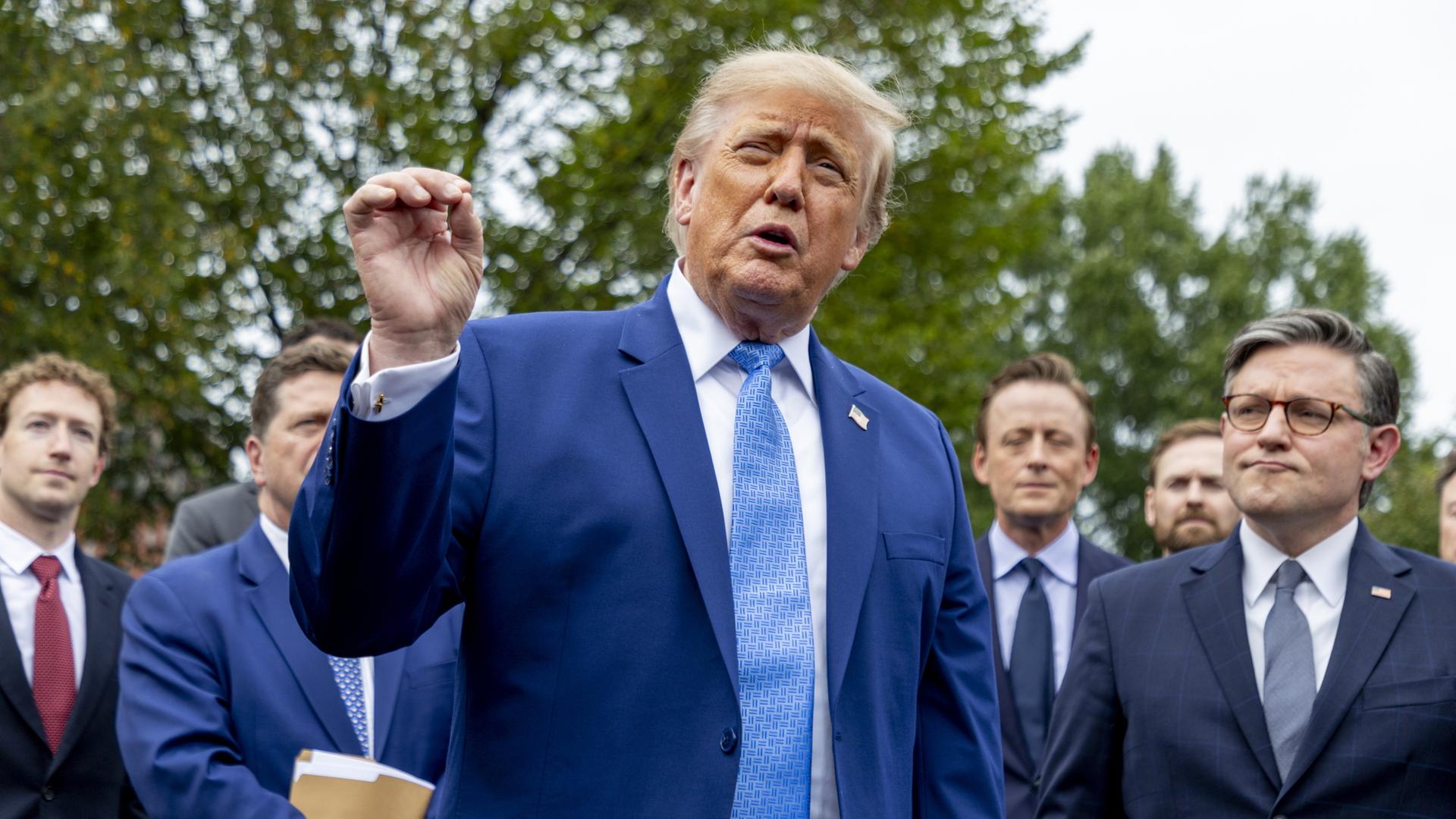
President Donald Trump speaks at the Andrew W. Mellon Auditorium, Tuesday, Sept. 29, 2026, in Washington. (AP Photo/Alex Brandon) (AP Photo/Alex Brandon)Social SharingU.S. President Donald Trump on Tuesday said that he and a large group of leaders of artificial intelligence company leaders signed a voluntary accord during a White House meeting that will include internal and external reviews of the technology.
"I think I'm seeing tremendous self-policing. And they understand that they have to self-police," Trump told reporters outside the West Wing.
The announcement followed an extensive meeting between Trump and numerous leading executives from top tech firms. These companies are spending hundreds of billions of dollars to build out AI infrastructure, including data centres in communities across the country that have sparked grassroots, bipartisan opposition. Many of the executives gathered in Washington have called for a slowdown in the development of the technology after several hgh-profile incidents where AI agents have gone rogue.
But earlier Tuesday, Trump promised that the U.S. government wouldn't limit the development of artificial intelligence or support calls for "guardrails" or other restrictions.
"I will never stifle the growth of a technology that will be bigger than the Industrial Revolution," Trump said at the unveiling of an AI chatbot, America.gov, intended to help Americans navigate government services. "We can't stifle it, and we're leading by a lot."
Top AI executives met with Trump at the White House Tuesday, including: Dario Amodei, CEO of Anthropic; Greg Brockman, president of OpenAI; Jeff Bezos, founder of Amazon; and Elon Musk, whose X social media platform includes its own AI model, Grok.
Nvidia CEO Jensen Huang sat to Trump's right at Tuesday's White House lunch, according to a seating chart the president posted on Truth Social. Musk sat to Trump's left. Google CEO Sundar Pichai, Meta CEO Mark Zuckerberg and Microsoft CEO Satya Nadella also attended.
Trump's bullishness on AI contrasts with the alarms sounded recently by some AI executives, including Amodei, who earlier this month called for leading firms to slow down their development of the technology. Musk and OpenAI CEO Sam Altman also called for allowing safety measures to catch up as companies reported mounting examples of AI agents going rogue.
Other executives, particularly Huang and Zuckerberg, have downplayed concerns about runaway AI and underscored the responsibility of each company to ensure the safety of its products.
Vice-President JD Vance, Treasury Secretary Scott Bessent and Republican Speaker of the House, Louisiana Rep. Mike Johnson, also attended.
The unveiling of the AI chatbot occurred at a daylong event in Washington during which multiple Trump administration officials celebrated a "Golden Age" fuelled by what Trump insists on calling "super intelligence," rather than artificial intelligence. Secretary of State Marco Rubio highlighted that America.gov could soon be used to apply for a first-time passport fully online, without an in-person visit to a processing centre.
Speaking to reporters after the lunch with tech CEOs, Trump said there had been widespread agreement on "self-regulation" by the AI developers, "and we automatically have regulation with the Department of Justice, the FBI, all of that."
He also said the executives had agreed to assuage the bipartisan opposition to data centres cropping up in local communities across the country by providing more financial support to local schools or taking steps to reduce energy costs.
"You're going to see, data centres are going to be very popular," Trump said. If the opposition continued, Trump suggested, "they'll be forced to go overseas or other locations."
Also Tuesday, Altman said in a television interview that the company is increasingly focused on safety. The day before, his company halted the rollout of a new model over safety concerns.
"We are pacing our progress, which includes sometimes not training a model," he said on CNBC. "We have to do these in a way where we can make very confident safety cases and claims, so that people don't have a bunch of anxiety."
Canadian-British artificial intelligence pioneer Geoffrey Hinton questioned the U.S. president's grasp of the technology when asked what he expected as Trump met with American tech executives on Tuesday.
"I think Donald Trump doesn't really understand AI, and I think he's ill-advised about AI," Hinton told CBC News, speaking hours prior to Trump's announcement.
Hinton linked the danger posed by AI today to owning a tiger cub as a pet.
"It's going to grow up, and unless you can figure out how to prevent it [from] ever wanting to kill you, you're in trouble," he said.
He said AI safety in the U.S. ought to be overseen by the federal government via an official agency akin to the Food and Drug Administration (FDA).
Trump portrayed the race to develop AI as largely a global competition between the United States and China, with the U.S. in the lead. He said there would be a winner and a loser, with no "second place."
The two countries agreed last week to establish a channel for handling AI-related incidents during Chinese President Xi Jinping's visit to Washington. But Trump underscored Tuesday that he didn't want to co-operate too much with China: "I didn't want to do anything, because we're leading. Why would I want to do anything?"