Trump and GOP See Reversal With Latinos in 2 Strongholds Ahead of Midterms - Newsweek
Hispanic voters in South Texas and South Florida are showing signs of moving away from President Donald Trump and the Republican Party, just five weeks before the midterm elections.
The two regions were key to Trump's gains with Latino voters in 2024, when he made major inroads in heavily Hispanic areas of both states. Now, Republican-held House seats in South Texas and South Florida are becoming more competitive, while the Texas U.S. Senate race has also tightened.
For Democrats, the shift has raised hopes of winning a statewide election in Texas for the first time since 1994.
The Cook Political Report, widely considered the industry standard for nonpartisan race ratings, moved three Florida House races and three Texas House races toward Democrats, including Texas' 9th Congressional District, which had long been considered solidly Republican.
While the two electorates are different, political strategists who track Latino voters told Newsweek they are responding to many of the same concerns.
A survey of Hispanic likely voters in Texas conducted for the Cook Political Report and TelevisaUnivision found Trump's job approval at 33 percent, two years after he carried Texas Hispanics by 10 percentage points. Republican Senator Ted Cruz won the group by 3 points in 2024.
Texas state Representative James Talarico, the Democratic Senate nominee, leads Republican Texas Attorney General Ken Paxton 63 percent to 30 percent among Hispanic voters, including 73 percent of self-described independents. In the governor's race, Democratic state Representative Gina Hinojosa leads Republican Governor Greg Abbott 60 percent to 33 percent. Abbott won 40 percent of Hispanics in 2022.
Much of the movement comes from Trump voters. Eighteen percent of Texas Hispanics who backed him in 2024 disapprove of his performance, 19 percent support Talarico over Paxton and 22 percent do not back a Republican in a generic House matchup.
Mike Madrid, a longtime Republican strategist and author of The Latino Century, said Washington misread what happened in 2024.
"People, I think, broadly are failing to understand that the Latino vote is the largest swing vote in America," Madrid told Newsweek. "Most people were thinking it was part of this permanent realignment. A lot of people who understand the Latino vote were saying it's not that at all."
Immigration enforcement is also a drag. Nearly two-thirds of respondents said they would be less likely to vote for a candidate who supports Trump's deportation policy, and 61 percent view Immigration and Customs Enforcement unfavorably. Voters still ranked the economy as their top concern by roughly 2-to-1 over immigration.
Every public poll of the race conducted in September has shown Talarico ahead, most within the margin of error.
Newsweek reached out to the Paxton and Talarico campaigns for comment Monday.
On September 25, Cook moved three Texas House races toward Democrats: the 15th District from Lean Republican to Toss-Up, the 35th from Likely Republican to Lean Republican, and the 9th from Solid Republican to Likely Republican.
Only the 15th is in the Rio Grande Valley, though Cook's poll also sampled voters in the Democratic-held 28th and 34th districts, both of which Texas Republicans redrew last year to make them more favorable to the GOP.
But the pressure is visible there. Bobby Pulido, a Tejano singer with two Latin Grammy Awards and broad name recognition across South Texas, is challenging Republican Representative Monica De La Cruz in a district Trump won by 18 points in 2024. A Texas Southern University poll puts Pulido ahead 50 percent to 45 percent.
Madrid, who recently traveled to South Texas, said voters there described specific grievances. He pointed to the administration's moves on Argentine beef in a region built on ranching.
"This is cattle-ranching country," he said. "He's literally poking the stick in the eye of fifth-generation Hispanic cattle ranchers. It's not like an academic discussion or a debate. He's directly attacking their businesses."
In the 28th District, Democratic Representative Henry Cuellar faces Tano Tijerina, a Webb County judge who switched from Democrat to Republican and won the GOP primary decisively. Trump won the district by 10 points under the new map. Cook rated the race Lean Democratic after Trump's pardon in December 2025 ended the federal bribery case against Cuellar. Coverage in recent months has focused on the race tightening, with Trump criticizing Cuellar while openly backing Tijerina.
The 34th District, which covers the Brownsville-McAllen area, is also roughly Trump +10 under the new lines. There, Democratic Representative Vicente Gonzalez faces Republican Eric Flores, a former assistant U.S. attorney. No independent general-election poll of the race has been published. An NRCC poll in late April had Flores ahead 41 percent to 40 percent, and a mid-June Ragnar Research poll had him up 44 percent to 41 percent. Cook and Sabato's Crystal Ball rate it a Toss-Up.
If any place has rewarded the Republican Party, and Trump in particular, for courting Hispanic voters, it is South Florida.
In 2016, Hillary Clinton won Miami-Dade County by 29 points. Four years later, Joe Biden carried it by just 7. In 2024, Trump became the first Republican presidential candidate since 1988 to win the county, where roughly 71 percent of the 2.8 million residents are Hispanic. He beat Kamala Harris there by 11 points, and an NBC exit poll found that he won 58 percent of the Latino vote statewide.
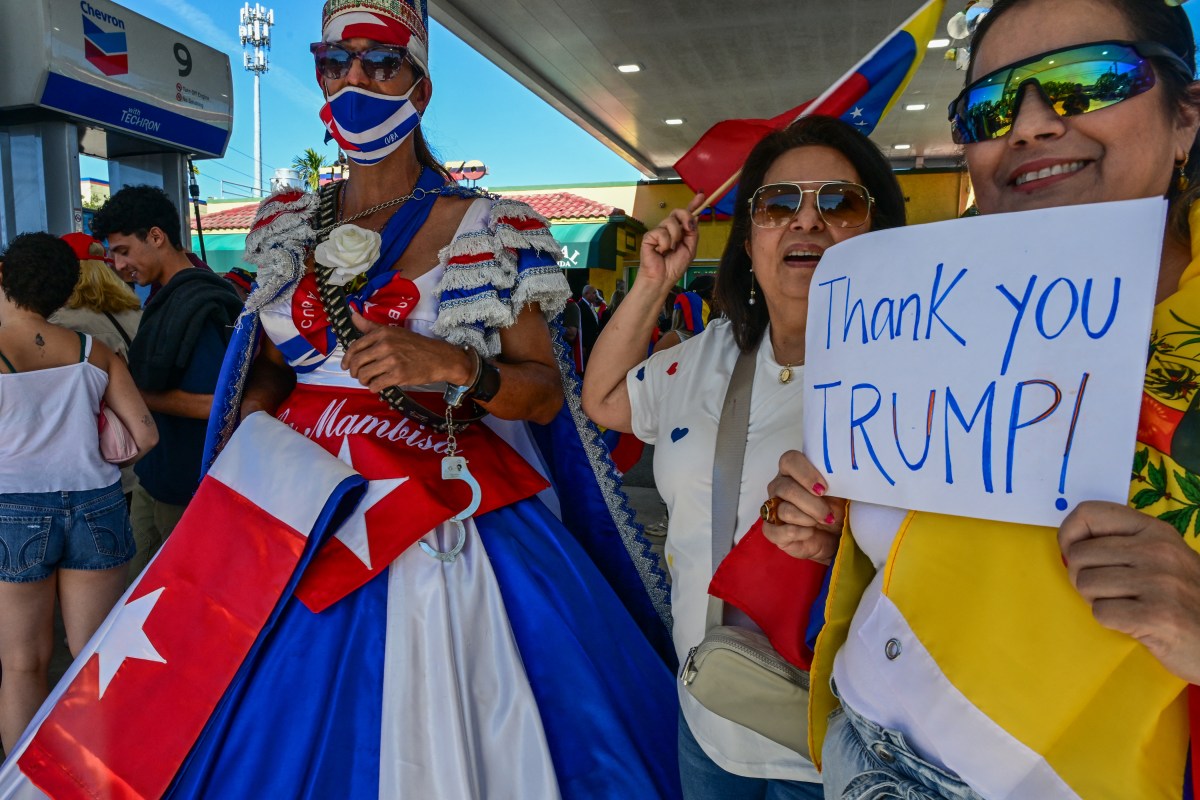
The shift was built largely on Cuban and Venezuelan American voters, many of whom fled leftist governments and have long seen the GOP as their political home. Those are the voters Republicans now risk losing.
On September 25, Cook moved three Florida House races toward Democrats: the 27th and 13th districts from Likely Republican to Lean Republican, and the 22nd from Lean Republican to Toss-Up.
Republican Representative Maria Elvira Salazar's 27th District, which covers Miami, Coral Gables, Palmetto Bay and Cutler Bay, is the one most tied to Latino voters. Almost three in four residents are Latino. Cook cited recent polls and a Hispanic backlash against the Trump administration that it said forced Salazar to play defense.
The race has escalated in recent days. After Salazar's ad criticizing Trump's immigration enforcement, the president shared at least 14 posts from other users attacking her on Truth Social. She has not directly responded to his weekend posts. Newsweek reached out to Salazar for comment Monday.
An internal poll for her Democratic challenger, former CBS Miami anchor Eliott Rodriguez, found the two tied at 45 percent once undecided voters were asked. The same survey found Trump 10 points underwater in the district, with 54 percent disapproving of his job performance. Forty-four percent said Salazar deserves reelection, and 47 percent said they would prefer someone new. The poll was conducted by Bendixen & Amandi International, which works for Rodriguez's campaign.
Eduardo Gamarra, a political science professor at Florida International University who publishes a weekly tracking report on the Latino vote in Florida, told Newsweek that his report had flagged Salazar's district as competitive for the first time this cycle.
"I live there. I'm already seeing a lot more negative commentary about her online than I was a week ago," he said.
The newly drawn 22nd District stretches across parts of western Broward and Palm Beach counties and includes Hendry and Collier counties. The old district backed Trump 55 percent to 44 percent in 2024 after voting for Joe Biden 51 percent to 48 percent in 2020. Democrat Pia Dandiya is running against Republican Casey Askar.
In the Tampa Bay-area 13th District, Democrat Leela Gray leads Republican Representative Anna Paulina Luna 51 percent to 46 percent in a House Majority PAC poll conducted by Hart Research Associates. An internal poll conducted for Luna by Fabrizio, Lee & Associates in August showed her leading by 8 points, a sign of how much the race has shifted in recent polling.
Other surveys point the same direction. A Pew Research Center survey in April found that 66 percent of Latino Trump voters approve of his job performance, down 27 percentage points since the start of his second term in January 2025. A New York Times/Siena poll conducted September 8-13 places Trump's approval among Hispanic voters at 26 percent.
In Texas, a separate UnidosUS poll found that 54 percent of Latino voters surveyed across five competitive districts planned to support the Democratic candidate, compared with 27 percent for the Republican.
The same polls carry warnings for Democrats. Texas Hispanic voters in the Cook survey preferred Republican messaging on transgender athletes over a progressive alternative by more than 20 points, though few named it as a top issue. In Florida, the UnidosUS poll found that dissatisfaction with Trump is not translating into support for Democratic candidates in the two marquee races on the statewide ballot.
Among Hispanic voters in Florida, Republican Senator Ashley Moody led Democratic state Representative Angie Nixon 40 percent to 32 percent, while in the governor's race, Republican Representative Byron Donalds led Democrat David Jolly, a former GOP congressman, 40 percent to 33 percent. More than one-quarter of respondents were undecided in each race.
"This is 100 percent about the Republicans," Madrid told Newsweek. "Not that the Democrats are doing anything right. It's that the Republicans are doing everything wrong."
Contact Newsweek editors on this story: Jason Lemon and Dave Siminoff.