Transcript: Rep. Ro Khanna on "Face the Nation with Margaret Brennan," Sept. 20, 2026
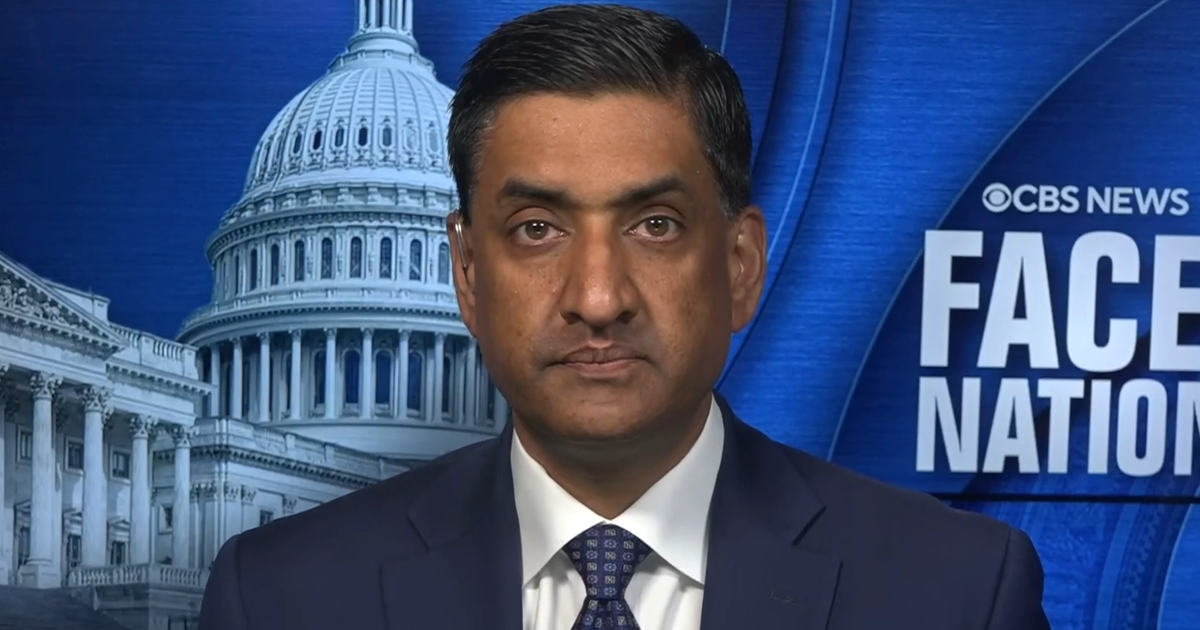
The following is the transcript of the interview with Rep. Ro Khanna, Democrat of California, that aired on "Face the Nation with Margaret Brennan" on Sept. 20, 2026.
MARGARET BRENNAN: We begin today with California Congressman Ro Khanna, who is the top Democrat on the Select Committee on the Chinese Communist Party, and he joins us from Fremont. Good morning to you, Congressman.
REPRESENTATIVE RO KHANNA: Good morning, Margaret.
MARGARET BRENNAN: So China and the U.S. are in an arms race. You've proposed this idea that Chinese AI firms should cooperate with American companies. You sent letters to DeepSeek, Alibaba, other firms, urging them to follow the lead of the American firms like OpenAI and Anthropic to slow the rate of AI advancement until society develops guardrails, as you put it. Have any of these Chinese firms responded to your proposal?
REP. RO KHANNA: They have not. Winning an AI war is like winning a nuclear war. It is catastrophic for civilization. And what we have asked is that they agree to some basic terms. Look, there are two dangers to AI: either the loss of control or misuse, and the Chinese firms have taken no actions on either of them.
MARGARET BRENNAN: Well, I'm looking at what the FBI, the NSA, and Homeland Security, their division CISA, they have all warned that China-based AI companies are targeting and copying American artificial intelligence at what they describe as an industrial scale. So, how can you ask competitors to collaborate? Isn't it inherently at odds if they're stealing technology?
REP. RO KHANNA: Well, they're right that they are engaging in distillation. Basically, they are copying American models. That's one reason, frankly, to regulate American models because they're copying them. Some of the safeguards would protect the world, but at the same time, we also need an international agreement with Xi Jinping to have basic standards. That should include international monitoring, it should include checks through the data centers where you can tell whether a model is being used for inference or training, and it should use enforceable and verifiable tools. Now, obviously, you can't just trust the Chinese, but like any agreement, like an arms control agreement, as Reagan said, you need to trust and verify. And the world has done this before. There's no reason we can't do it when it comes to AI.
MARGARET BRENNAN: Well, I'm looking at Bloomberg's figures. They report China is preparing to spend about $300 billion over the next five years to build data centers across that country, which will be operated by state-owned firms. As you know, there's really no wall between the state and industry in China. So, when you are acknowledging they commit human rights abuses and their AI firms help the state to commit those abuses, aren't you asking the CEOs to- to do something that's at odds with what Xi Jinping is- is seeking to do?
REP. RO KHANNA: Well, the first ask is of Trump and Xi Jinping to come up with an international agreement, and two of the core principles should be one: banning any self-improving AI, recursive self-improving AI. That's basically AI that continues to improve itself, and where we could lose control. The second is to have safeguards so that AI can't be misused by people for biological nuclear weapons. The letters to the Chinese companies were simply seeking information about what they're doing. It wasn't intended as a solution. What it was intended to do was highlight the need for the Chinese government and the U.S. government to come to an agreement, and that needs to be the first agenda item on the Trump-Xi Jinping summit.
MARGARET BRENNAN: Well, we know it's going to come up. We just don't know the details of exactly what it is the U.S. is proposing at all. We're going to watch for that in this next week-long set of meetings with China. You sit on the Armed Services Committee. Yesterday, President Trump posted on social media that his plan is to create an AI czar and form the "AI Force, much like I did the Space Force." I'm not exactly sure where he's going with that, but you yourself have called for a new government agency to be set up to deal with AI. So you both seem to agree that the existing infrastructure isn't enough. Why can't you just have Cyber Command handle all of this? What does the executive branch or Congress actually have to do?
REP. RO KHANNA: Well, we need to set up an AI agency like the FDA. I mean, I don't know what Trump- President Trump's vision is. I don't know if he's using AI in an offensive capability, which would give me a lot of pause, especially because when you have things like the shooting of the Iranian school, where you had AI information basically feed something into a- into a general, and then you had pro-forma sign off. That gives me concern. What I'm talking about is what Geoffrey Hinton, the godfather of AI, has said, which is that this can be regulated like we regulate nuclear energy, electricity, aviation, have independent technical experts make sure AI is safe. And Margaret, one of the things that really annoys me is when you have these tech CEOs out there saying, "Oh, this is too complicated. People in Washington don't understand this." Give me a break. We have regulated very complex things. We know we can appoint independent, smart people from universities. This is not complicated. We need to have an independent federal agency.
MARGARET BRENNAN: Well, respectfully, Congressman, Congress hasn't regulated a lot of things or come forward with much legislation of late. But to put that aside, I take your broader point. I want to ask you about another important topic at this meeting with Xi Jinping and President Trump, and that is the fate of Americans who do business or travel to China. Secretary Rubio has designated 2 U.S. citizens as wrongfully detained by China, and one of them is your constituent, scholar Min Zin. He has been held for 100 days now by the Ministry of State Security without access to a lawyer, he has no court date, and I spoke with his wife on Friday. Take a listen.
SYLVIA ZIN: He's been charged with endangering national security, and that's all we know.
MARGARET BRENNAN: That's a big charge.
SYLVIA ZIN: It's a huge charge. It's a, you know my daughter looked it up, and she, I think that really freaked her out. That's when she was like, "What is going to happen to Dad?" You know, and yeah, it's- it's a shock, right? I mean, he's a scholar, he's an academic, he's not a spy.
MARGARET BRENNAN: What did you think when the U.S. government explained to you this charge?
SYLVIA ZIN: That was what I asked. Like, what does that mean? You know, and they like we don't have more information. This is all we've been told.
MARGARET BRENNAN: When the U.S. government says that the safety of Americans is their highest priority, do you believe that?
SYLVIA ZIN: Well, President has brought home over 100 wrongfully detained Americans home, right? So, I'm hoping my husband is the next one.
MARGARET BRENNAN: Now, this scholar was disappeared shortly after he landed to a conference he was invited to. A lot of Americans go to China to conduct business. What are you and others in the government doing to help those who are detained when they're doing work there?
REP. RO KHANNA: Well, it's appalling, and while I have my disagreements with Secretary Rubio, in this I stand in complete solidarity with him, as does the China Committee. We cannot have American citizens or scholars in America be detained or disappeared because of what they say. And when I was in China about a year ago, we raised this issue not on this specific case, but we had heard cases of Chinese students in the United States who were not being allowed to continue because they may have engaged in some protest or had an errant social media tweet. We had heard cases of people who were detained, business leaders or people doing business because they disagreed with the Chinese government, and that is unacceptable to the United States. And then, of course, there's the whole situation with the Uyghurs. We just had a hearing last week on the Uyghurs situation, extraordinary human rights abuses, and we need that to be front and center in this meeting as well.
MARGARET BRENNAN: Congressman Khanna, we thank you for your time today.