
Through the Eyes of Alf Kumalo — Soweto, 16 June 1976 - IOL
A memorial in photographs — marking fifty years since the children of Soweto changed the history of South Africa.
On the morning of 16 June 1976, students poured out of Morris Isaacson, Naledi, Phefeni and a dozen other schools. They walked in their thousands toward Orlando Stadium, raising placards against the imposition of Afrikaans as the language of instruction. They were children. The youngest were ten.
Students on the march to Orlando Stadium, June 1976.
The placards were hand-cut from cardboard. The slogans were written in marker, in chalk, in pen. Bantu Education was the law that designed Black schools to produce labourers — Hendrik Verwoerd had said so himself. The children of Soweto refused to inherit it.
Children of Soweto with a placard reading "Destroy Bantu Education".
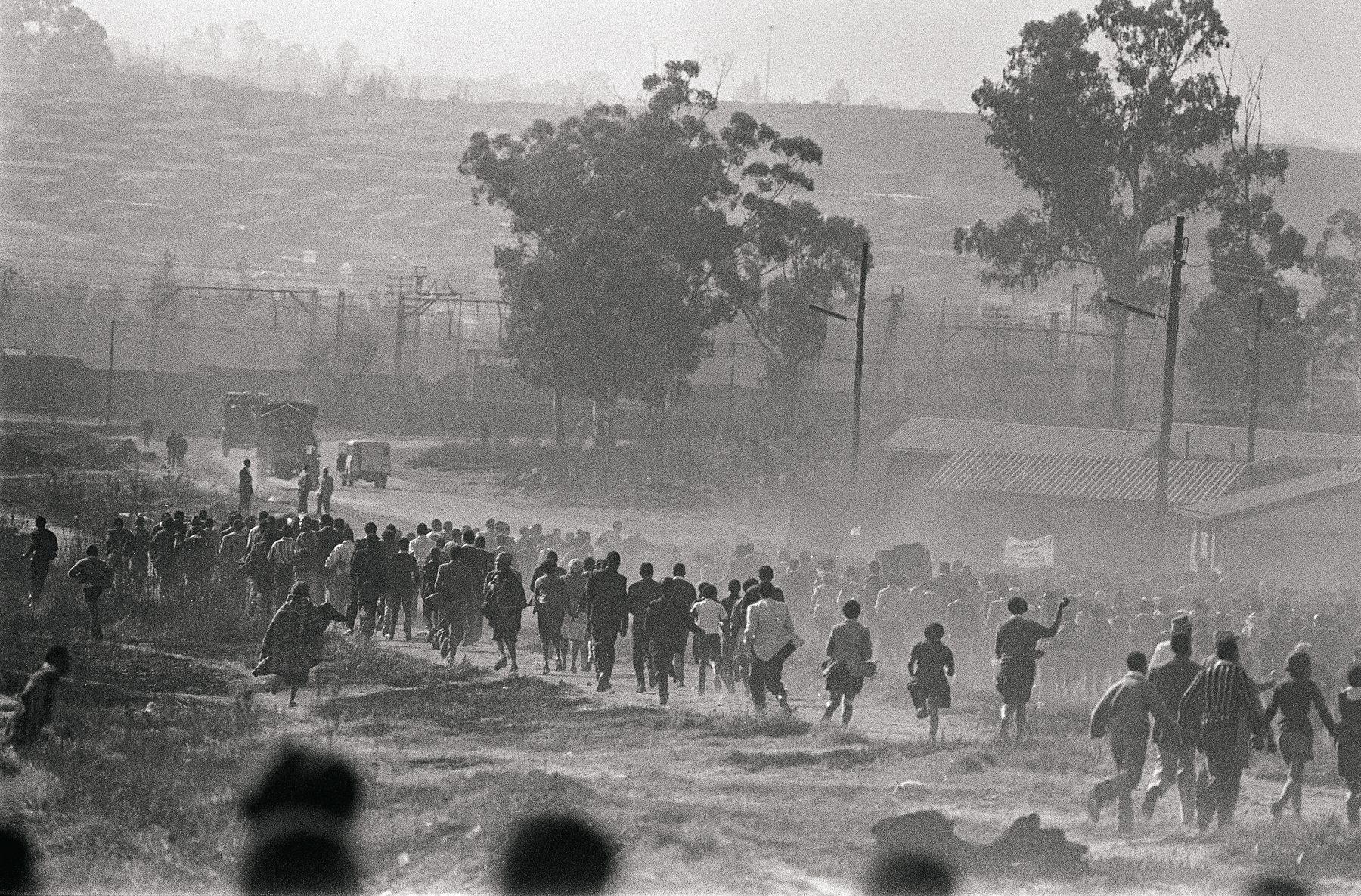
The police arrived. They threw teargas first. Then they fired into the crowd. Adult activists ran with the children — labourers, mothers, neighbours, everyone who had heard the shots. Soweto was not a place that ran from its own.
Residents scatter as teargas permeates the air near Mzimhlope Hostel.
Alf Kumalo carried his cameras through it. As a Black photographer, he could not be everywhere the white press could; he could also be in places they could not. He hid film canisters in his socks. He kept walking.
A Soweto resident runs from the toxic smell of teargas, 1976.
Beerhalls burned. Government buildings burned. The dead were being counted, and the count was wrong — the official toll was a fraction of the real one. Across Soweto, sixteen burned through into seventeen, and the fires were still alight.
Children look on as Khwezi Station, Soweto, goes up in smoke.
A delivery truck was blackened next to the police station. A single soldier in camouflage watching it burn. Kumalo composed the frame the way he composed all of them — with patience, even in chaos. He believed the photograph had to outlive the night.
A burning truck next to Moroka Police Station conveys the mood of the era.
Two days on, the Cape Times went to press. Twenty-one buildings were destroyed by fire. Latest official toll: twenty-nine dead, two hundred and twenty-four injured. The real numbers would not be known for years. The Minister of police told Parliament that the death toll had risen. The stock market, the paper noted on its lower fold, was taking the riots calmly. The page is not a Kumalo photograph. It is what his photographs had, by then, made impossible to ignore.
The Cape Times, Friday 18 June 1976 — "Soweto violence spreads". — Independent Newspapers Archive
Kumalo took this photograph from the rear window of a car. The Sunday Times' own drivers had refused to enter Soweto — "it was too dangerous," he said. The orders to the police were to "shoot and kill anyone, even photographers." The Times never published the image in his lifetime. An editor told the BBC he had been "unlucky" — that he had no good pictures. He had this one.
Dead lie before an army vehicle near Mzimhlope, days after June 16. Photographed by Alf Kumalo from the rear window of a car.
After June, the youth filled every bus for every funeral. They sat on the roofs. They hung from the doors. The state had killed their schoolmates and the answer was not silence — the answer was visibility, mass, presence, song. The struggle had a new generation now, and it had decided.
Students hanging from buses on the way to funerals and demonstrations, late 1970s.
August 19, 1963 — June 16, 1976. Twelve years old. Kumalo returned to the grave often. He photographed this woman — herself wounded in the uprising, herself in a wheelchair — laying flowers. The headstone reads: deeply mourned by his parents, sisters, and a nation that remembers.
A woman injured during the Soweto uprising pays respect at the grave of Hector Pieterson.
Tsietsi Mashinini and Khotso Seathlholo led the Soweto Students' Representative Council. The state put up posters for them — dead or alive. They crossed the border. Kumalo found them in Botswana and made this photograph: two boys, fists raised, laughing. They were nineteen and eighteen.
Tsietsi Mashinini and Khotso Seathlholo, student leaders, share a light-hearted moment in exile in Botswana.
The route the children of Soweto walked on 16 June 1976.
Kumalo became famous for his coverage of the resistance to apartheid that swept South Africa, and especially Soweto, where he lived for most of his life.
He described how he would sometimes take a single shot on a roll of film before hiding the canister in his socks — or elsewhere on his body — to protect it from the police. He risked his life to ensure that the story would be told. Sometimes the censors won; the pictures sat in drawers for decades. Sometimes they reached the world. Either way, he kept the negatives.
He photographed Mandela, Ali, Tutu, Sisulu. He photographed boys with cardboard placards. He photographed his own neighbours fleeing the only place they had to go. There is a way of seeing that does not flinch and does not perform — that is patient, dignified, and unblinking. That is what Kumalo had.
These eleven photographs are not all that he made in 1976. They are a beginning.

