
The site of India’s maiden gold: Between a bench and baseball cage - The Indian Express
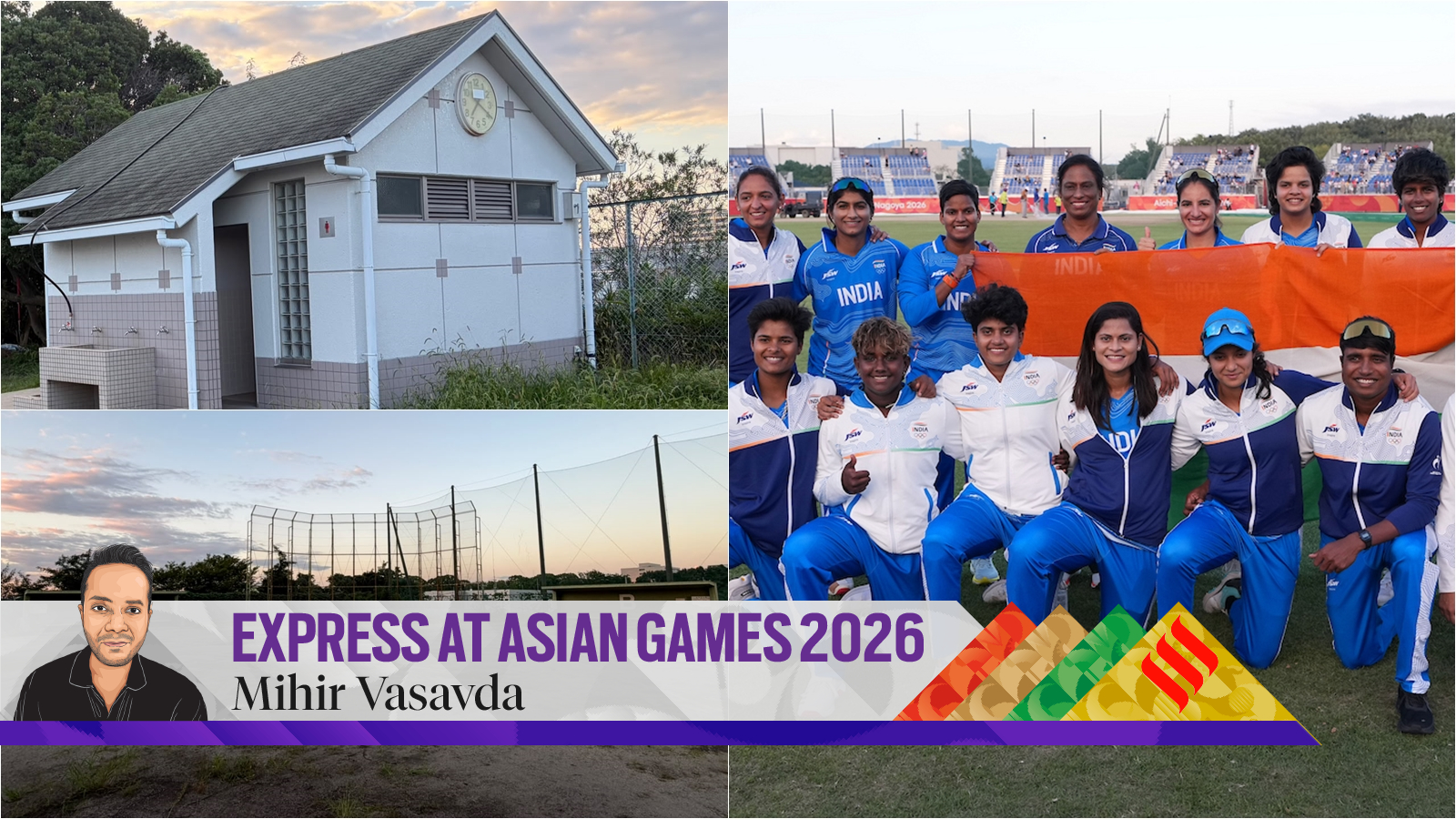
There is a toilet, a bench and a baseball cage, the only permanent structures. And then there is the cricket pitch — the latest addition.
Korogi Athletic Park is almost too open, too green, too tranquil to be an international sporting venue. Even Harmanpreet Kaur, the India captain, knew this was a nation hardly associated with cricket. “But knowing Japan, we knew they would manage something,” she said.
They had managed something that looked quite a lot like a quaint English county ground.
On Tuesday afternoon, in this unlikely setting in the middle of a public park in Nisshin, on the outskirts of Nagoya, India won the first gold medal of its Asian Games campaign. They beat Sri Lanka by 147 runs, so comprehensively that the suspense had disappeared long before the celebrations.
When the celebrations finally came, Radha Yadav and Renuka Thakur started sprinting towards the middle with the Indian flag. Then they slowed to a walk, almost as if they had realised there was no need to hurry. The final had been so one-sided that even the celebration seemed to have time to spare.
But the people watching did not seem to mind.
A Sri Lankan family had driven for a couple of hours from Nara to be here. There were Indians from England, on holiday in Seoul, who had made their way to Nisshin to watch India play.
And then there were the Japanese. For many of them, this was their first cricket match. “I have come to watch because my daughter has married a Sri Lankan man,” said one spectator. An elderly couple, Naofumi and Chisato, had seen children practice baseball hits here, and came for cricket just out of curiosity. “We know nothing about it,” Naofumi said.
They had been handed a beginner’s guide in Japanese explaining the rules and were repeatedly looking down at them, then back at the field, trying to make sense of what had just happened. A wicket, a boundary, a change of bowler — moments that require no explanation to a cricket audience were being learnt in real time.
Mimi Hirayama, the public announcer, was helping them along. “Mainly rules, because the Japanese audience is not familiar with this sport,” Hirayama said. “But they are very familiar with baseball. So I’ll keep giving them my hints to understand what’s going on.” So a six became a home run. “And when the batter hits four, it’s like a three-base hit or something like that,” Hirayama said.
It was an ingenious way of introducing cricket to an audience that already understood another bat-and-ball sport.
Hirayama could make the comparisons because she had spent many years in England and was familiar with cricket. Before the Games, she also watched matches involving India and other countries to learn more about the sport.
For a few hours, then, Korogi contained several different versions of cricket fandom at once: Indians celebrating, Sri Lankans supporting their team, an overseas diaspora making an unexpected detour, and Japanese spectators discovering the game through baseball.
It was an unusual scene for a ground that, until recently, was not a cricket ground at all.
Korogi is a public ground that has facilities for baseball, tennis and football, which is where the teams trained, too. When cricket was added to the Asian Games programme at the last minute, Indian Olympic Association president PT Usha said she helped finalise this geound as the venue. And so, the baseball ground was converted for the Games between September last year and March 2026. The 305 million yen (approximately Rs 18 crore) project involved relaying 14,984 square metres of grass, installing practice nets and building an equipment store. It hosted six matches of the ICC Men’s T20 World Cup East Asia-Pacific Qualifier in May as its first major test.
Now it has hosted an Asian Games final — and India’s first gold of these Games.
Harmanpreet said the only adjustment the team had to make was playing on the hybrid pitches. “But we knew how the pitch would behave because recently in England, we played on hybrid pitches too. The other facilities weren’t of top level but they managed it pretty well, she added.
Once the flags come down, Nisshin mayor Hiroki Kondo said the cricket will continue. “This is the second ground in Japan after Sano. After the Asian Games we will continue playing cricket here along with baseball,” Kondo said.
It might not be much, but Hirayama hopes it will be just enough to keep the link with the sport alive. “I hope many people here in Japan, who have found this sport exciting and think they will enjoy it enough to play,” Hirayama said. “So I hope this ground will also be used for cricket in the future.”
Soon, Jasprit Bumrah and India’s men will walk out onto the same strip. And, somewhere between the baseball cage and the toilet, cricket has found a place to stay.
Over the course of a 18-year-long career, Mihir Vasavda has covered 2010 FIFA World Cup; the London 2012, Tokyo 2020 and Paris 2024 Olympic Games; Asian Games in 2014 and 2022; Commonwealth Games in 2010 and 2018; Hockey World Cups in 2018 and 2023 and the 2023 ODI Cricket World Cup. ... Read More
Stay updated with the latest sports news across Cricket, Football, Chess, and more. Catch all the action with real-time live cricket score updates and in-depth coverage of ongoing matches.
