The paranoia of another China? Why US is targeting India with policies, tariffs
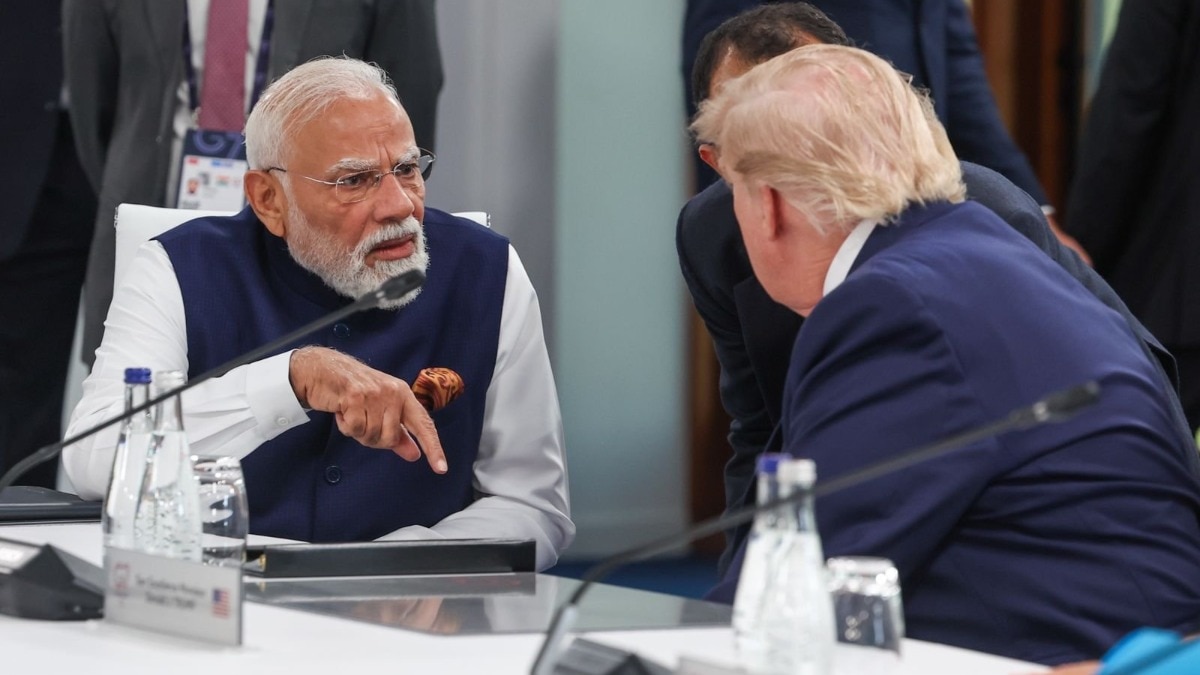
Exactly 25 years ago, in September 2001, the then-George W Bush administration lifted a series of American sanctions that Washington had imposed on India back in 1998. Those particular sanctions had been imposed after India became a full-fledged nuclear power via Operation Pokhran-II. Twenty-five years later, Washington is once again poised to impose a punishing set of sanctions on India, this time, for purchasing Russian crude.
In an exceptionally rare show of bipartisan support, the US House of Representatives (the lower house of the US Congress) on Thursday passed the Lindsey O Graham Sanctioning Russia and Iran Act of 2026. It had already cleared the US Senate (the upper house).
On September 19, President Donald Trump signed the bill, which puts countries, including India, at the risk of a 100% tariff.
While the sanctions bill, at least on paper, gives the President the authority to impose tariffs of up to 100% on countries that continue buying Russian oil and gas, it is quite clear that two countries in particular are in focus. Those are China and India, the largest importers of Russian energy.
As US Senator and Democrat Richard Blumenthal put it, "For China and India, it would be better if you improve your performance. Buy your oil and gas from somewhere else."
While it is yet unsure if these tariffs will succeed in getting India to cut imports of Russian crude, it risks chilling ties between Washington and India.
Following the bill's passage, India's Ministry of External Affairs released a statement saying that the issue "which had been discussed at high levels in recent months", risks carrying what it described as "potential implications" for the "bilateral relationship." Writing on X, author and foreign policy expert Michael Kugelman was more direct, stating "In a year-plus of big blows to US-India ties, the new Russia sanctions bill may be the biggest yet."
In 1998, India was hit with targeted sanctions for pursuing its ambition of becoming a nuclear power. In 2026, however, it faces the prospect of blanket tariffs for something far more mundane, importing a large share of its energy needs, particularly crude oil, from Russia.
The question therefore is: why is the Trump administration targeting India?
One of the prime reasons, as experts suggest, is that the US might be trying to prevent India from becoming another China, another Asian giant capable of competing with the US on the global stage.A CHINA MISTAKE THAT THE US WANTS TO AVOID WITH INDIA?
That the US is following a policy to ensure that India does not become another China, is hardly a secret. During a visit to India in March, US Deputy Secretary of State Christopher Landau had stated, "India should understand that we're not going to make the same mistakes with India that we made with China 20 years ago."
"We're going to let you be able to develop all these markets, and then the next thing we know, you're beating us in a lot of commercial things," he said.
So what's the mistake the US made with China?
From the 1970s, when Washington-Beijing ties entered a thawing phase, successive administrations, starting from Richard Nixon, patronised China in the form of preferential market access, investments, educational exchanges, technology transfers among others. And starting from the 1990s, American firms increasingly offshored most of their manufacturing to Chinese shores.
The numbers show how Washington's bet transformed China. In 1980, China's Gross Domestic Product (GDP) stood at $191 billion, barely 7% of the US economy, which then stood at $2.86 trillion. Cut to 2025, China's GDP now stands at $19.5 trillion, compared to the US' $30.8 trillion, according to data from the World Bank.
The transformation was even more pronounced in the field of manufacturing. Data from the United Nations Industrial Development Organisation shows that China's share of global manufacturing rose from 3% in 1990 to 31.8% in 2023. Over roughly the same period, the US share fell from 23.6% in 1995 to 15% in 2023.
As a May 2026 report in The Diplomat put it, "Washington's faith in globalisation allowed Beijing to hollow out the American industrial base, sustained by the expectation that a wealthier China would naturally turn democratic and support global stability."
That faith was misplaced. China became an economic superpower, but failed to liberalise domestically. As The Diplomat put it, China instead became the "most formidable economic and political adversary the US has ever faced, all while eroding the West’s capacity to respond."
This may explain the current American policy of imposing heavy tariffs on India. Once bitten, twice shy, it wants a pliant partner in New Delhi which would align with Washington's interests, instead of asserting itself like Beijing.WHY SUCH AMERICAN POLICY WON'T WORK WITH INDIA
In many ways, the US expects its allies to be, if not subservient, at least amenable to its demands. Take, for instance, the North Atlantic Treaty Organisation (Nato). Although it is a military alliance comprising European and North American countries, it is the US that wields ultimate military authority within the alliance. The position of Supreme Allied Commander Europe (SACEUR), Nato's top military command, has been held by an American four-star general or flag officer since the alliance was founded.
Such an approach, however, is unlikely to work with India.
New Delhi’s foreign policy has long prioritised its own national interests over aligning itself exclusively with any foreign power. This has allowed India to purchase American-made helicopters, French-made fighter jets, Russian crude (which accounted for nearly 52% of India's total crude imports in July 2026) and Chinese electronics, depending on its strategic and economic needs.
This policy of strategic autonomy, partnering with different countries to advance its own interests, was reflected in a post on X by India's Ambassador to the US, Vinay Mohan Kwatra, on Thursday. Making the case for India's energy choices, Kwatra said that "energy is a vital strategic necessity for 1.4 billion Indians and a foundation of our development." He said India's choices are guided by "availability, affordability, market conditions and commercial viability."
Kwatra argued that this approach had become particularly important during periods of global instability. "When recent conflicts squeezed global supplies, India acted decisively to protect its people from price shocks," he said, adding that this "also helped steady global energy markets and prevent a deeper crisis".
He concluded with a blunt articulation of New Delhi’s priority, "The energy security of India's people comes first!"
The numbers help explain that position. India is the world's third-largest oil importer, while more than 88% of its crude consumption was met through imports in 2024-25. When Russian crude accounted for around half of those imports in July 2026, replacing it was not simply a question of political preference but of finding sufficient alternative supplies at competitive prices. Indian refiners have already warned that replacing Russian crude could be difficult amid constrained global supplies.
A similar statement was also made by India's Ministry of Foreign Affairs on September 17, which said, "As stated on several earlier occasions, India remains firmly committed to ensuring energy security for its 1.4 billion people." It added that New Delhi has also made clear to the US side its determination to take all necessary measures to protect the country’s trade and economic interests.CAN INDIA WEATHER ANOTHER ROUND OF US PRESSURE?
So, Washington DC is punishing Delhi's decision to obtain affordable energy by dangling threats of imposing a blanket 100% tariff on all Indian exports to the US, while following a policy of ensuring that India does not reach a level wherein it can challenge American hegemony, like China did. India, meanwhile, has continued to assert that it will not compromise on its own interests to align with Washington.
So what is the way forward from the impasse that both sides find themselves in? Lessons can be drawn from the 1998 sanctions and their withdrawal in 2001. After India conducted Operation Smiling Buddha, the US banned all sale of military goods, halted any tech transfer initiatives, banned loans from American banks, and committed to voting against Indian interests in global institutions like the World Trade Organisation.
India, however, would ride out that particular storm, grow its own economy, while continuing to engage with the US. So much so, that in 2001, then Finance Minister Yashwant Sinha would tell PTI that, "As far as the Indian economy itself was concerned, except for certain defence supplies, sanctions had no meaning."
Ultimately, as US-Indian ties started thawing after decades of mutual Cold War suspicion, President George W Bush waived the remaining 1998 sanctions in September 2001, opening the door to economic and military aid. Post-9/11, India's support in the global fight against terrorism further cemented the partnership. Finally, in 2008, the signing of the Indo-US nuclear deal saw Washington finally recognise India as a nuclear power.
India in 2026 needs to similarly ride out the threats of tariffs. It needs to ensure it can maintain its strategic autonomy by diversifying its energy and military suppliers, build up its own manufacturing base, while continuing to engage with the US.
At the same time, the US needs to recognise that diplomacy cannot be reduced to public tests of loyalty, such as demanding that India stop buying Russian crude, or treating partnership as synonymous with pliant stooges. Attempts to constrain India's economic growth to prevent the emergence of another China could instead strain ties with New Delhi, especially at a time when bilateral relations are more strained than ever. As author and foreign policy expert, Micheal Kugelmann, wrote in a post on X, "In a year-plus of big blows to US-India ties, the new Russia sanctions bill may be the biggest yet."
Hence, Washington needs to recognise, as it did in 2001, that a partnership with New Delhi is more likely to endure when it is based on mutual interests rather than one-sided subservience. Strong-arming India into plugging the Russian crude tap might reduce Moscow's coffers, but it is unlikely to significantly curb India’s economic growth. It could, however, add another source of friction to an otherwise important bilateral relationship. India will rise, and the US can do pretty little to prevent that.- EndsPublished By: Shounak SanyalPublished On: Sep 21, 2026 07:00 IST