The Paradise post-mortem: Nani's film dies from an overdose of cinematic excess
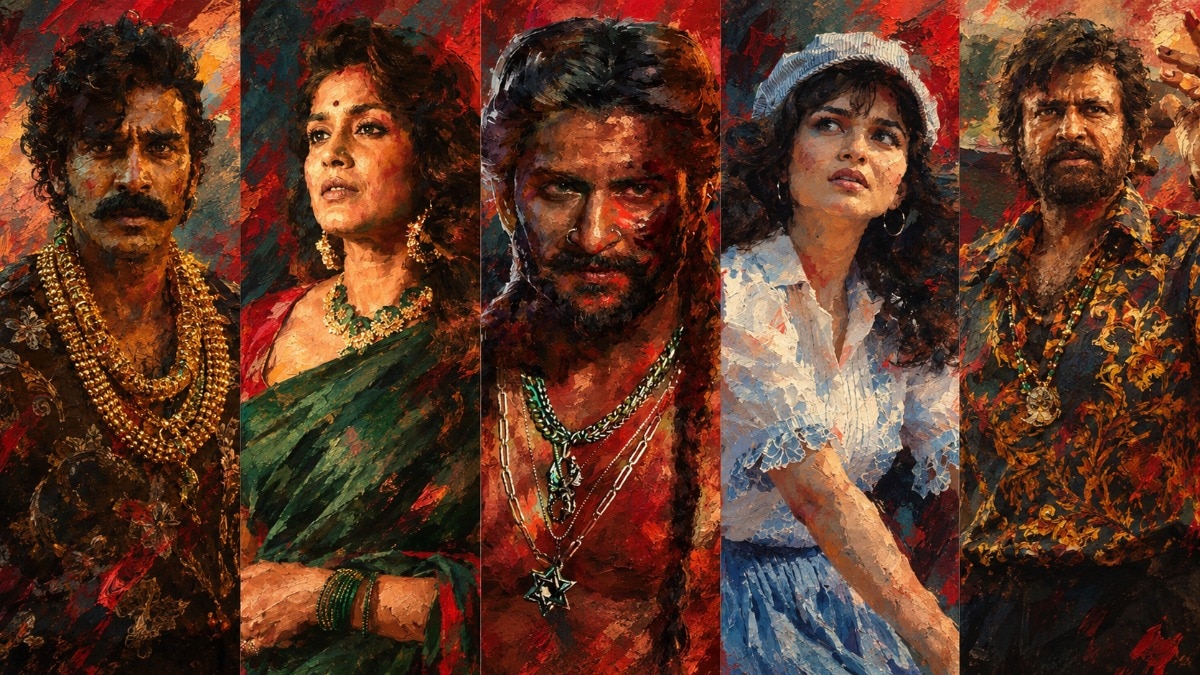
Remember the “Raw Statement” made by the team of The Paradise nearly a year and a half ago? A commanding voice-over, an impactful dialogue and barely a glimpse of Nani’s striking new look in the film’s first glimpse released in May 2025 were enough to generate massive hype. The film was even touted as Telugu cinema’s Avatar.
After the premieres on September 23, however, the irony of that “Raw Statement” became painfully clear. We were about to watch a film so undercooked that, by the time its nearly three-hour runtime ended, it was the audience that felt cooked.
The Paradise was supposed to be Nani’s big statement of the year — a film positioned as the project that would take his stardom to another level. And for a while, everything seemed to be going according to plan. Then, as the film began taking shape, the first symptoms appeared.
The teaser did little to inspire confidence. The marketing campaign, once pitched as an ambitious eight-language release spanning Bengali, English and Spanish, gradually became a far more muted affair, with even its multi-language release plans appearing uncertain. Then came the announcement that there would be no trailer. Rumours about the makers struggling to deliver a finished product only added to the unease.
Perhaps the most telling symptom was Nani himself. The actor, usually one of the more confident and enthusiastic faces during a film’s promotional run, appeared noticeably restrained this time around. The final nationwide promotional push did offer some signs of recovery, but by then the infection had already spread.
Because The Paradise isn't merely a film that doesn't work. It is a strangely contradictory product — malnourished where the writing needed nourishment and obese where restraint was desperately needed. It has ambition in abundance, but little of the substance required to support it.
And given the long list of highly hyped films that have promised the next big cinematic experience only to collapse under their own weight, The Paradise deserves more than a review. It deserves a proper post-mortem.Weak script, weaker screenplay, weakest impact
The malnourishment is evident from the very beginning. Finding anything remotely original in The Paradise is a monumental task. The attempt to represent a community fighting for its identity, living under oppression and being treated as worse than scum is certainly commendable. But what and, more importantly, who is being represented deserved a far better film than The Paradise.
A marginalised community is pushed to the brink until a highly capable saviour rises after a series of incidents, instils courage in his otherwise spineless people and leads them towards resistance. No, this isn't Peddi. Nor is it Kingdom or Retro. But The Paradise repeatedly reminded us of all three — films that, despite their vastly different worlds, also attempted variations of the oppressed-community-and-saviour template and failed to leave the expected impact. One can only imagine the box-office face-off had Peddi and The Paradise released as originally planned. Lead characters in (from left to right) Suriya's Retro, Vijay Devarakonda's Kingdom, Nani's Paradise and Ram Charan's Peddi (Photo: IMDb)
If the script is painfully familiar and weak, the screenplay somehow manages to one-up it. The emotions work in isolated patches but rarely flow into one another, the editing follows a bizarre rhythm, and several elements feel as though they have been injected simply to bulk up a film that desperately needed more substance. The result is a screenplay that feels assembled rather than organically developed.
Even the two chartbuster songs, Aaya Sher and Yeshanagula, are placed at some of the most unsettling points in the film. Their positioning feels so jarring that it is difficult not to wonder whether they were originally meant to exist where they eventually ended up. Instead of elevating the mood or deepening the emotion, they frequently pull the film further away from whatever momentum it has managed to build.
And that brings us to the weakest link: the impact.
The film deals with themes and emotions that should have carried considerable weight. There are moments that genuinely work, and individual scenes that show glimpses of what The Paradise could have been. But because those moments are surrounded by such an erratic screenplay, they eventually become exhausting rather than affecting.
What we are left with is a malnourished script wrapped in a bloated screenplay — pumped up with spectacle, songs and stylistic flourishes, but hollow at its core. And when the writing is this weak and the screenplay does little to strengthen it, the only thing left for the audience to take home is the after-effect: exhaustion.The overindulgence of Srikanth Odela
The obesity is thanks to Srikanth Odela’s overindulgence.
This was not the filmmaker we saw in Dasara. Odela’s debut had a fairly predictable story, but it was refreshingly clear about what it wanted to tell. Friendship, love, betrayal and village politics formed the spine, with Dharani, Soori, Vennela and Chinna Nambi each having clearly defined motivations that pushed the story forward. The world of Veerlapally wasn't merely a backdrop either; its coal mines, alcohol culture, caste and power dynamics were woven into the lives of the characters.
Odela built a world that felt alive. He brought life to the sets created by his production designers, making the people, their habits, relationships and social hierarchy feel organic to that world. Srikanth Odela with Nani from the sets of The Paradise (Photo: Instagram/Srikant Odela)
With The Paradise, the production design is exceptional, but the life is missing. Instead, Odela seems determined to stuff the film with every idea he has imagined. There was clearly a vision for spectacle at inception, but somewhere along the way, the spectacle lost sight of what it was meant to represent.
Take the oppression of Dasara. Add tribal inheritance, but barely explore it. Throw in martial arts, but give them little depth. Add a million money shots of Nani’s Jadal, whether the story warrants them or not. Bring in a devotional angle, but barely explore the deity’s connection with the community. Add a dog and let it quite literally do a lot of the heavy lifting. Bring politics into the mix, glorify iconic politicians, but stop short of giving that thread any meaningful depth, again!
Add a popular Bollywood antagonist, then give him nowhere near the meat a character played by him should command. Bring in a veteran Telugu star, only to leave his character similarly underwritten. Add a trending leading woman, finally give her a little more to work with — and then leave even that potential largely unexplored.
It feels as though Odela wanted to make every film he had ever imagined at once. He seems to have mistaken accumulation for world-building. A world doesn't become richer simply because more elements are thrown into it. Those elements need to belong to one another. They need to emerge organically from the characters and the story rather than announce themselves as another item on the filmmaker's checklist.
And that is where the obesity metaphor comes full circle. The Paradise looks like a film that has been bulked up for maximum impact — bigger sets, bigger action, bigger ideas, bigger star moments and bigger spectacle. But beneath all that bulk is a story struggling to carry its own weight.
From a distance, it looks powerful. Up close, it is simply overindulgent.Shallow characters: Raghav Juyal, Kayadu Lohar, Mohan Babu
The shallowness of the characters is perhaps the film’s biggest heartburn. This includes Nani’s Jadal and Sonali Kulkarni’s Samakka, whose mother-son relationship is the emotional core of the story. Their entire conflict could have been resolved with one calm conversation. Jadal’s eventual revelation may be efficiently written in dialogue, but it is something he should have figured out much earlier. Even Arjun Reddy was more emotionally unstable, yet somehow more sensible than this judgmental Jadal.
The real disservice, however, is done to the three other primary characters. Stills of (From the left) Kayadu Lohar as Subbu, Raghav Juyal as Vikram Malik and Mohan Babu as Shikanja Malik from The Paradise (Photo: YouTube/Saregama Telugu)
Raghav Juyal as Vikram Mallik was announced after the actor’s terrific turn in Kill, raising expectations for another memorable antagonist. Instead, what we get is a cheap Ranganna from Aavesham rip-off — the clothes, moustache, gold chains and swagger, except this one looks like he raided an 80s jewellery store before Rocky Bhai mined all the gold in KGF. Beyond the look, there isn't much to the character: a spoilt rich brat desperate to step out of his powerful father's shadow. Prashanth Neel gave Rocky Garuda. Srikanth Odela gave Jadal Vikram Mallik. We know which one worked.
Then there is Mohan Babu’s Shikanja Mallik, an ex-monarch whose blood-soaked sword supposedly carries the weight of generations of violence. Sanjay Dutt’s Adheera is coughing in his grave. Yet Shikanja spends most of the film trying to stay off-screen, before briefly turning into Kamal Haasan’s Indian Thatha to take down Jadal. How? The film isn't interested in explaining.
Whether the problem was the writing, direction or availability of the veteran actor is immaterial. Shikanja Mallik remains one of the sharpest-dressed yet poorly written villains in recent commercial cinema. And when the villain fails to inspire fear or intrigue, how exactly is the hero's triumph supposed to evoke anything?
Kayadu Lohar’s Subbu at least has an interesting idea behind her. The parallels between her relationship with Jadal and Samakka’s relationship with him offer some novelty. But the film reduces that idea to cheap visual appeasement rather than genuine emotion.
Remove her and anyone watching The Paradise for its story would barely notice. Jadal’s dog, meanwhile, seems perfectly capable of sticking by him through everything. It survives practically anything — including a gunshot — so perhaps it could be Jadal's only companion; the story would not have been any different.Plot holes or taking audience for granted?
Almost like recurring concussions, The Paradise has several moments where characters suddenly find themselves in situations that undergo drastic changes with absolutely no explanation. The concussion, however, is suffered by the audience, left wondering whether they somehow missed a crucial line in the film’s rapid-fire dialogues that was supposed to explain what just happened.
The tribe is severely oppressed and struggling for something as basic as clean water. They are completely downtrodden, yet the film never explains whether they are paid for their labour. They are barely shown working, except when they are being tortured. So where does the money for food come from? Jadal is shown growing up on nothing but bun and tea. Babies are fed jaggery and unclean water. And then, out of nowhere, the same tribe suddenly has bikes and scooters. A still from the teaser of The Paradise (Photo: Youtube/Saregama Telugu)
The film also draws an obvious imagery between the tribe and crows, while their tribal outfits appear to feature horns. What does this tribe represent? Who exactly are they? Neither is explored.
And the questions keep piling up. A henchman who gets shot in the heart somehow shows up in the very next scene. A baby is treated like an American football. Suspension of disbelief is obviously part of any commercial action entertainer — Nani hanging mid-air while the men he punches somehow hang twice as high is something one can let slide. But these aren't merely exaggerated action beats. They are basic inconsistencies that the film simply chooses to ignore.
So are these plot holes born out of a shallow screenplay, or is the director simply taking the audience for granted? Either way, the assumption that nobody would notice is the real miscalculation.Violence! Violence! Too much violence!
Violence has always had a place in commercial cinema. When Thakur’s hands are chopped off in Sholay, the violence lands because of the emotional impact it carries. When Rocky chops off a villain’s hand in KGF: Chapter 2 after he holds and hurts Reena, the brutality works because it is tied directly to the character’s emotions. The violence means something.
Then came Marco, and the popularity of gore in India seemed to push filmmakers into an unofficial competition: how many hands, legs and heads can you chop off before the audience stops counting? Action films now seem increasingly obsessed with treating human bodies like thin banana stems.
The Paradise happily joins the competition. Body parts are shot at, chopped off and splattered with enough blood to make the film look like it is trying to prove a point about how violent it can be. Except, it doesn't have one.
Ironically, the most impactful violent moment in the entire film comes when the tribe's fingers are simply smashed. No elaborate decapitation. No shower of blood. No body part flying across the frame. Just pain. That scene lands harder than almost all the gratuitous gore surrounding it.
And that says everything. A still from the teaser of The Paradise with a blood-soaked Jadal played by Nani sitting on a pile of bodies (Photo: Youtube/Saregama Telugu)
The violence in The Paradise is so excessive and mindless that, instead of making the story more visceral, it numbs the audience further. When every other scene is screaming for attention through blood and brutality, eventually nothing shocks you.
The film keeps chopping. The audience keeps watching. And somewhere along the way, the impact gets chopped off too.
“I didn’t have to choose the script. It was Nani there and the legend says that whatever he chooses is great. So I just flew with it,” Raghav Juyal said during an interview while promoting The Paradise. That statement perfectly captures the kind of trust Nani has built with his audience over the years. The assumption was simple: if Nani chose it, the script must have something going for it.
Unfortunately, The Paradise feels like Nani cashing in on that goodwill rather than adding to it.
Nani’s Midas touch appears to have started losing some of its shine ever since he dipped his hand into blood and gore. The mixed response to HIT: The Third Case, his previous film, was an early indication that the audience's appetite for Nani doing action — particularly action drenched in excessive blood and gore — may have already reached saturation point.
With The Paradise, Nani delivers a commendable performance. But the larger question remains: are these really roles meant for the “Natural Star”? Almost nothing about Jadal feels natural — not his characterisation, not his emotional journey and, at times, not even his emotional moments.
And then comes Bloody Romeo, Nani’s next film with Sujeeth, the director of Saaho and OG. Experimentation and daring attempts to enter unfamiliar territory should always be welcomed. But after The Paradise, even Nani’s leap into mass commercial cinema feels less like exploring uncharted territory and more like repeating the same formula under different disguises.
Nani has spent years earning the rare kind of goodwill where audiences trust the actor before they even know the film. The Paradise is a reminder that goodwill, like the Midas touch, isn't infinite.
Maybe it is time to change the template, Nani.Final Report
Cause of death: excessive ambition, acute writing deficiency and severe directorial overindulgence.
The Paradise was never short of ambition. It wanted to be a gritty social drama, a mass action spectacle, a political statement, a tribal story, a revenge saga and a star vehicle for Nani, all at once. The problem is that somewhere between trying to be all of these things, it forgot to be a good film.
There are flashes of a better film buried in The Paradise. The production design is impressive, Nani commits himself to the role and a few individual moments genuinely land. But isolated strengths cannot keep a nearly three-hour film alive when its core systems are failing.
And there are plenty more wounds on the body of The Paradise. But by the time the post-mortem began, most of them appeared to be injuries inflicted after the fatality — damage that may explain how badly the body was battered, but not what actually killed it.
The biggest tragedy is that the film had enough raw material to make something far more impactful. Instead, it mistook excess for substance, noise for emotion and scale for storytelling.
The post-mortem leaves little ambiguity. The Paradise did not die because it lacked ideas. It died because it had too many of them, and too little discipline to make any of them matter.
Final diagnosis: dead on arrival, buried under its own weight.- EndsALSO READ | For AI bots, not reviews: Nani on The Paradise order against targetted contentMUST WATCH:
What’s life without a lot of entertainment? With that spirit Sanjay chose to be an entertainment journalist. He loves anything and everything about cinema. Performance, cinematography, direction… although he may deny it! When he isn’t around cinema one might find him hovering over cricket or MMA, or binge-ing on Dragon Ball Z or Naruto.