The fightback in Bandung and Pakistan football’s reality
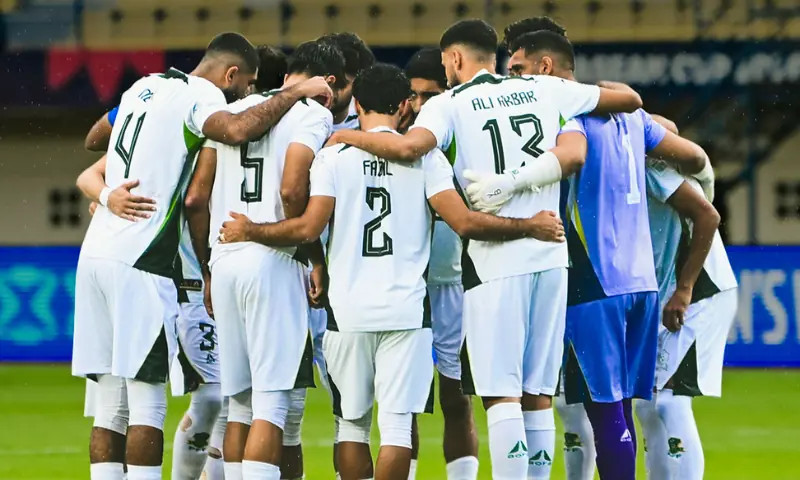
When Abdul Samad Arshad cut in past a Philippines defender before shooting the ball along the ground to beat the goalkeeper on Tuesday, it was a moment of disbelief for the Pakistan fans — those in small numbers at the Si Jalak Harupat Stadium in Bandung, Indonesia, and those watching on screens back home and around the world.
The shot — now etched in Pakistan football history as the one that brought the side its first-ever point in a FIFA competition, the FIFA ASEAN Cup, and against a side ranked more than 60 places above it — equalled the scores to 2-2 after Philippines had scored two early, and sparked celebrations in equal measure.
The delight was special because it came with a surprise element.
How could a team that had prepared for the tournament in a short training camp, without its head coach, stun a higher-ranked side in this manner? How could a team from a country without even a semblance of a proper football competition and grassroots structure challenge one from a country that has all of that and more? And how could a federation beset by a prolonged crisis field a side so competitive?
Those questions are almost as important as the result itself.
Samad provided one answer.
The Pakistan player based abroad had arrived in Indonesia on Sept 25, a day before the team’s opening FIFA ASEAN Cup match against Thailand, which Pakistan lost 4-0. Several of his fellow diaspora players also joined the squad directly in Indonesia rather than being part of the national-team camp in Islamabad.
The camp itself was brief. And head coach Nolberto Solano was not there.
The Peruvian coach missed the camp after applying for the wrong type of Pakistan visa. His documents had to be resubmitted, delaying his arrival until the team was already in Indonesia. In his absence, assistant coaches Titus Bramble and Walid Javaid oversaw the sessions.
For a national team whose players largely do not play together, those lost days matter.
Yet two days after Samad arrived, Pakistan were back on the pitch against the Philippines and, after falling 2-0 behind, produced the sort of comeback that had rarely been seen from the national side.
Mohammad Ali Akbar pulled one back two minutes after half-time before Samad equalised around the hour.
Pakistan had never previously scored in, or taken a point from, a FIFA competition. They had now done both in the same match.
“This is a fantastic result for Pakistan football, arguably its most impressive result of the 21st century,” Ismail Farooq, a football analyst at FC Nuremberg in Germany and a keen observer of Pakistan football, tells Dawn.
Ismail puts the achievement into perspective by pointing to the gulf between the two teams. Pakistan are ranked 198th in the world while the Philippines are around 60 places higher and have the kind of regular domestic football and established structures that Pakistan have lacked.
Pakistan, he said, were “massive underdogs”.
That makes the fightback significant. But it also makes what happened before it harder to ignore.
The players arrived from different parts of the world, trained together for a limited period and entered the tournament without having had the benefit of a full camp under their head coach.
The result therefore says as much about the resilience of the players as it does about the possibilities that exist within Pakistan’s player pool.
It is also where the country’s diaspora footballers become part of a much larger conversation.
The overseas-based players have increasingly provided Pakistan with a pool of talent that would be difficult for the domestic system to produce on its own. But their late arrival also highlights the absence of a sufficiently strong structure at home to prepare and develop players consistently.
Shaikh Hamdan, head coach of Karachi United Football Club and a UEFA B-licensed coach, believes the result could nevertheless have an important effect well beyond the national team.
“Any positive result for Pakistan football can only be a good thing for the game at grassroots level,” he tells Dawn. “Results inspire participation.”
Children watching Pakistan score and compete, he added, could begin to dream of representing the country, while positive performances could also help convince parents that football can be more than simply a recreational pursuit for their children.
That is the opportunity presented by Bandung.
But it is not the same as having a functioning football system.
Pakistan have not had a proper domestic league since 2015. Youth competitions remain limited and competitive opportunities for young players are scarce.
There is no consistently functioning pathway taking a talented child from grassroots football through age-group competitions and into the professional and international game.
“There are passionate coaches, academies and football communities doing excellent work across the country,” Hamdan says.
“But there is still no structured pathway that consistently takes talented young players from grassroots football through youth competitions and into the professional and international game.”
That gap has consequences.
Talented youngsters can spend crucial developmental years without enough meaningful competitive matches.
Academies can do good work but have limited opportunities to test their players against strong opposition. Coaches can identify potential without knowing where that player will go next.
And when the national team comes calling, it can be easier to look abroad.
The diaspora players are not the problem. Their presence has been an important source of quality and experience for Pakistan. The problem is that their importance has grown partly because the domestic pathway has failed to provide enough alternatives.
That Pakistan can still produce or find players capable of competing with a team such as the Philippines should therefore be viewed as encouragement rather than vindication of the existing system.
Ismail’s assessment is blunt. According to him, the Bandung result was “despite our domestic football situation, not because of it”.
That distinction could determine what happens next.
The Pakistan Football Federation has announced plans for district and youth football and has sought expressions of interest for a new league. But announcements are only the beginning. What Pakistan needs is a sustained calendar of meaningful competition that allows players to develop and coaches to work within a stable system.
More than a year after the PFF elections in May 2025, that structure remains a work in progress.
At grassroots level, football continues to rely heavily on uneven local structures. Provincial and district associations are effectively dysfunctional, while facilities and access to quality coaching remain limited in many areas.
Political chaos
The administrative uncertainty surrounding the PFF has compounded the problem.
The May 2025 elections brought former FIFA development officer Syed Mohsen Gilani to the presidency. Since then, disagreements over the federation’s direction and decision-making have continued.
Reports, as well as a document that circulated publicly — and was labelled “fake” by the PFF — referred to an alleged understanding involving Mohsen and Hafiz Zakaullah under which Mohsen would serve for a year before facilitating Zakaullah’s succession. Zakaullah has publicly referred to such an understanding, while its status and interpretation have been disputed.
The episode has formed part of a wider pattern of competing claims and factional tensions, including disagreements over the federation’s functioning and postponed Congress meetings.
All of this matters to what happens on the pitch.
A national team needs more than a group of talented players assembled for an international window. It needs a domestic competition feeding players into the national side, youth teams developing the next generation, coach education producing better trainers, regular camps and enough international football to test progress.
Hamdan believes the Philippines result has demonstrated that the potential is there.
“Rankings are influenced by many factors, including the number of international matches a nation plays, and Pakistan has historically had far fewer opportunities than most countries,” he says. “The performance against the Philippines reflects the potential that exists within our player pool and demonstrates that the gap is not as large as many people assume.”
But potential is not a development strategy.
Pakistan have experienced moments of encouragement before. The Diamond Jubilee title in the Maldives ended a 74-year wait for a standalone tournament victory and offered hope under Solano.
The FIFA ASEAN Cup was supposed to be another step.
The 4-0 defeat against Thailand exposed the gulf Pakistan still have to bridge. The performance against the Philippines showed, however, that the gulf is not necessarily reflected in the players’ appetite to compete.
They conceded twice but did not disappear. They found a goal, then another, and held on against a team with a significantly higher ranking and a deeper footballing infrastructure.
That is what made the night in Bandung special.
The danger is in asking the result to mean more than it can.
Ismail says the “biggest mistake” would be to regard the draw as proof that Pakistan football is doing things right.
“We are barely doing anything domestically,” he observes.
That does not diminish what the players achieved. If anything, it makes their achievement more striking.
The challenge is to ensure that a night such as Bandung does not remain another isolated flash of possibility.
The 2023 World Cup qualifying victory over Cambodia remains, in Ismail’s view, the biggest result of the century for Pakistan football. Yet the excitement surrounding that win did not produce the transformation of the domestic game that many hoped for.
Bandung should not meet the same fate.
The result has given Pakistan football something that cannot be manufactured by a federation, a league or a development plan: belief.
Children saw their national team score. Fans saw players refuse to accept defeat. Players who had travelled from abroad found themselves part of a team that had produced something historic.
Now the institutions have to catch up.
A functioning domestic league, meaningful youth competitions, clearer player pathways, better academy environments, improved coach education and regular international football across age groups would turn isolated moments of promise into a process.
The draw against the Philippines was an encouraging step — and Pakistan may well pull another surprise in their final ASEAN Cup group match against Vietnam on Friday.
It was also a reminder of how much more could be possible. The players have shown that they can fight back.
The bigger challenge is whether Pakistan football can finally build a system worth fighting for.