
The federal Liberals secretly halted a promised ban on thermal coal exports - Toronto Star
Cabinet ministers didn't say Thursday what happened with the ban.
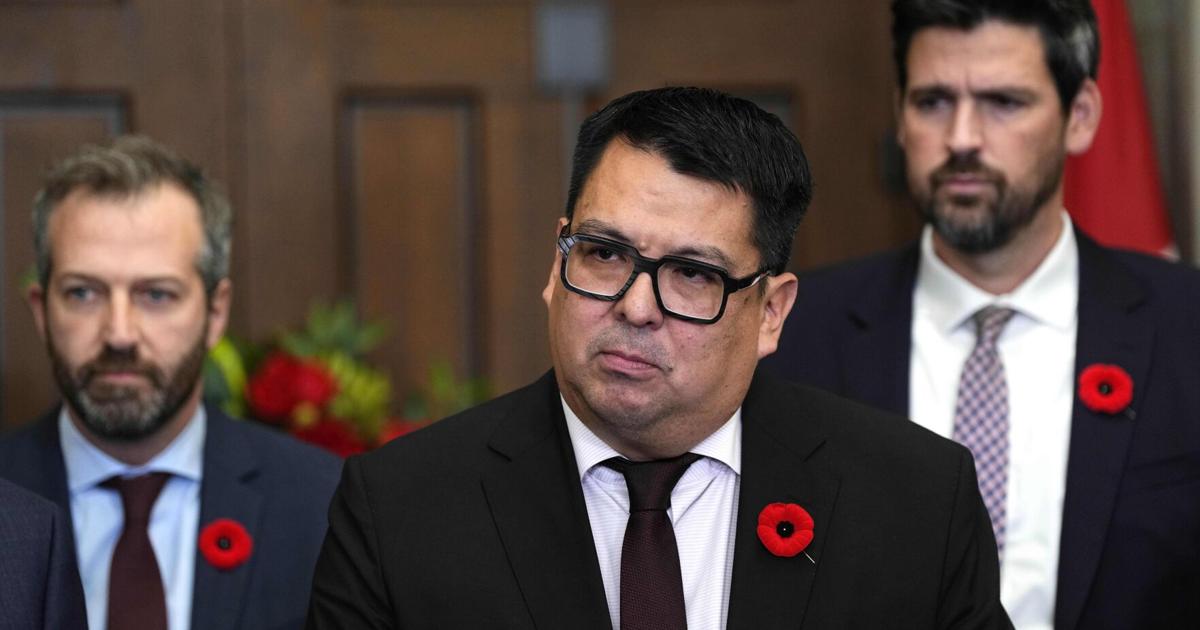
Wade Grant, centre, parliamentary secretary to Environment Minister Julie Dabrusin, failed to explain on Thursday, Oct. 29 why work on the thermal coal export ban abruptly stopped.
OTTAWA — A group of cabinet ministers was unable to explain how or why their government secretly halted plans to ban thermal coal exports, after Canada’s environment watchdog revealed Thursday that the promise federal Liberals long championed as part of Canada’s global climate leadership was shelved last year without any public announcement.
Thursday’s report from Environment Commissioner Jerry DeMarco discovered that work on the ban was formally halted in August 2025, as part of Prime Minister Mark Carney’s effort to reduce government spending, and months after efforts stopped inside the department of Environment and Climate Change in November 2024. DeMarco reported that his office could not find any official directive from inside the department that ordered civil servants to drop this work.
Under prime minister Justin Trudeau, the federal government co-founded an international group called the ”Powering Past Coal Alliance,” which gathered like-minded countries who shared the goal to stop burning the fossil fuel for electricity generation. In 2021, the governing Liberals promised to ban exports of thermal coal, a high-emitting source of energy that is used in coal-fired power plants, by 2030.
Facing questions from reporters on Parliament Hill, Wade Grant — parliamentary secretary to Environment Minister Julie Dabrusin — failed to explain why work on the ban abruptly stopped. He also did not say whether the government is still committed to the idea, or why internal efforts to implement it halted without any notification to the public.
The Star had asked Dabrusin’s office whether the Carney government would still keep this Trudeau-era promise, but spokesperson Amy Falkner did not answer the question in a written response provided Oct. 2.
“The previous government in 2024 paused that,” Grant said Thursday, despite DeMarco’s finding that the government “formalized” its decision to stop work on the ban under the current Carney-led Liberal government.
“I wasn’t here at that time,” continued Grant, who was appointed parliamentary secretary for the environment in June 2025, two months before the formal decision DeMarco uncovered.
“I’m moving forward to learn and listen to people on this issue,” he said.
The federal government has also been slow to push out more than $1 billion in promised funding to help developing countries stop burning coal, DeMarco found, concluding only about one per cent of the funding has been made available so far.
Cabinet ministers appearing with Grant on Thursday also didn’t say what happened with the thermal coal exports ban, with Justice Minister Sean Fraser stating that “it would depend on the specifics of the circumstances.”
In general, however, Fraser noted the Carney government has “established a different set of priorities” and that previous plans aren’t guaranteed to carry over from the Trudeau era.
“In my engagements with the prime minister, it’s clear that he’s going to make decisions that are arrived upon independently that he believes are in the best interest of the country,” Fraser said.
In a statement Thursday, the climate advocacy group stand.earth slammed the government for having “ditched its commitment with zero transparency, no public communications, and no internal reports to justify it.”
DeMarco’s report was one of nine tabled in Parliament Thursday from Canada’s auditor general’s office. Alongside the findings on the abandoned coal commitments, DeMarco also reported that Canada is falling further behind on reaching its 2030 emissions target, noting that the Carney government has “cancelled or weakened” several climate policies from an earlier plan to achieve at least 40 per cent below 2005 emissions levels by that year.
These include eliminating the national consumer carbon price, weakening the future increases of the carbon price for large industries like fossil fuel production, and cancelling plans for a regulatory cap on emissions from the heavy-polluting oil and gas sector. The Carney government also dropped sales mandates for electric vehicles that the previous government promised to implement, and plans to freeze vehicle emissions standards at 2026 levels without making them more stringent for at least three years.
DeMarco’s report said Thursday that Canada is currently on track to reduce emissions to 28 per cent below 2005 levels by 2030, a projection that doesn’t include all “recent cancellation and weakening” of previous climate measures.
The Carney government has argued it must change federal policies as it tries to bolster the Canadian economy in the face of the trade crisis with the United States. It is also arguing that it must rewrite laws and create new powers to fast-track major projects, including a major new oil pipeline from Alberta through British Columbia, to make Canada an “energy superpower” and break dependence on the U.S. by boosting exports to other countries.
Error! Sorry, there was an error processing your request.
There was a problem with the recaptcha. Please try again.
You may unsubscribe at any time. By signing up, you agree to our terms of use and privacy policy. This site is protected by reCAPTCHA and the Google privacy policy and terms of service apply.
Alex Ballingall is the Deputy Ottawa Bureau Chief for the Star. Reach him via email: aballingall@thestar.ca


