The Doomer and the Boomer - Newsweek
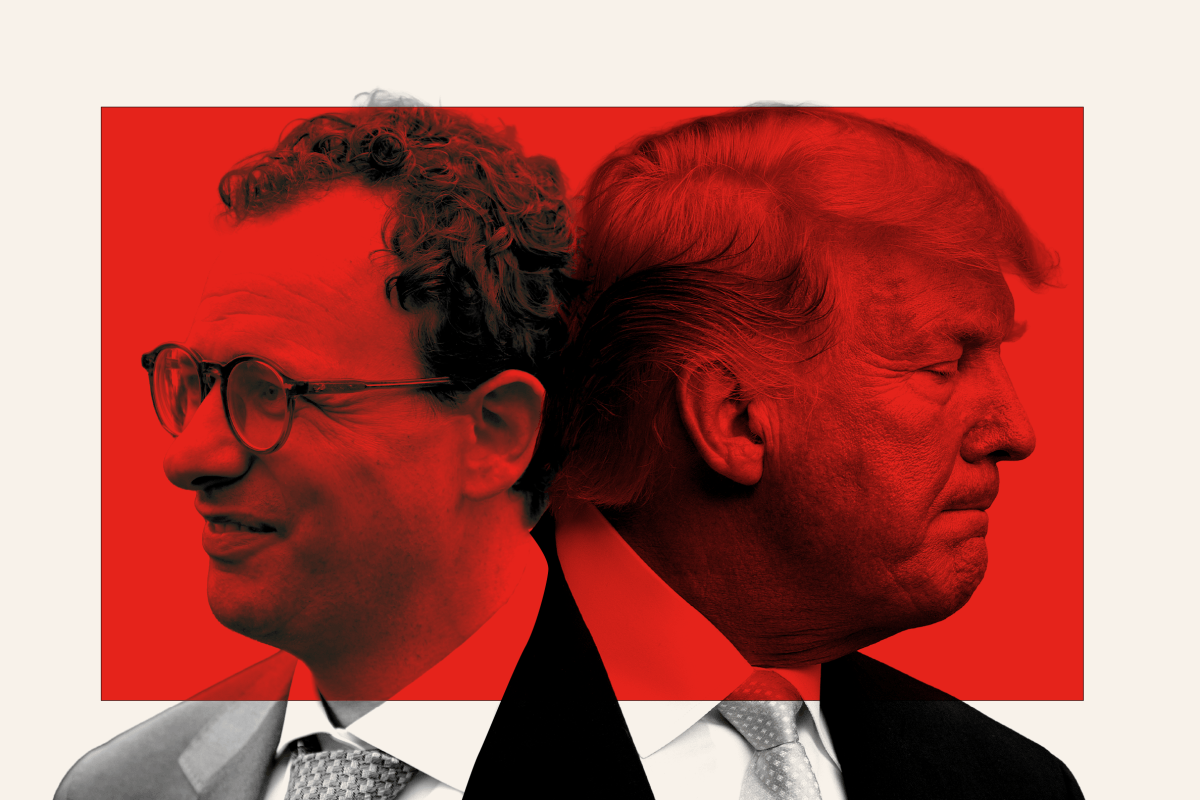
More than four decades separate Dario Amodei and Donald Trump. The two men's paths have crossed by timing more than anything else.
Trump happens to be president right at the moment Amodei’s artificial intelligence company Anthropic is emerging as perhaps the preeminent player in that epoch-shaping new world.
Personality-wise, the two could not appear more different. Trump is a people person, easy in the company of others. For the awkward Amodei, eye contact looks like it induces physical pain.
But there is a much deeper divergence between 43-year-old Amodei and 80-year-old Trump. They symbolize a generational difference in outlook, shaped by their formative experiences. It is the doomer and the boomer.
On the last Sunday of September, Trump took in the final day of the Presidents Cup outside Chicago, flew back to Joint Base Andrews, and told reporters he had a 10 p.m. dinner with Amodei.
These are "long days, but I seem to be able to handle it," Trump added, a gentle nod to his age.
Earlier that day, he had previewed his line on the evening’s menu’s real main course: artificial intelligence. "I’m for let’s go and let’s win," Trump said.
Thirteen days before, he had accused his dinner guest of pretending to be a "perfect little angel" and, declaring himself "the Hoax Buster," dismissed growing fears that AI could destroy the world.
Now, Amodei was "highly respected."
That night, Amodei and his wife, Cami Clark, greeted the president at the new White House helipad.
Trump’s insults had followed Amodei’s September 12 essay, whose key sentence was an urgent plea, against the president’s instincts: "We must slow the pace at which we improve the capabilities of AI models."
Eleven days later, Amodei told the U.N. Security Council by video that, if managed poorly, AI could be "a risk to humanity as a whole."
Amodei was in full doomer mode (though his essay counts doomerism among the accusations his company faces.)
After all, he had set up Anthropic to be a safety-first lab for the development of AI, reflecting the pessimism at the core of a technological advancement that also carries so much promise.
Yes, it might cure many cancers, unlock new understandings in physics, or ease some of the burdens of everyday life. But it might also develop a deadly bioweapon, or take control of the internet, or worse.
Above all, and on this all were agreed, including Amodei and Trump, the U.S. must win the race.
The next night, Amodei missed the state dinner for visiting Chinese President Xi Jinping—allegedly due to a scheduling conflict—as his rivals Sam Altman, Elon Musk, and Mark Zuckerberg worked the East Room.
No readout of Sunday’s dinner has been released, though Trump later told Time magazine his guest was "maybe different from I thought."
On Tuesday, Amodei and five other tech executives signed the White House Accord on "Super Intelligence," Trump’s new name for AI, imposed on federal agencies by executive order that day.
"I think it’s morally binding," Trump said, calling it "almost like a constitution." Amodei’s version turned on one vital word: "we can win, and we can win safely."
Trump was born in June 1946, the first year of the baby boom, when the postwar world looked to new opportunities and hope, led by people who saw the moon and then went there.
Amodei, born in 1983, is a millennial who voices the many anxieties of the cohorts behind him, where neuroses, neurodivergence, and an economic squeeze shape how younger people see the world.
Trump looks at AI and sees the next moonshot. Amodei sees a moonshot strapped to a bomb.
The deeper irony is that postwar optimism came with insurance—and it’s the doomer, not the boomer, who is trying to renew the policy.
The president came of age in the great postwar climb.
Roughly 90 percent of Americans born in 1940 out-earned their parents, Raj Chetty and colleagues have found. For those born in the 1980s, Amodei’s cohort, the odds were a coin flip.
Trump was 23 when Neil Armstrong walked on the moon. Technology meant jets, satellites, and color television—inventions that opened up the world and put America at its center.
That sensibility runs through Trump’s AI policy, down to a White House fact sheet hailing the "limitless promise" of Super Intelligence.
Make America Great Again is, at heart, a promise to resume the climb. It is nostalgia for a lost American dynamism.
Amodei’s generation and those newer to the world inherited a different gradient, one that feels a lot like decline.
And so, with AI, while young adults are likelier than their elders to use it, those under 30 are the most likely to say it will be bad for society and for themselves.
The share of under-30s more concerned than excited about AI has risen from 31 percent in 2021 to 55 percent this summer, Pew Research Center found, and 73 percent expect it to mean fewer jobs.
Anxiety symptoms are most common among adults under 30 and decline with age, federal survey data show.
Across eight U.S. health systems, autism diagnosis rates among adults ages 26 to 34 rose more than fivefold from 2011 to 2022, a jump researchers partly attribute to better screening and awareness.
A generation this practiced at scrutinizing itself turns the same unsparing gaze on the future. If everything feels like it’s getting worse, you’ll see the downsides before the upsides, and that applies to AI too.
Their unease is also about a world that seems to be closing in.
In January, Trump ordered the United States out of 66 international organizations. At the U.N. General Assembly on September 22, he declared that America rejects any "globalist scheme of control" over AI.
The next afternoon, Amodei was making the case to the Security Council for international cooperation.
To Trump, retreat from the postwar order is restored sovereignty from unelected bureaucrats. To the young, who have known nothing else, it looks like the guardrails coming off just as the road gets steeper.
The boomer, through experience, will know that prophecies of doom have a poor record.
Trump used the U.N. podium to mock those who, he claimed, had warned that global warming meant "we’ll all be dead in 12 years." Children who practiced duck-and-cover drills grew old without the bomb ever falling.
The doomer’s motives are under question, too. David Sacks, then Trump’s AI czar, accused Anthropic last year of running "a sophisticated regulatory capture strategy based on fearmongering."
To many onlookers, it’s no coincidence that these AI giants, including Anthropic, are pursuing huge IPOs. What better way to demonstrate the prowess of your model by saying it can destroy human civilization?
Nor is Trump’s exuberance typical of his generation. In Pew’s polling, Americans 65 and older are at least as wary of AI as the young, and just 4 percent are more excited than concerned.
So the real divide is less about fear than it is proximity. Older Americans worry about AI from the outside. The young worry from inside it—in their classrooms, their inboxes, and, they suspect, their paychecks.
But the boomers did not survive the bomb on optimism alone.
After the Cuban missile crisis—Trump was sweet 16—Washington and Moscow agreed to a hotline, then banned atmospheric nuclear tests, and later, through the SALT talks, capped their missile launchers.
Postwar confidence was underwritten by arms control. Amodei’s essay reaches for exactly that precedent, floating a SALT-style speed limit on how fast AI systems can improve themselves.
During Xi’s visit, the two leaders agreed to set up a channel for handling AI incidents. It is, in effect, a hotline: a reflex from the president’s own youth.
The doomer and the boomer have now broken bread. They even seem to get along, despite their differences. The America that went to the moon also built the hotline.
For that generation, hope was never a mood. It was a policy.