The curious case of the ‘missing’ Shah Commission report on Emergency and its eventual rediscovery
You don’t have any Active Subscription.
Account subscription benefits alongside Premium Stories, Editorials, Opinions and more. Unlock these with Subscription
On June 12, 1975, in Courtroom no. 24 of the Allahabad High Court, Justice Jagmohanlal Sinha pronounced the Prime Minister of India, Indira Gandhi, guilty of electoral malpractice. It was found that Gandhi violated Section 123(7) of the Representation of the People Act, 1951, by availing the services of gazetted officers in furthering her election campaign. Her election was declared “null and void” and she was disqualified from holding any electoral office for the next six years.
In a last-ditch, hasty attempt to hold on to power, she recommended that President Fakhruddin Ali Ahmed declare a national emergency. The head of the State obliged to her wishes and at the stroke of the midnight hour on June 25, 1975, proclaimed Emergency.
Following this, the fundamental rights of the citizens were suspended, and a federal democracy morphed into a unitary one overnight. The next 21 months saw the imprisonment of political leaders, censorship of the press, and even forced sterilisations.
So, when she was finally defeated in the 1977 general elections, the political parties that allied to form the Janata Party, which eventually formed the government, appointed the Shah Commission in 1978, headed by former Chief Justice J.C. Shah, to inquire into the excesses committed during the Emergency.
Author Katherine Frank in her biography of Indira Gandhi titled Indira: The Life of Indira Nehru Gandhi noted that the former Prime Minister was unwilling to cooperate during the deposition.
Eventually, the Commission published two interim reports and one final report on August 6, 1978. The reports detailed the abuse of power by the Central government, which included detention and arbitrary arrest of political dissidents, and censorship of the media. The report also highlighted the systematic suppression of civil liberties, among other excesses.
However, these conclusions could not remain in the public consciousness for long, as cracks started to develop in the Janata government due to ideological disagreements. Citizens were forced back into queues at voting centres in just two years. This time around, the mandate was overwhelmingly in favour of Indira Gandhi.
Prime Minister Indira Gandhi, along with former Chief Minister of Karnataka, Devraj Urs (2nd right), and Congress leaders, P.A. Sangma (second from left) and Sitaram Kesri (extreme left), during the swearing in ceremony of new Union Ministers at the Ashoka Hall at Rashtrapati Bhavan in New Delhi on June 8, 1980. | Photo Credit: The Hindu Archives
Once back at the helm, she seemed keen on refuting the evidence collected by the Shah Commission. Author Vernon Hewitt, in his book Political Mobilization and Democracy in India: States of Emergency, noted that she attempted to recall copies of the Commission’s reports wherever possible. And it looked like she succeeded for a moment; no one, including researchers, authors, and journalists, could get hold of the report.
It almost looked like this historical document containing a young democracy’s troubles got lost in time.
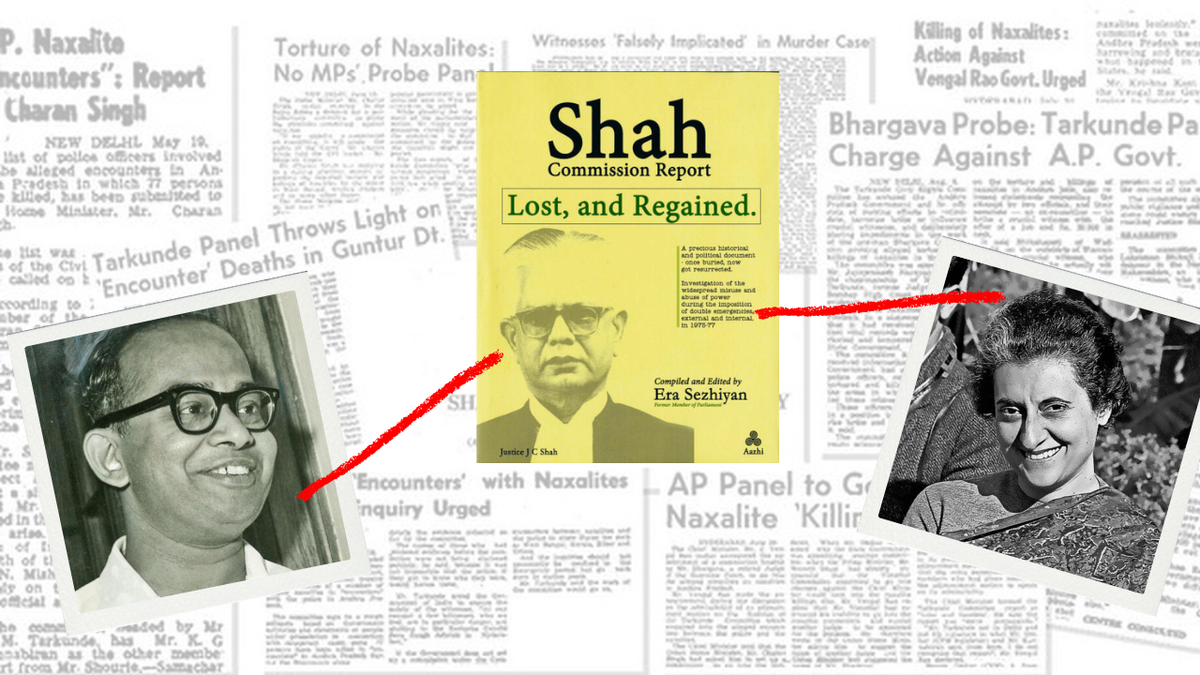
But this was until Rajagopal ‘Era’ Sezhiyan, former Member of the Parliament, unearthed the report in his home library in 2010, and decided to publish it as Shah Commission Report: Lost, and Regained. In republishing the book, an important documented account of history made its way back to political, legal, and academic circles of the country, enriching our understanding of authoritarian decisions and their excesses.
Era Sezhiyan. File. | Photo Credit: The Hindu Archives
Later it was revealed that the National Library of Australia too had a copy of the report of the Commission.
Talking about the document, Era Sezhiyan remarked, “…it is more than an investigative report; it is a magnificent historical document to serve as a warning for those coming to power in the future not to disturb the basic structure of a functioning democracy and also, for those suppressed under a despotic rule, a hopeful guide to redeem the freedom by spirited struggle.”
On June 24, 2025, Goa’s Governor P.S. Sreedharan Pillai launched his book Shah Commission: Echoes from a Buried Report. Slowly one could be lead to believe that the report is making its way back to public consciousness.
Comments have to be in English, and in full sentences. They cannot be abusive or personal. Please abide by our community guidelines for posting your comments.
We have migrated to a new commenting platform. If you are already a registered user of The Hindu and logged in, you may continue to engage with our articles. If you do not have an account please register and login to post comments. Users can access their older comments by logging into their accounts on Vuukle.