Texas Ten Commandments Law Heads to Supreme Court - Newsweek
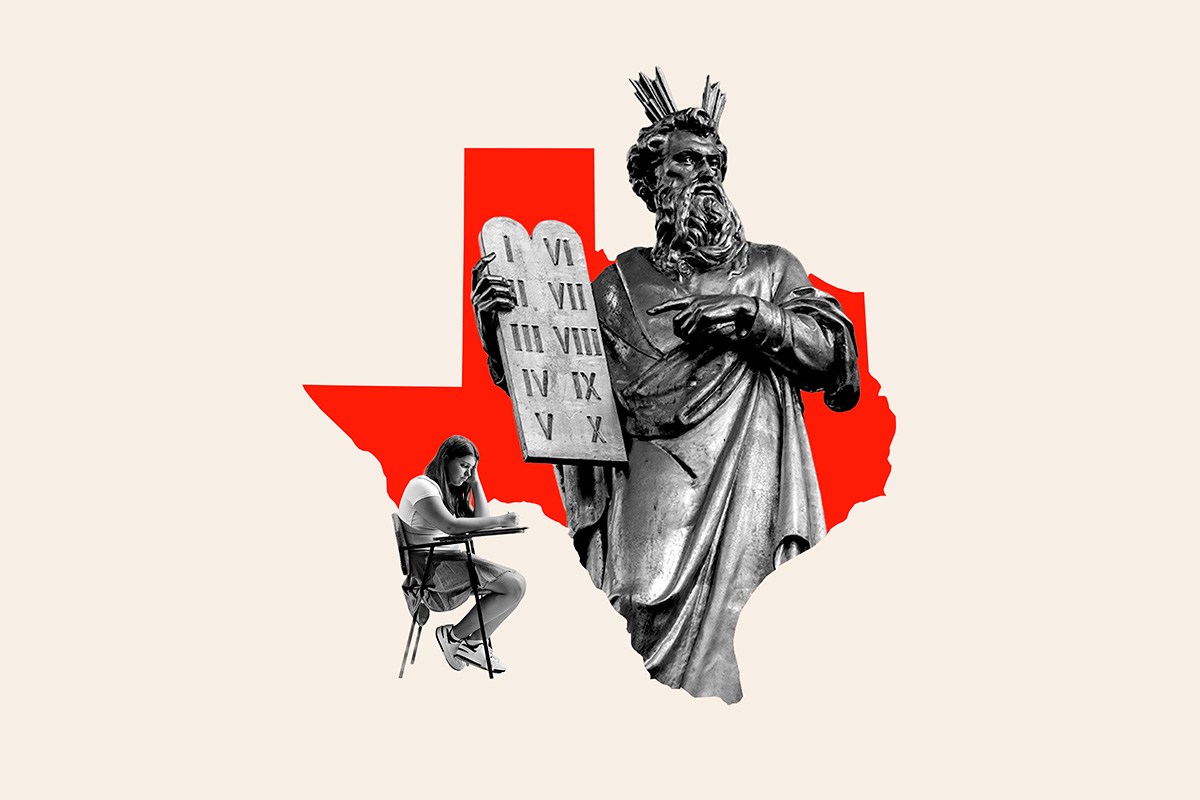
Texas lawmakers have required the Ten Commandments to be displayed in public school classrooms, a mandate now tied up in litigation and asking a practical question of an ancient religious text: how large should Sinai be?
Under the law, the answer is at least 16 by 20 inches, displayed conspicuously and readable from anywhere in the room. Millennia after Moses came down the mountain with stone tablets, Texas has added the poster specifications.
The fight is no longer theoretical. On Oct. 1, a state judge ordered Galveston Independent School District to put up donated Ten Commandments posters within 10 days, the latest turn in a standoff that began when the district voted last year to delay displaying them while the law was being challenged. Texas Attorney General Ken Paxton sued, arguing that Galveston—unlike the districts then protected by a federal injunction—was required to comply. The district now says it will.
The legal fight has now reached the Supreme Court, where challengers in Nathan v. Alamo Heights Independent School District are asking the justices to take up the case. Their petition follows an unusually tangled year of litigation. In August 2025, a federal judge blocked the mandate in 11 Texas school districts—including Alamo Heights, Austin, Houston and Plano—while the case proceeded, and Paxton instructed districts outside that injunction to begin displaying the Commandments. In April, however, the full Fifth Circuit reversed the lower court, ruling 9–8 that Texas could enforce the law and rejecting the challengers’ Establishment and Free Exercise claims. The families filed their Supreme Court petition in August.
Nor is Texas operating in isolation. Louisiana became the first state in the modern wave to require the Ten Commandments in every public-school classroom, passing its mandate in 2024, and its challenge was heard by the same Fifth Circuit now overseeing the Texas fight. Arkansas followed in 2025 with a similar classroom-display law, although its litigation is proceeding separately in the Eighth Circuit; a federal judge there permanently blocked the law in March. Together, the cases have turned what might look like a Texas culture-war experiment into a broader constitutional test of how far states can go in returning explicitly religious texts to public-school walls.
Supporters say displaying the Ten Commandments gives students moral clarity and grounds them in American history.
“Few documents have had a larger impact on our moral code and our legal code,” the bill’s author, Republican state Senator Phil King, said in a statement. Lead plaintiff Rabbi Mara Nathan sees the matter differently: religious beliefs, she said, should be instilled by “parents and faith communities, not politicians and public schools.”
The dispute is unfolding in a state that is deeply religious but hardly religiously uniform: 27 percent of Texas adults identify as evangelical Protestants, while another 26 percent are religiously unaffiliated, according to Pew’s 2023–24 Religious Landscape Study. At first glance, then, this looks like a familiar church-and-state fight. But zoom in on the poster itself.
If the Ten Commandments are important enough to mandate, they are important enough to take seriously, including their warnings about using God’s name for unworthy purposes, making idols, bearing false witness and coveting what belongs to someone else.
Texas wants the commandments to judge the classroom—but perhaps they have something to say about Texas?
Start with the obvious one: “Thou shalt not take the Name of the Lord thy God in vain,” one of the lines Texas specifically requires schools to display. The law does not merely permit schools to post the commandments; it prescribes their wording, dimensions and visibility. The required text begins with a declaration of God and commands that no other gods be before Him.
Today, taking God’s name “in vain” is commonly understood as a ban on profanity. The older religious idea is broader: God’s name should not be invoked falsely, frivolously or for purposes unworthy of it.
Therein lies the first problem for Texas. The state is invoking God’s words to accomplish a political and civic purpose.
King, the bill's author, has said the commandments provide students with “moral clarity” and help explain the foundations of American history and law. He has described them as integral to the American story and Western civilization.
That argument may be sincere, sure, but it also turns scripture into evidence for something scripture itself never claims to be: a statement about American national identity.
“I am the Lord thy God” is a declaration of religious authority. In the Texas argument, it is also being asked to perform another job: to help establish a story about what America is, where its laws came from and which moral tradition belongs on its classroom walls.
How ironic. A commandment warning against putting God’s name to improper use has become part of a political campaign built around putting God’s name to use.
The second commandment presents Texas with a more visual problem: “Thou shalt not make unto thee any graven image.”
No one is suggesting that a 16-by-20-inch classroom poster is a golden calf, but the commandment concerns something larger than sculpture: the human tendency to take what is sacred and give it a physical form that can itself become the object of reverence.
Texas has done something adjacent to that by taking the Ten Commandments, a religious text concerned with a believer’s obligations to God and other people, and turning them into an official object.
And here the law produces a rather strange result: the Fifth Circuit emphasized that students are not required to read the commandments, recite them, accept them or participate in any religious observance. They are simply required to share a classroom with the display.
That may strengthen Texas’ constitutional case, but it leaves an odd theological picture: the state insists that the Commandments must be seen while insisting that nobody need heed them.
The sacred text has become, quite literally, a fixture.
The ninth commandment presents a more empirical test.
Supporters repeatedly describe the Ten Commandments as foundational to American law, which is a pretty strong word considering that several of them regulate worship, idols and the Sabbath, areas American law leaves alone.
The point is not that the commandments had no influence on American culture or law. It is that influence and foundation are different claims. If Texas is going to put “Thou shalt not bear false witness” on the classroom wall, it might want to be particularly precise about the history hanging beneath it.
And that history gets messier still: Jewish, Catholic and Protestant traditions do not even divide and render the Ten Commandments in the same way. Texas has nevertheless chosen one version for every classroom, a curious way to teach the history of a religious tradition by ironing out the history.
And finally: “Thou shalt not covet.”
Coveting is an unusual offense for the state to advertise against because it happens somewhere legislation cannot reach: inside a person. Government can punish theft; It has a considerably harder time with wanting your neighbor’s ox, though.
The commandment makes explicit what much of the Decalogue assumes: these are demands on conscience, not merely rules of public conduct. Texas can require the words to hang on a wall, but it cannot require the inward discipline those words demand.
Which brings the argument back to the poster. The state can specify its dimensions, its wording and its location. It can even make the Ten Commandments impossible to miss. What it cannot do is make anyone believe, obey or revere them.
The state can mandate the Ten Commandments’ presence but cannot manufacture their authority. And the harder politics tries to turn sacred words into public property, the easier it becomes to confuse displaying them with honoring them.