Terror groups across Africa are expanding, leveraging technology – US AFRICOM chief - Premium Times Nigeria
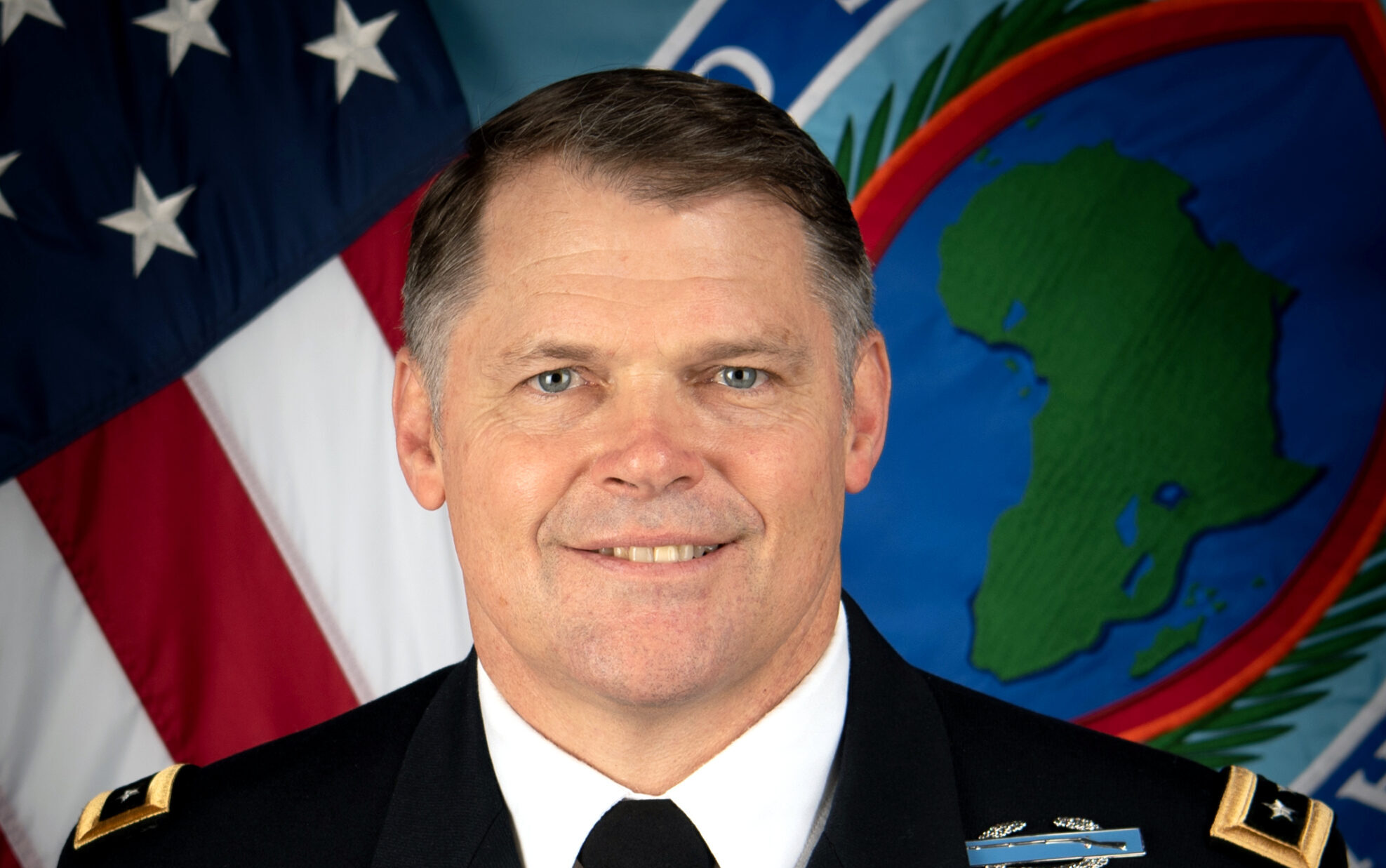
U.S. Africa Command Deputy Commander, U.S. Army John W. Brennan Jr
As the United States marks the 25th anniversary of the 11 September attacks, one of the most important lessons from Africa is that terrorist threats rarely begin with an attack on the United States.
They begin earlier. When armed groups find recruits, develop financing, move through weakly governed areas, gain access to technology, intimidate communities and establish relationships across borders.
That is the setting in which the Deputy Commander, United States Africa Command, John Brennan Jr., views Africa’s current security environment.
Mr Brennan, a US Army lieutenant general, is a three-decade veteran of special operations, with deep expertise forged in counterterrorism and irregular warfare. His position gives him a view of how the United States assesses armed groups, works with African partners and decides when a local conflict has begun to develop wider implications.
Days before the 9/11 anniversary, Mr Brennan described African jihadist organisations as more adaptive, more lethal and more capable of using technology and resources than they were in the years immediately after 9/11.
“The number of terrorist fighters, their lethality, their ability to leverage technology and resources is alarming in Africa, and they’re like water,” he said. “They go the path of least resistance and expand where they are not under CT pressure.”
The significance of that assessment for Nigeria and West Africa is considerable. It suggests that the most important security question is not only where attacks are taking place today. It is where armed groups are building the capacity to survive pressure and appear somewhere else tomorrow.
The Sahel remains one of the world’s most severe concentrations of jihadist violence. Burkina Faso has repeatedly ranked among the countries most affected by terrorism, while Mali is widely regarded as important because of JNIM’s regional reach and its ability to place pressure on roads, supply chains and state authority.
But Africa’s terrorist threat is not limited to the Sahel. Al-Shabaab and ISIS-Somalia remain significant in East Africa. In Mozambique, Islamic State Mozambique has adapted through attacks on roads, fishing communities, forests and mining areas. In the eastern Democratic Republic of the Congo, ISIS-DRC, also known as the Allied Democratic Forces, has exploited farms, forests, mines and transport corridors.
These theatres are not interchangeable. Their histories, armed groups and political economies are different. Yet they raise a common concern: violent extremist organisations are becoming better at treating geography as an opportunity rather than a constraint.
Mr Brennan said the groups are also becoming more connected.
“It is much more interrelated and much more complex than just going after a single group at a single time,” he said.
For US counterterrorism planners, that means looking beyond individual attacks or organisations. The movement of recruits, money, propaganda, weapons, technology and tactics may be as important as the location of a particular battlefield.
It also explains why East Africa receives special attention in the US threat assessment.
“Our priority is obviously where there’s threats to the homeland, and they emanate right now in East Africa,” Mr Brennan said. “Preventing these potential attacks is our number one job, full stop.”
This does not mean that the Sahel is less important. It means that the global map of terrorist violence and the US homeland-threat map are not necessarily identical.
A conflict can be devastating to local communities and strategically important to Africa without yet presenting an imminent threat to the United States. The US threshold changes when local infrastructure begins to support external operations—through money, instructions, facilitators, sleeper networks or leadership linked to plotting beyond the immediate theatre.
“When we see those threats start to metastasise, that’s when we have to take action,” Mr Brennan said.
The 25th anniversary of 9/11 gives that distinction particular weight. The attacks of 2001 demonstrated what can happen when a terrorist organisation has time, space, money, leadership and a permissive environment in which to prepare. The lesson for Africa is not that every local insurgency is on the verge of becoming al-Qaeda in Afghanistan. It is that warning signs often appear before the final attack.
The US approach is therefore selective. This approach seeks to use capabilities that African partners may not have—including intelligence, surveillance, precision targeting, special operations and technical exploitation—while helping local forces address the wider networks causing insecurity.
That approach was visible in two US airstrikes – a 4 September airstrike and a 5 September airstrike – both against al-Shabaab in Somalia. One took place approximately 175 kilometres west of Mogadishu, while the other was near Quumbi, about 75 kilometres north-north-west of Kismayo. AFRICOM said the operations were carried out with Somali government and security partners and were aimed at thwarting al-Shabaab’s ability to threaten US forces and citizens overseas.
The strikes were a secondary event within a wider strategy of disrupting threats before they can mature, while relying on African forces to carry the longer-term security burden.
That same partner-focused approach was evident during Mr Brennan’s recent visits to Angola and Ghana with Assistant Secretary of War Daniel Zimmerman. In Luanda, the two officials participated in the second Joint Angolan-American Defence Cooperation Committee meeting. In Accra, they discussed domestic, maritime, border and regional security capabilities.
Ghana is especially relevant to Nigeria. Its position on the southern edge of the Sahel and within the Gulf of Guinea security environment places it in a region that Abuja also has a direct interest in protecting. For Nigeria, the value of stronger US–Ghanaian cooperation would lie in practical areas such as intelligence-sharing, maritime awareness, border coordination and tracking the movement of terrorist and criminal networks.
The United States Embassy in Ghana described the partnership as involving joint exercises, African land and maritime forces summits, medical exchanges and military education.
Angola represents a different but complementary element of US engagement. It strengthens Washington’s defence relationship in Southern Africa and expands the number of African partners with which the United States can discuss regional security and defence cooperation.
Mr Brennan also connected counterterrorism to what he called “defence economics.” Defence economics is about applying economic methods to questions concerning national defence. This could include the relationship between security, investment, trade, technology and the ability of African states to maintain their own security institutions.
“Security begets economic investment,” he said.
That argument is important for Nigeria and other African countries facing the combined pressures of terrorism, kidnapping, organised crime and youth unemployment. Economic opportunity does not automatically defeat extremism. But when young people have few alternatives, armed groups and criminal organisations can offer income, identity, protection or status.
“What concerns me are narco states popping up with terrorists that are basically the enforcers,” Mr Brennan said.
The warning points to a possible future in which terrorist and criminal networks reinforce each other across weakly governed spaces.
Twenty-five years after 9/11, the most important measure of counterterrorism success may, therefore, be whether governments and their partners can identify a threat before it becomes an international crisis.
For Nigeria, that means connecting national counterterrorism efforts to wider systems of intelligence, border, maritime and financial cooperation. For the United States, it means using force selectively while ensuring that African partners have the capability and legitimacy to sustain the gains.
The objective is not simply to strike where terrorists are visible. It is to understand where they are gaining the ability to recruit, move, finance themselves and influence communities—and to act before that local power becomes a broader threat.
Pearl Matibe is a Washington, D.C.-based geopolitical analyst and correspondent covering Congress, the Pentagon, the State Department, and White House, with expertise in foreign and defence policy. Follow her on Twitter: @PearlMatibe.