Syrian students get caught in rift between Druze leaders and Damascus
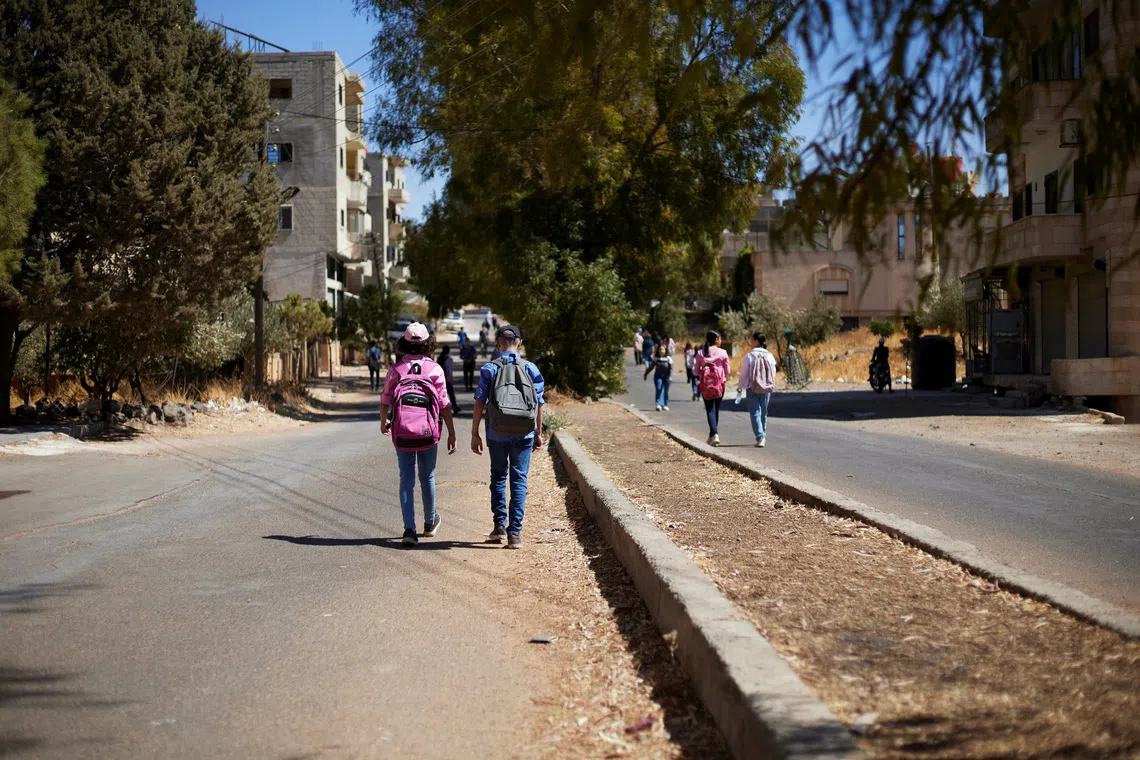
SWEIDA, Syria Oct 2 - Young people in Syria's Sweida province are unable to progress through school and university due to a deepening rift between the post-Assad Islamist government and the Israel-aligned Druze leaders of the last area outside central control.
Their dilemma reflects deep trauma and lingering instability in the province, where hundreds of Druze were killed last year in sectarian violence by government-linked forces and Israel struck Syria's military, saying it was defending the minority.
Maram Abu Hamra had been pursuing her dream of studying architecture in Syria's northern city of Aleppo but has been back in Sweida for more than a year, too afraid to return to government-held territory.
"Every student had a dream of being an engineer, a doctor, an artist -- or anything that they can achieve. But sadness, fear and resentment took control instead," the 20-year-old told Reuters.
Sweida, home to many of the estimated 700,000 Druze in Syria, lies in the southwest, bordering Jordan. Most of it is now controlled by forces loyal to Sheikh Hikmat al-Hajari, a Druze cleric who declared his community 'part and parcel of the state of Israel' in an August video.
Facing calls from Israeli Druze to help Syrian Druze, Israeli leaders have cited protecting them as a reason for attacking Syria repeatedly.
Syria's President Ahmed al-Sharaa, who aims to restore the country's relations with the West after overthrowing longtime ruler Bashar al-Assad in 2024, has vowed to reunite Syrian territory under a single leadership.
But many Druze, Arabs who follow a branch of Islam seen as heretical by some Sunni Muslims, do not trust assurances that he will protect their rights, citing his earlier links with al Qaeda as well as last year's mass killings.
"What I want to say is that our fear is justified, because there are past incidents that were not that long ago, that were barely a year ago," said Fahed Abu Saad, whose son and daughter missed their final exams this year.
Syrian authorities first cancelled exams for high school and university entry in Sweida last year as a result of the killings. Syrian government troops withdrew from most of Sweida and Hajari barred them from returning, hardening his stance against integration and founding an armed faction called the National Guard.
Hajari's areas are now the only ones outside government control, after Kurdish authorities in Syria's northeast began integrating earlier this year following a lightning government offensive.
Even there, Syria's Kurds are seeking to preserve schooling in their mother tongue.
Many Druze students studying in other parts of Syria returned to Sweida in 2025.
But this year, student exams were disrupted again, with the government and Druze factions trading blame once more.
In the spring, Damascus offered to send proctors into Sweida to supervise exams, but some Druze saw it as an attempt to redeploy government forces.
Qutaiba Azzam, the government's media relations director for Sweida province, said local factions threatened the proctors, a claim Reuters could not independently verify.
In August, Damascus proposed that students from Hajari-held areas take their exams in a northern part of Sweida province now held by the government.
But that spooked students and their parents.
"It is not allowed for us to be scared that our children go to the northern countryside, but it is allowed for the ministry of education to be scared for its envoys to come here," Abu Saad said.
Some Druze, still shaken by the 2025 killings, fear Hajari's forces would label students as traitors for travelling into government-held territory for the exams.
Government-appointed provincial official Tarek Adwan told Reuters armed factions in Sweida city had attacked buses meant to carry students to their exams, a claim Reuters could not independently verify.
Hajari's office did not reply to repeated requests for comment. Syria's education ministry declined to comment.
Only 150 of 13,700 school students in Sweida managed to take exams this year that they need to progress into high school or university, according to government figures shared on Syria's state news agency.
The rest -- as well as university students like Abu Hamra -- remain in limbo, along with the Sweida province as a whole.
The area has traditionally been fairly autonomous, including during the nearly 14-year civil war that killed hundreds of thousands of Syrians and forced millions from their homes.
Syria's government, Jordan and the United States agreed last year on a seven-step roadmap to resolve the Sweida dispute, but the United Nations said in June that it had made "no progress." REUTERS