
Susan Delacourt: Mark Carney’s budget bets Canadians will buy a story about sovereignty and pride - Toronto Star
A critical voice sees the new emphasis as a 'little drizzle of maple syrup' coating the government's other priorities.
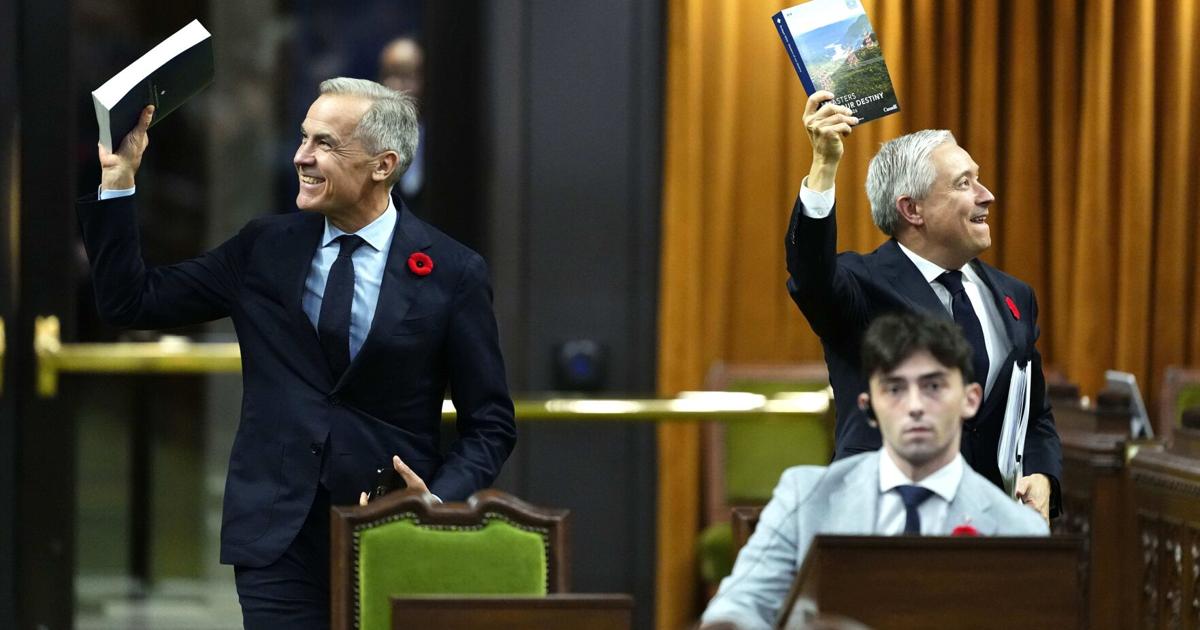
Minister of Finance and National Revenue François-Philippe Champagne, right and Prime Minister Mark Carney arrive in the House of Commons to table the federal budget in Ottawa, on Thursday, Nov. 5, 2026. Canadian books, though not necessarily the budget document itself, were among the cultural products that received taxpayer support in the budget.
Susan Delacourt is an Ottawa-based columnist covering national politics for the Star. Reach her via email: sdelacourt@thestar.ca or follow her on X: @susandelacourt
The 500-plus-page budget that has now landed before Canadians is not exactly a piece of literature — but it is coming from a government with some literary aspirations.
Mark Carney’s government is leaning on themes of culture and identity with Budget 2026, hoping that it tells a story of Canadian pride and patriotism at this moment in the country’s history.
What is this moment? In keeping with this government’s habit of talking about Donald Trump without actually mentioning the U.S. president, the budget drapes many of its measures with the mantle of sovereignty.
It was Trump’s sovereignty threats that put Carney in office and prompted the prime minister to walk away from trade talks with the U.S. later this year. So it should come as no surprise that it’s a uniting thread throughout those hundreds of pages.
Some of that is packaging — fiscal sovereignty, defence sovereignty, investment sovereignty, to name a few — but the budget’s measures on cultural sovereignty display a side of the Carney government that it shows less often.
“Sovereignty means building a country where Canadian culture thrives, where Canadians see themselves in their stories, music, songs and movies,” the budget announces in the chapter about a “strong and united Canada.”
Once again, the shadow of the U.S. looms here, without specifically mentioning it. “As more of what we watch, read and listen to is coming from beyond our borders, Canadians deserve to see themselves in their stories,” the budget states.
It’s here where we see a government dabbling in the literary — the establishment of a Canada Creative Credit to give tax relief to people in the creative arts, setting up a national digital collection of Canadian books, to be made available free to citizens. The Canada Book Fund gets $20 million over four years to boost the production of more Canadian books.
It’s in the budget’s culture section, too, that we see a government trying to fuse populism and patriotism with some measures that will go over well with many Canadians, making admission permanently free or discounted to people under 25 at museums, galleries, parks and for rail travel.
Big Canadian cultural institutions, from the National Gallery and the National Arts Centre to the CBC/Radio-Canada are also singled out for infusions of cash. Though this isn’t an overly political budget, I’m reasonably sure the Carney government wouldn’t mind if this spending is a reminder of what might not happen under a Conservative government — especially the continued funding for the CBC.
Ditto for the budget measures to support journalism as a whole, whether that’s the journalism labour tax credit or the $134 million over four years for the Local Journalism Initiative.
In an era where Trump seems to be at permanent war with the journalism industry, you could also see that as a declaration from Canada: no, that’s not happening here.
Governments work hard to create what the political pros like to call the “narrative” of major announcements like a budget. Finance Minister François-Philippe Champagne has been flagging for weeks that he wanted this budget to be seen in the larger context of culture and identity.
That’s been feeling a bit like a course correction. Carney’s government spends a lot of time talking about projects and investment and construction, so perhaps they’re looking for a softer side.
The finance minister came close to making that admission when he talked to reporters on Thursday. “It’s about defending our country for sure, but also celebrating who we are,” Champagne said. “It’s not just about the hard assets, but it’s telling our story.”
But not everyone will come away from this budget calling it a cultural milepost.
Armine Yalnizyan, economist and senior fellow with the Atkinson Foundation, had been hoping that if the government did want to show its softer side, it would have had more to say about the “caring economy,” but she didn’t come away with much reassurance there.
“There’s not enough child care, health care, or long-term care … crickets on this whole issue,” she said.
She said she overheard on Thursday what she thought was the best description of this budget.
“This is a defence budget. It’s an investment budget. And there’s a little drizzle of maple syrup on top.”
Ultimately, it will be up to the members of Canada’s cultural communities to assess whether this budget’s emphasis on culture and identity is non-fiction or fiction. And to be fair, this budget is treating the patriotic moment in Canada’s history as a resource, or even an asset.
The prime minister himself, in his pre-political life, is no stranger to all things literary. He’s written a book and was a member of a book club — some of them still in contact with him today.
Their reviews of the budget would be fascinating to hear. It’s not literature, but it’s tried hard to land as a story.
Error! Sorry, there was an error processing your request.
There was a problem with the recaptcha. Please try again.
You may unsubscribe at any time. By signing up, you agree to our terms of use and privacy policy. This site is protected by reCAPTCHA and the Google privacy policy and terms of service apply.
Opinion articles are based on the author’s interpretations and judgments of facts, data and events. More details
Susan Delacourt is an Ottawa-based columnist covering national politics for the Star. Reach her via email: sdelacourt@thestar.ca or follow her on X: @susandelacourt


