Susan Delacourt: In Mark Carney’s Canada, a pipeline announcement is the new unity rally - Toronto Star
Not only is the prime minister contending with sovereignty issues in the trade war with the U.S., but he has them at home, too.
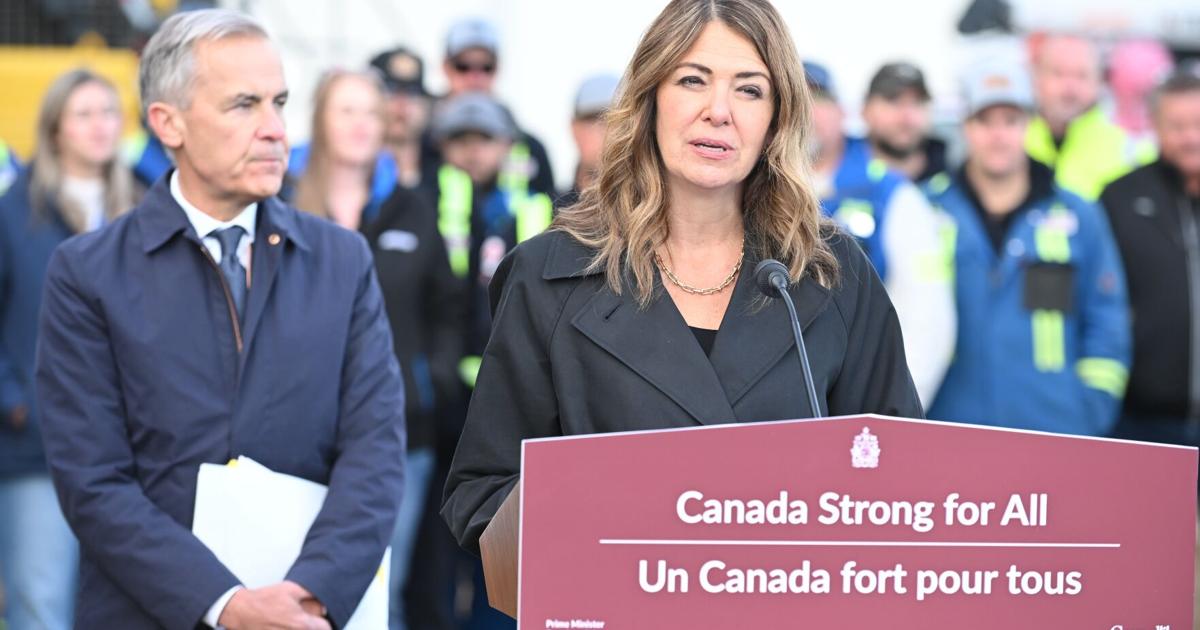
Alberta Premier Danielle Smith speaks as Prime Minister Mark Carney listens in Fort McMurray on Oct 1, 2026.
Susan Delacourt is an Ottawa-based columnist covering national politics for the Star. Reach her via email: sdelacourt@thestar.ca or follow her on X: @susandelacourt
The first day of October was a big one for Alberta. At the same time an Alberta-born astronaut was getting launched into space, Mark Carney and Danielle Smith were unveiling plans for a new pipeline here on Earth.
An even bigger day looms later this month, when the province votes on whether to hold an independence referendum, and that pipeline announcement factors heavily into that choice being laid before Albertans.
Carney wasn’t subtle about it, punctuating his remarks and answers to reporters’ questions with the refrain, “Canada is working.”
“The demonstration of today’s announcement is Canada is working,” he said when asked how he wanted referendum voters to see the announcement.
The premier said outright that she hoped that people tempted to vote for independence were watching.
Noting that polls put the separatist sentiment in the low 20 per cent range, Smith said, “I don’t like the fact that many of our fellow citizens have given up on Canada, and I think it’s incumbent upon both myself and the prime minister to continue identifying the issues that have caused that disheartening reaction.
The Pacific Link pipeline she said, “is one example, along with the work we’ve done over the last year, I think, of demonstrating that co-operative federalism can work in action.”
The plain fact, though — and Smith and Carney know this — is that some of that 20 or so per cent of Albertans won’t be mollified by a pipeline.
Jeffrey Rath, one of the leading separatist voices, was quick to post on social media after the Carney-Smith announcement that it only strengthened the case for Alberta independence.
“If this pipeline gets built it is projected to generate 268 billion in royalties and likely hundreds of billions more in associated economic activity and revenue,” Rath declared, adding in all-capital letters: “THIS MAKES ALBERTA INDEPENDENCE THAT MUCH MORE AFFORDABLE.”
For the record, Carney and Smith weren’t using that $268-billion figure yesterday, with the prime minister talking about more than $100 billion in government revenues and the premier talking of “tens of billions.”
But the argument is clear: the pipeline should be part of an independent Alberta.
This is what the fall of 2026 looks like in Canada. Not only is Carney contending with sovereignty issues in the battle with the U.S., but within this country too. A major national project becomes a jumping-off point for what’s defining the nation these days.
Carney was asked at the news conference about the Quebec election next week, and assertions from Parti Quebecois Leader Paul St.-Pierre Plamondon — who could end up as premier — that the federal government is “anti-democratic.” (Plamondon has said Quebec won’t hold a referendum on sovereignty until Donald Trump is no longer the American president, but he hasn’t put the plan away forever.)
Carney fell back on his “Canada is working” refrain, which he said applied to Quebec, Alberta and the country as a whole. “The federal government will work with the next Quebec premier in a spirit of co-operative federalism,” he said. “This is a time where we’re trying to build Alberta, Canada and Quebec to make our country stronger, more autonomous, more sovereign.”
The pipeline also threatens to be a testing ground for Canada’s relationship with Indigenous people — a reality Carney had to confront head on, acknowledging that the consultation process had just begun.
More than 130 Indigenous communities along the pipeline’s proposed route have already been consulted, but there’s almost another year to go before consultations wrap up next September, and that’s plenty of time for fractures to emerge in that constitutional relationship.
Carney has given every indication that he takes the threat of Alberta separatism seriously, and has said he wished this referendum wasn’t happening at this particular juncture in the country’s history. He says he fears that too many Albertans may believe, as those in Britain did a decade ago, that there would be no cost in voting for greater independence. (In the case of Brexit, that was independence from the European Union, which Carney has also been embracing of late.)
The prime minister has made periodic appearances in Alberta since the referendum was announced, but he hasn’t really done any rally-around-the-flag rallies, as Jean Chretien did during Quebec’s referendum in 1995.
Thursday’s announcement was Carney doing his version of a unity rally, speaking in the language of projects and money.
Meanwhile, that other Albertan in the news on this big day, astronaut Joshua Kutryk, was hurtling toward the International Space Station, where he will spend the next six months.
By the time he’s back, Kutryk will know whether his home province is headed to another referendum, and whether the pipeline announcement held the same day as his launch worked to bring separatism aspirations back to Earth, too.
Error! Sorry, there was an error processing your request.
There was a problem with the recaptcha. Please try again.
You may unsubscribe at any time. By signing up, you agree to our terms of use and privacy policy. This site is protected by reCAPTCHA and the Google privacy policy and terms of service apply.
Opinion articles are based on the author’s interpretations and judgments of facts, data and events. More details
Susan Delacourt is an Ottawa-based columnist covering national politics for the Star. Reach her via email: sdelacourt@thestar.ca or follow her on X: @susandelacourt