Superbloom season: A fynbos revival takes root at Grootbos - IOL
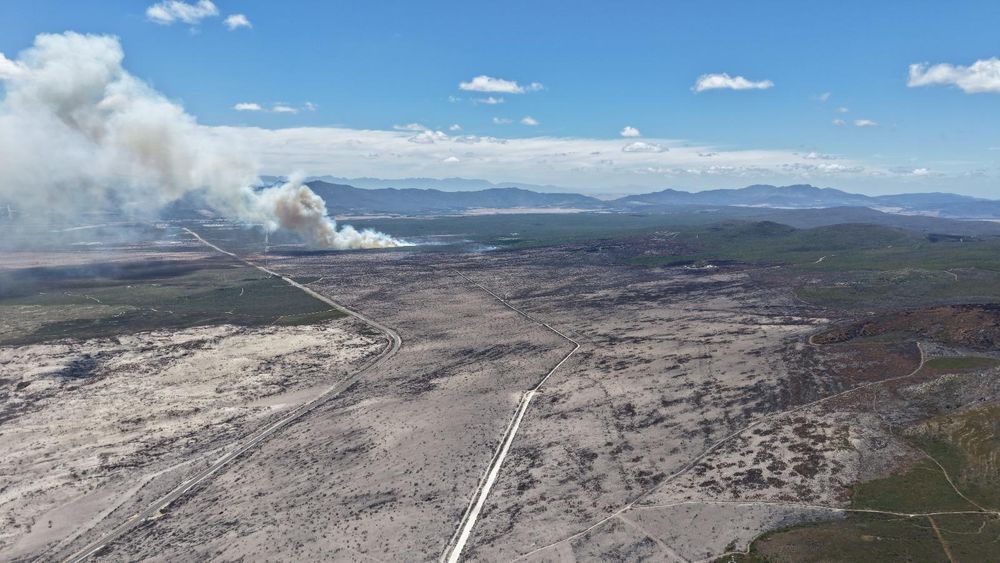
Grootbos Foundation conservation director Sean Privett, who helped fight the blaze, described the fire as a display of "raw elemental power."
Between November 2025 and January 2026, wildfires ravaged Grootbos Private Nature Reserve near Stanford, destroying about half of the 4,000-hectare estate and leading to the evacuation of guests.
Smoke billows over the hills of the Grootbos Private Nature Reserve during the devastating late-2025 wildfires.
The aftermath of the blaze left large sections of the Walker Bay hills blackened, though patches of surviving vegetation remain across the 4,000-hectare estate.
The fires left sections of the hills above Walker Bay blackened, with surviving vegetation forming patches across the reserve. More than 2,000 hectares burnt, Grootbos said.
Hot, dry, and windy conditions fueled the flames, prompting a massive, coordinated response from reserve staff and local firefighting teams.
The fires spread during hot, dry and windy weather, drawing reserve staff, neighbouring landowners, and firefighting teams into the response.
While the fires tragically claimed some wildlife, Grootbos reported no human injuries and limited damage to infrastructure.
Some wildlife died, although no people were injured and infrastructure damage was limited, Grootbos said.
With the immediate danger passed, conservationists are already monitoring the charred landscape for the first signs of a spectacular natural revival.
Sean Privett, conservation director at the Grootbos Foundation, joined the firefighting effort during the late-2025 fires. The experience allowed him “to witness its raw elemental power”, Privett said.
Prior to the fires, aging protea canopies had densely shaded the fynbos, suppressing the growth of underlying vegetation.
With the immediate danger over, the reserve’s conservation team is looking for the first indications of how the vegetation will recover. “Over the next few years, we will witness a spectacular natural revival,” Privett said.
Before the fires, some parts of Grootbos’s fynbos had become densely overgrown. Protea canopies shaded the vegetation beneath them, and ageing shrubs were declining, Privett said.
Far from being purely destructive, fire acts as a vital "reset button" for the fynbos ecosystem to maintain biodiversity.
“Fire is an essential part of fynbos ecology. Without it, the ecological clock stalls, species falter, and diversity fades,” he said. “What appears to be devastation is, in truth, the fynbos ‘reset’ button.”
With the dense canopy burnt away, crucial sunlight can now reach the soil to stimulate the growth of dormant seeds.
Where the canopy has burnt away, more light reaches the ground, allowing plants suppressed beneath the older vegetation another opportunity to grow.
For some species, the response begins with exposure to heat or smoke. Research by the Royal Botanic Gardens, Kew, and partner institutions examined germination in 40 species of Leucadendron, members of the protea family.
Certain species in the protea family rely entirely on post-fire conditions to release their seeds from cones or germinate from the soil.
Some release seeds from cones following fire; others had seeds in the soil that responded to smoke, or to both heat and smoke. “Being able to predict germination requirements of a plant is extremely helpful,” lead researcher Dr Rosemary Newton said
The clearing of mature, dense fynbos paves the way for a vibrant succession of new flowering seasons.
Conservationists now anticipate a succession of flowering seasons, as fire stimulates germination and clears space for plants previously hidden beneath mature fynbos.
Grootbos experts are predicting a historic floral "superbloom," the likes of which haven't been seen on the property in two decades.
Grootbos has described the anticipated flowering as a “superbloom” unlike anything seen on the property in about two decades.
The landscape's transformation is expected to unfold gradually over the coming months and years as different species resprout and bloom.
That expectation extends beyond a single season: the landscape will change as different species germinate, resprout and flower in response to the conditions following the burns. Grootbos said the transformation would unfold over months and years.
At Grootbos, those different responses are expected to produce a changing display of flowers. “Guests can expect an explosion of species long hidden beneath dense foliage: delicate orchids will emerge, while irises and fire lilies will paint the landscape with colour,” Privett said.
The post-fire environment offers botanists a rare, temporary window to document the early stages of fynbos regeneration before the brush grows dense again.
Some plants will establish from seed; others will regenerate from structures that survived the flames. Their appearance will give botanists an opportunity to document the early stages of recovery, before the vegetation grows dense again.
The recovery is taking place within the Cape Floristic Region, the smallest of the world’s six floral kingdoms. “The Cape Floristic Region sustains 20% of the total number of plant species found on the African continent,” UNESCO said.
The Grootbos recovery is a vital event for the Cape Floristic Region, a unique biome home to thousands of plant species found nowhere else on Earth.
Roughly two-thirds of its approximately 9,000 species occur nowhere else on Earth, according to NASA’s Earth Observatory. That concentration makes the fate of individual habitats especially significant for species whose entire ranges occupy a limited area.
The reserve said it had recorded more than 1,030 plant species, with seven species new to science discovered there since 2001. The coming flowering seasons could bring previously inconspicuous plants into view, particularly those that flower in response to fire.
“New species, or those that flower specifically after fire, return,” Privett said, also anticipating the reappearance of “dormant species not seen for decades”. Further discoveries are possible, although the immediate task will be to identify and record what emerges.
The longer-term outcome will depend partly on whether the recovering plants have enough time to mature before another burn. “Too frequent fires, however, prevent plant species that take long to mature from setting seed and producing offspring,” CapeNature said in its conservation reporting.
True recovery will require these new seedlings to survive, mature, and replenish the seed bank before the next inevitable fire cycle begins.
A successful flowering season is therefore only one measure of recovery. Seedlings must survive, reach reproductive age and replenish the reserves of seed that will support future generations.