
South Korea and Kazakhstan sign agreements worth €16.5 billion
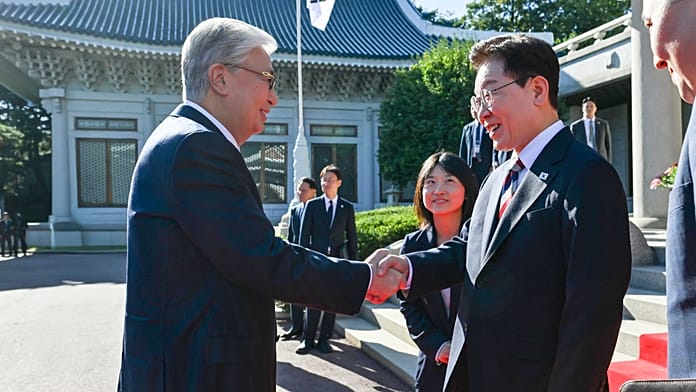
President of Kazakhstan Kassym-Jomart Tokayev, during his official visit to South Korea on Tuesday, said that the countries should double their trade turnover, which last year amounted to €2.6 billion.
“To achieve this, it is important not only to increase volumes, but also to qualitatively transform the structure of trade and expand the range of high-value-added goods,” Tokayev said during his meeting with Prime Minister Han Seongsook.
He welcomed the development of the Comprehensive Program for Trade, Economic, and Investment Cooperation between Kazakhstan and Korea for 2027–2030 and offered to prepare a roadmap for industrial cooperation.
In a meeting with Korean President Lee Jae Myung, Tokayev highlighted the productive nature of the visit, which resulted in signed commercial agreements worth €16.5 billion.
"We are firmly committed to taking our cooperation to a qualitatively new level and comprehensively strengthening the bonds of friendship and partnership," said the Kazakh president.
The heads of state also agreed to elevate bilateral relations to a Future-Oriented Comprehensive Strategic Partnership.
As part of the visit, President Tokayev met with a number of heads of Korean companies and spoke at the Kazakhstan-South Korea Business Roundtable.
He noted that foreign direct investments from South Korea to Kazakhstan over the years of cooperation came to €10.4 billion, while over 1,000 Korean companies work in Kazakhstan. Tokayev offered to expand this relationship and indicated a number of areas where South Korean and Kazakhstani companies could work together.
For South Korea, the main point of interest was raw and critical materials.
President Lee Jae Myung welcomed the signing of the Framework Agreement on Crude Oil Cooperation, which established details of the decision to import 18 million barrels of crude oil from Kazakhstan. The country decided to make this purchase in April to mitigate the effects of the Middle East instability on oil supplies.
Lee also welcomed the establishment of a the Rare Metals Technology Cooperation Center in Almaty. In this regard, Kazakhstan vouched to increase the supply of materials and components for microelectronics and semiconductor manufacturing necessary for the production of all appliances.
For Kazakhstan, South Korea is a source of technological advancement and capital. The negotiations spanned construction, car manufacturing, oil and gas processing, digital technologies, food processing and logistics.
"We believe the time has come to expand South Korea's participation in the development of the Middle Corridor," said Tokayev, proposing joint ventures and logistics projects, such as logistics centers and multimodal terminals established by CJ Logistics and LX Pantos, which will ensure the seamless transit of Korean cargo through Kazakhstan to Europe.
Hyundai Engineering is already taking part in the construction of the Karachaganak gas processing plant and Tokayev invited more Korean companies to establish their presence in gas processing, petrochemicals, and energy infrastructure.
The two countries also have a long-standing relationship in car manufacturing with Hyundai factory working in Kazakhstan for six years and Kia opening a factory last year.
In a meeting with Hyundai Motor Group President for Strategic Planning Sung Kim, the Kazakh president outlined the country's desire to become a regional car production and export hub. The parties agreed to deepen localisation, expanding the production of automotive components, and boosting the industry's export potential.
Hyundai Motor Company and Astana Motors also exchanged the agreement on production of new Hyundai Tucson in Kazakhstan.
One other venture the Kazakh president tried to attract partners to was the construction of the Alatau Smart City near Almaty.
Korea Overseas Infrastructure & Urban Development Corporation (KIND) is already taking part in the creation of the city master plan and the development of residential areas. Korea Advanced Institute of Science & Technology (KAIST) is planning to build its branch in the city, while Lotte plans a hotel and residential complexes.

