
SMOKERS’ CORNER: THE MAKING OF HAMAS

During the 1970s and 1980s, a dramatic political shift permanently altered the geopolitical topography of the Middle East and the broader Muslim world. Islamism gained momentum as secular nationalism declined. It was a collapse accelerated by the defeat of Egypt, Syria and Jordan in the 1967 Arab-Israeli War.
At the time, Western powers viewed Islamism, a right-wing ideology opposed to socialism and secular nationalism, as a useful counterweight to Soviet-backed nationalist regimes in Egypt, Syria, Iraq and, later, Libya. One of the most consequential applications of this strategy unfolded in the Israeli-occupied West Bank and Gaza. Anti-Israel Palestinian resistance was largely dominated by secular and left-leaning groups operating primarily within the Israeli-occupied territories of Palestine and neighbouring nationalist Arab states.
The French scholar Jean-Pierre Filiu wrote that, in order to neutralise Palestinian resistance groups, Israel quietly nurtured the growth of local Islamist movements, specifically the Palestinian branch of the Muslim Brotherhood. This was a deliberate strategy, designed to fragment and undermine the primary face of Palestinian nationalism: Yasser Arafat’s left-leaning and secular Palestine Liberation Organisation (PLO).
For Israeli strategists, the PLO’s anti-colonial rhetoric posed a serious political threat. To curb the PLO’s influence, Israeli military intelligence began to cultivate a counterweight in the shape of Sheikh Ahmed Yassin. A charismatic Palestinian cleric, Yassin had begun building a social and religious network under the Muslim Brotherhood umbrella in Gaza, culminating in the founding of al-Mujama al-Islami in 1973.
The PLO viewed Yassin’s followers as “quietist fundamentalists” preoccupied with social welfare and moral purification. The PLO did not exhibit concern even when Israeli authorities permitted al-Mujama to operate unhindered. In 1979, the Israeli military administration formally recognised the al-Mujama charity, granting it permission to establish mosques, schools and medical clinics across Gaza.
Israel’s relentless efforts, across decades, to weaken secular Palestinian resistance to its occupation of Palestine by backing a ‘counterweight’ ultimately backfired. The current Hamas is the blowback
According to Filiu, while PLO sympathisers faced relentless crackdowns, Yassin was allowed to build a vast social network. Gulf funds, primarily from Saudi Arabia, flowed into al-Mujama’s coffers with minimal Israeli interference. In 1978, Israeli authorities even permitted the establishment of an Islamic university in Gaza, which eventually became a stronghold for Islamist recruitment.
Years later, Brig Gen Yitzhak Segev, the Israeli military governor of Gaza in the late 1970s and early 1980s, admitted that he was provided a state budget to assist in funding Yassin’s project to offset the PLO. In the book Israel’s Wars, political scientist Ahron Bregman wrote that defence minister Yitzhak Rabin maintained a policy throughout the 1980s of tolerating Yassin and his organisation’s activities, provided their hostility remained directed at the PLO rather than Israeli soldiers.
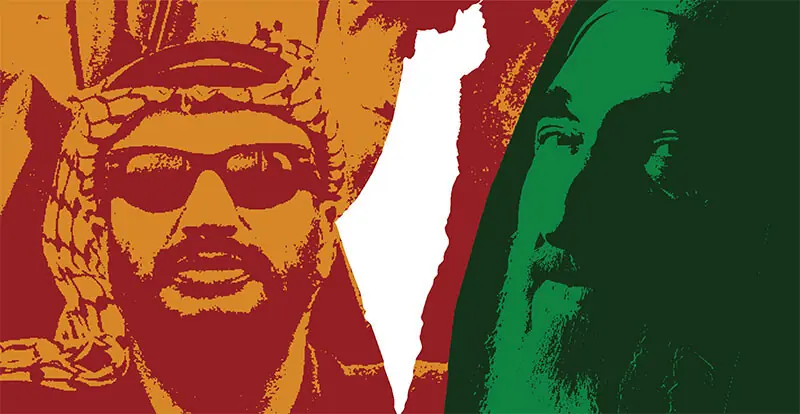
The late 1970s and early 1980s saw violent clashes erupt across Gaza and the West Bank between the PLO and Yassin’s followers. Members and supporters of al-Mujama torched PLO offices, attacked cinemas and targeted secular intellectuals.
However, the assumption that Yassin’s movement would remain a benign social organisation focused solely on rivalling the PLO proved to be a miscalculation. Writing in The Wall Street Journal in 2009, journalist Andrew Higgins documented how Israeli forces raided Yassin’s home in 1984 following a tip-off, discovering a concealed weapons cache. Yassin was arrested and sentenced to 12 years in prison. Yet, Higgins added, in a move underscoring Israel’s persistent conviction that Islamists remained a secondary threat compared to secular nationalists, Israel released Yassin just 11 months later, in 1985.
The turning point occurred in December 1987 with the outbreak of the first Intifada, a spontaneous grassroots uprising against Israeli occupation. Fearing that the PLO would bounce back to take command of the uprising, Yassin and his inner circle transformed al-Mujama al-Islami into a militant resistance organisation. In early 1988, the group published its founding covenant under a new name: Hamas.
Hamas was thus the direct byproduct of a charitable and proselytising network shaped in the 1970s by the Gaza chapter of the Muslim Brotherhood and facilitated by Israeli policy. Its original objective of drawing Palestinians toward religious piety and discrediting secular groups, evolved during the Intifada into an armed struggle. Hamas’ 1988 charter combined militant anti-Zionism with unyielding Islamism, calling for an Islamic state in Palestine and rejecting the PLO’s gradual move toward a diplomatic, two-state compromise.
Even during the initial months of the Intifada, Israeli authorities hesitated to suppress Hamas with the severity applied to the PLO, hoping the group would fracture the uprising. However, as Higgins observed, when Hamas initiated armed attacks, kidnappings and suicide operations against Israeli personnel, Tel Aviv recognised the scale of its strategic error.
By the time Israel outlawed Hamas and rearrested Yassin in 1989, the network that Israel helped nurture was deeply entrenched. This manoeuvre yielded a fierce adversary. Much like the American backing of the Afghan mujahideen in the 1980s, Israel’s policy towards the Palestinian Muslim Brotherhood became a classic instance of strategic blowback. A quietist religious charity group transformed into an entrenched militant movement.
Even after the PLO’s influence waned from the 1990s onwards, evidence indicates that Israel’s strategic interest in leveraging Hamas persisted. As reported by The New York Times and The Times of Israel in 2023, Prime Minister Benjamin Netanyahu’s far-right coalition governments facilitated hundreds of millions of dollars in Qatari cash transfers into Gaza between 2009 and 2023. The objective was to keep Hamas viable in Gaza, thereby keeping the Palestinian leadership permanently divided and isolating the PLO in the West Bank.
Netanyahu explicitly articulated this doctrine during his party’s meeting in March 2019, stating: “Anyone who wants to thwart the establishment of a Palestinian state has to support bolstering Hamas…” This was widely quoted by major Israeli newspapers.
This policy relied on tactical coordination, work-permit allocations and economic incentives to manage Hamas, while derailing two-state diplomatic efforts. As detailed in one of Israel’s largest newspapers, Haaretz, in 2023, this long-standing gamble to sustain Hamas as a political wedge ultimately collapsed with the Hamas attacks of October 7, 2023.
In the aftermath, some analysts argued that the far-right Israeli administration intentionally overlooked intelligence warnings to allow an attack that could serve as a pretext for destroying Gaza and dismantling opposition in the West Bank. In November 2023, The New York Times reporters Ronen Bergman and Adam Goldman revealed that Israeli military and intelligence agencies had possessed a detailed, 40-page Hamas attack plan for over a year.
This may be a show of reckless indifference, or an exhibition of hubris and a flawed strategic doctrine that assumed Hamas was permanently deterred. Indeed, but there is an increasing number of analysts who view the failure to act on these blueprints as evidence of deliberate omission.
Published in Dawn, EOS, October 4th, 2026


