Scientists built a computer powered by bacteria to solve complex maths problems
What if the next big breakthrough in computing does not come from a faster chip, but from billions of living bacteria working together?
Scientists are testing precisely that idea. As per a recent report by The Microbiologist, a research team led by Canada's McGill University has developed a bacteria-powered biocomputer that can explore complex mathematical problems by sending living microorganisms through tiny networks of interconnected channels.
Unlike conventional computing systems, which can require enormous computational resources to examine complex combinations, this approach uses bacterial growth to explore multiple possible solutions simultaneously.
The researchers believe it could eventually find applications in molecular biology, encryption and artificial intelligence. But this is still a proof of concept, not a computer ready to replace the machines we use today.
The idea is to use living cells as biological processors.
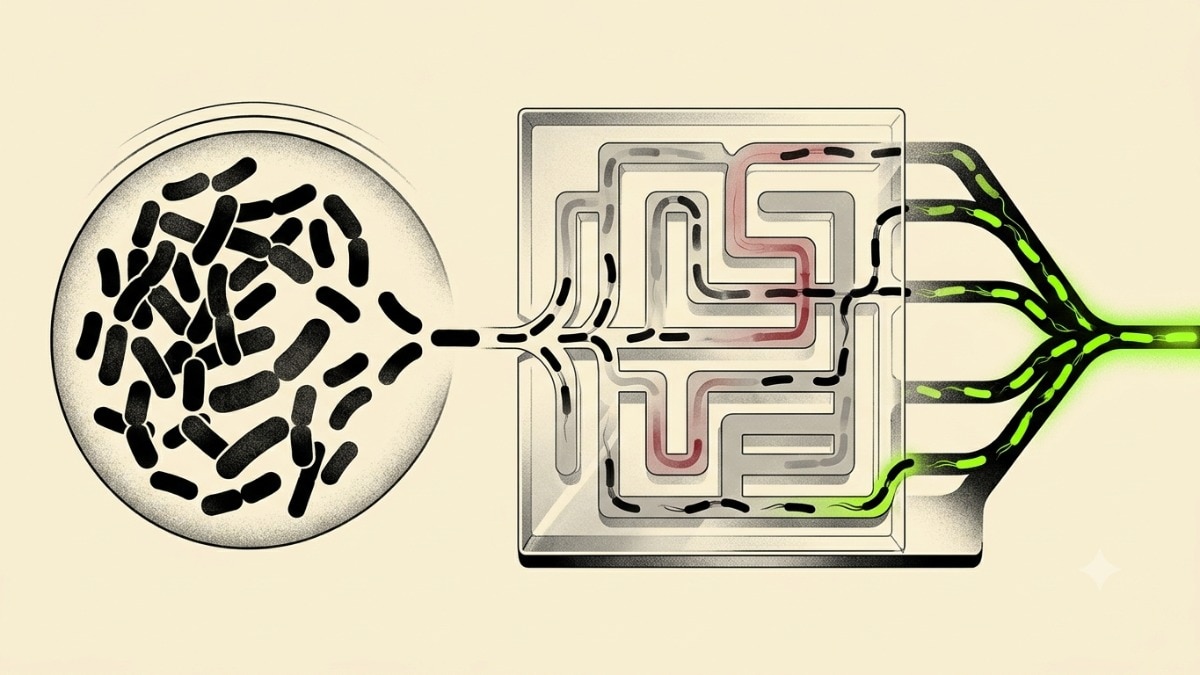
The research team first converted a mathematical problem into a graph representing different possible choices. They then recreated this structure using a network of tiny, interconnected channels.
Each route through the network represented a possible solution, while specially designed junctions acted as decision points.
As bacteria moved through these channels and multiplied, they explored different routes simultaneously. The researchers could then observe their movements and use automated image analysis to identify routes that met the problem's conditions.
Bacterial multiplication is central to the concept. As the microorganisms divide, they create more biological processors, allowing the system to explore more possibilities.
Senior author Dan Nicolau, a Professor of Bioengineering, compared this to having a million chips working together instead of relying on a single chip.WHAT COULD LIVING COMPUTERS SOLVE?
The researchers see potential applications in areas where exploring enormous combinations of possibilities is particularly difficult.
These include understanding protein structures, solving problems in molecular biology and exploring certain encryption-related challenges.
The approach could also offer a different way of tackling problems in AI. Nicolau argues that conventional AI often identifies patterns from available data, while the proposed system aims to explore possible solutions directly.
However, these are potential applications, not capabilities that have already been demonstrated across all these fields.WHY BACTERIA CANNOT REPLACE YOUR COMPUTER YET
There are considerable hurdles to overcome.
Researchers identified problems such as errors at channel junctions, where bacteria may take unintended routes. Overcrowding is another concern as bacterial populations multiply and fill the available space.
The team has explored controlling bacterial growth through temperature adjustments, but managing these biological systems remains challenging.
There is also a fundamental difference between biological and electronic computing. Bacteria may offer massive parallel processing potential, but individual biological processors are much slower and less predictable than electronic circuits.
The project, which involved researchers across Canada, Europe, the UK and Australia over two decades, is an intriguing experiment in computing.
For now, it does not spell the end of silicon chips. It does, however, raise an interesting possibility: could the computers of tomorrow be partly alive?- EndsRead | Bacteria that think? MIT engineers build living systems that computeRead | As RAM crisis deepens, MIT engineers build working computer circuits using bacteria