
Russia Issues Warning As Trump Considers New Military Base - Newsweek
Russia has criticized a proposed permanent U.S. military base in Lithuania and plans advanced by the country's lawmakers on Tuesday to scrap a ban on nuclear weapons being stationed in the country.
Lithuanian Prime Minister Mindaugas Sinkevičius said on Tuesday that Vilnius would be willing to pay the cost of establishing a new American base in the Baltic nation, shortly after President Donald Trump said the U.S. would "certainly look" at whether a military facility in the country would be viable.
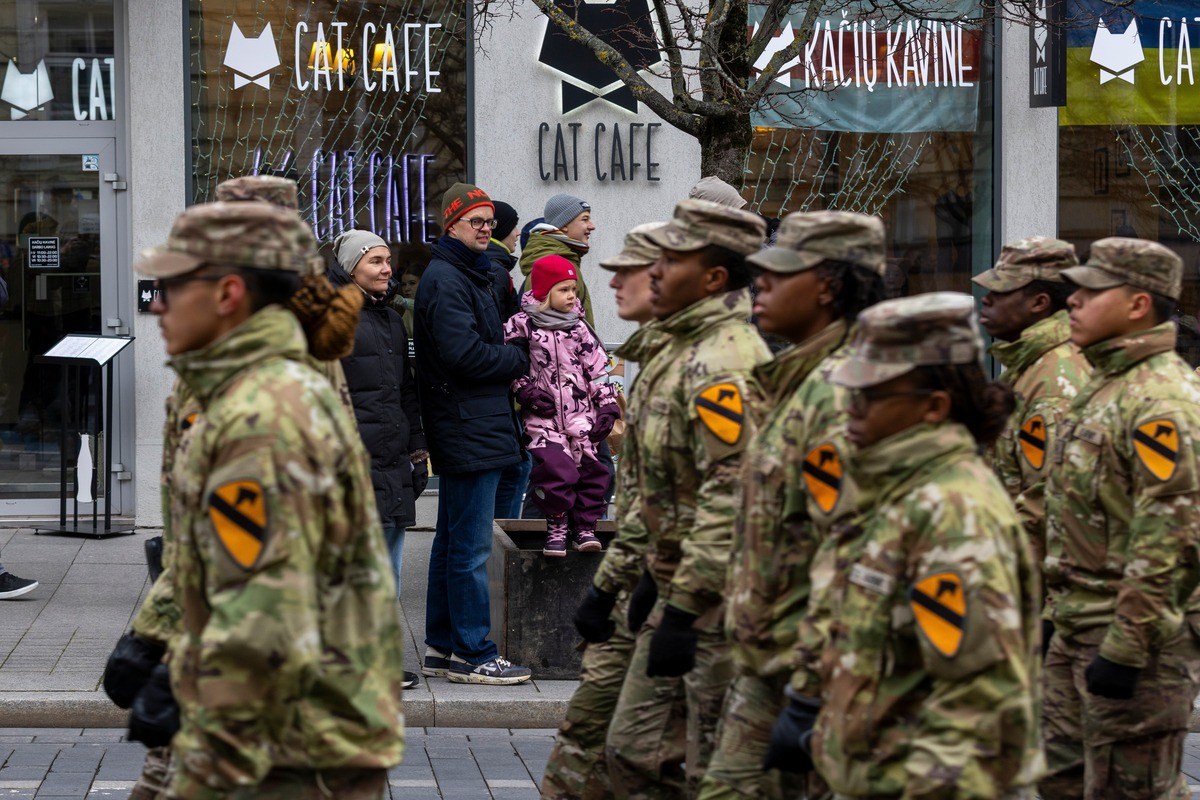
Roughly 1,000 U.S. soldiers are regularly sent to Lithuania on a rotational basis, although Trump paused a fresh deployment of troops to the Baltic state this summer as the Pentagon forged ahead with a review of all its forces in Europe.
The Lithuanian government then said in late September that American soldiers "are returning to Lithuania," adding an engineer battalion and a second battalion equipped with U.S.-made Abrams tanks would depart for the country. The size of a battalion can vary, but it's generally between 500 and 1,000 troops.
Meanwhile, Lithuania's parliament on Tuesday voted to push forward a change to the country's constitution, which would strike off a ban on weapons of mass destruction being deployed on Lithuanian soil.
This could open up a path for nuclear weapons owned and controlled by other NATO states to be positioned in Lithuania, which borders Russia's Kaliningrad region and Moscow ally, Belarus. A final vote is scheduled for mid-January, according to Juozas Olekas, Lithuania's parliamentary speaker.
Kremlin spokesperson, Dmitry Peskov, said on Tuesday that a build-up of NATO forces on Russia's doorstep "cannot be perceived as anything other than a step toward escalating tensions, just as the deployment of nuclear weapons in a neighboring country cannot."
Lithuania doesn't have nuclear weapons, but under NATO nuclear-sharing policy, some European states host American nuclear weapons on their territory. They remain entirely under U.S. control.
The developments on Tuesday "mark yet another significant escalation of tensions," Peskov said in comments reported by Russian state media.
"Moscow will be forced to take all necessary measures to guarantee its own security," he added.
Lithuania has long said it wants to host more U.S. soldiers, which could help deter any potential Russian attack on the country.
It will also eventually host roughly 5,000 German Army personnel with the 45th Armoured Brigade, which will include NATO forces already deployed in Lithuania. It's expected to be fully up and running by the end of next year.
Referring to Trump's comments, Lithuanian Defense Minister Robertas Kaunas said this was an indication the U.S. president "knows Lithuania, knows our investments, knows our determination to build security and appreciates it."
Kaunas said he had discussed the possibility of a full-time U.S. base in Lithuania during a previous visit to the U.S., according to the country's LRT broadcaster.
Baltic states like Lithuania have stormed ahead in defense spending, while officials have drawn up plans for evacuating parts of its population in the event of a war with Russia.
Vilnius is on track to spend 5.38 percent of its GDP on military capabilities this year, far outstripping some Western European nations located further from the Russian border, which have struggled to surpass 2 percent.
Lithuania has also been rattled by repeated airspace violations in the past year, including a drone crossing from Belarus in mid-September. It was shot down by Italian fighter jets tasked with defending NATO airspace.
In October 2025, Vilnius said a Russian fighter jet and a refueling aircraft had breached its airspace after crossing over from Kaliningrad. Russia denied the accusation.
European nations have sounded the alarm over a string of incidents described as hybrid warfare attacks, with Russia directly named as the alleged perpetrator or suspected of being involved.
"Hybrid warfare" is a broad term, largely referring to activities that stop short of open warfare, such as cyberattacks, information campaigns or targeting vulnerable infrastructure like power grids or undersea cables.
Lithuanian authorities have accused Belarus of orchestrating hybrid attacks on its soil, including sending balloons over the border last month.
Prime Minister Sinkevičius said in September that Lithuanian residents felt "constantly threatened" by Moscow.
Last week, Russian President Vladimir Putin threatened to use nuclear weapons if NATO attacked Kaliningrad, an isolated exclave squashed between Poland and Lithuania that looks out onto the Baltic Sea.
NATO denounced "irresponsible nuclear rhetoric" and insisted the alliance in no way posed a risk to Russia, including when conducting military exercises in the Baltic.
Kaliningrad is home to a major Russian naval fleet and launchers able to fire fast-traveling missiles, but is surrounded by NATO member states.
Last month, British broadcaster Sky News aired a miniseries tracing a hypothetical Russian attack on the U.K. and how the country might respond—including by authorizing operations against Kaliningrad. It generated significant British media attention.
"Those advocating plans to blockade or strike Kaliningrad should have no illusions about the consequences," the Russian embassy in London said at the time.
Contact Newsweek editors on this story: Tobias Meyjes and Tony Phillips.
