Rudrankksh Patil’s road to Asian Games bronze: Tears, near misses, Khel Ratna snub - The Indian Express
“I have cried a lot in the last 12 months.”
Rudrankksh Patil says it with a smile, almost as a matter of fact, as two medals — a 10m air rifle team silver, and an individual bronze — hang around his neck.
The first time was after the 2025 World Championships, where he failed to make the 10m air rifle final. “I wanted to win it twice, but couldn’t,” says the 2022 world champion. He cried again after finishing fourth at the World Cup Final in Doha.
Then came the National Sports Awards, where Patil expected his body of work to count for something. His name wasn’t there. “One of the reasons Gukesh got the Khel Ratna was because he became the youngest (Chess) world champion. I was the youngest in 2022, too, and I saw my other teammates who won a bronze getting it.”
At the Asian Championships this year, there was a moment when his own practice left him questioning where he was headed. “I was seeing my pathetic state of practice, and I was like, I can’t do shooting like that. I need to do something about it.”
The disappointments became fuel. The fourth places, the awards omission, the bad practice sessions – he could only keep working, stay patient and wait for the results.
On Monday, at the Asian Games, one finally came – a bronze he was delighted to have. “Very happy,” he said. “A lot of things could have gone wrong, but all of the things worked well. And I would like to look at the positive side compared to the negative.”
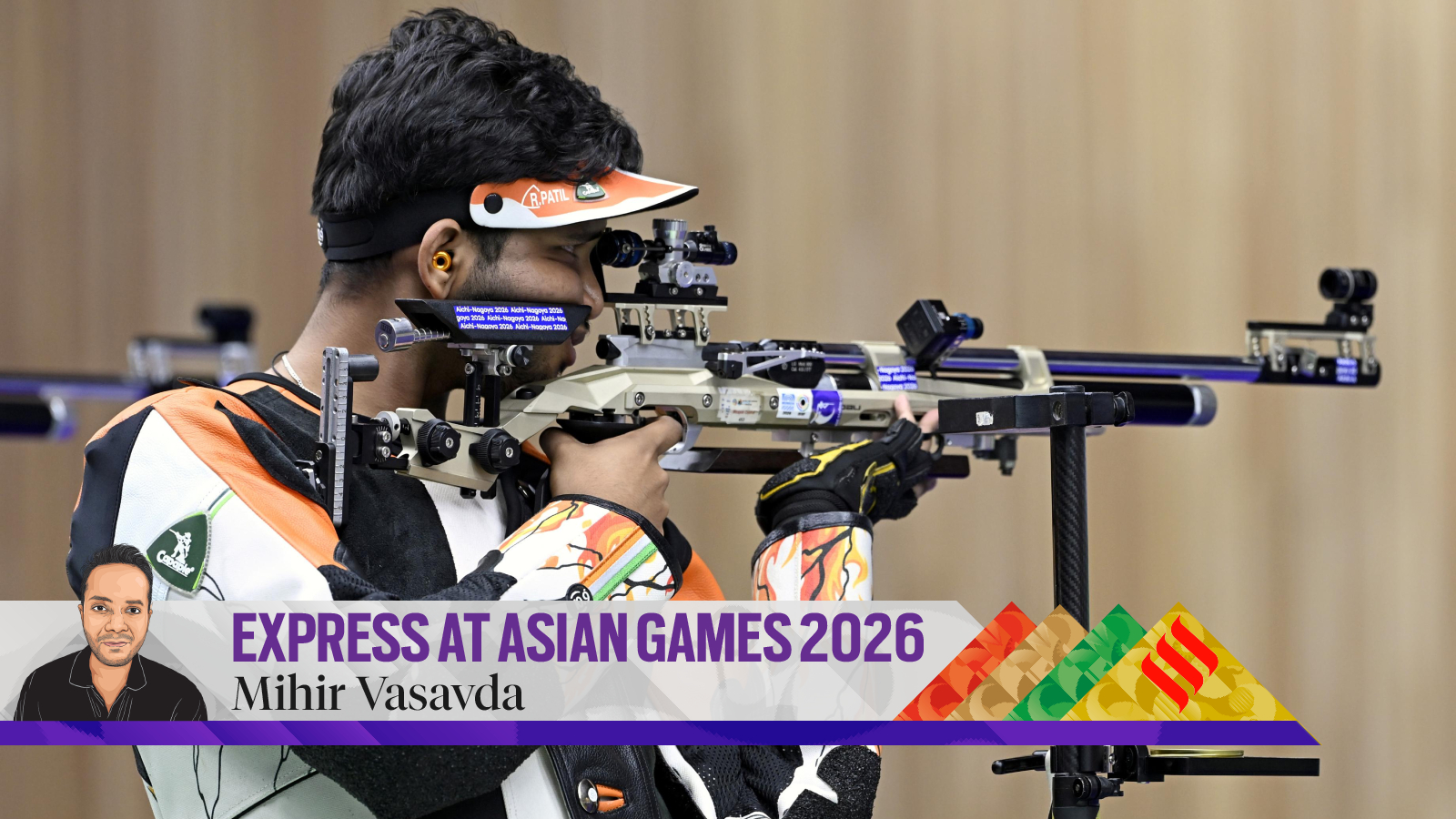
For long stretches of the 10m air rifle final, Patil looked capable of doing much more than settling for bronze. Like Elavenil Valarivan, who won the women’s silver on Sunday, he started strongly. And like Elavenil, he could not sustain that momentum as the final wore on. Himanshu Dhillon’s fortunes were even more volatile, swinging from medal-threatening lows to gold-medal hopes and back again.
Patil seized the early lead and refused to let go. Behind him, the Chinese, Koreans and Mongolians scrambled for position until the fight for the podium narrowed to three: Patil, Dhillon and China’s Sheng Lihao, who was about to turn his chase into theatre.
There was barely any room for error, and even less room to breathe. Decimals separated the top three, and the standard was so high that on the 11th shot, four shooters — Sheng, Dhillon and South Korea’s Shin Minki and Park Hajun — all produced 10.9s. “I haven’t seen anything like that,” Dhillon sighed.
For a moment, it looked as if the Indians might take over. Dhillon’s 10.9 on the 15th shot lifted him into second and brought the prospect of an Indian gold-silver finish into view. It lasted barely a minute.
Sheng had begun quietly, posting 104.9 in his first 10 shots. Not bad, but Patil had been better. Then the 21-year-old began to catch up. Not frantically or spectacularly, but with the cold consistency that has already made him one of the defining rifle shooters of his generation.
He had won silver at the Tokyo Olympics aged 16 years and 233 days, becoming the youngest Olympic shooting medallist in history. Three years later, he was Olympic champion in Paris. He had also won the individual title at the last Asian Games.
He was not about to surrender this one easily. After 16 shots, Sheng had moved back in front, a position he would not relinquish. What followed was almost mechanical. While the Indians searched for a way back, Sheng kept finding the smallest possible margins inside the 10-ring.
His next six series all tallied 21.4, a remarkable show of consistency when the stakes were high. Across those 12 shots, he averaged almost 10.7. Shooting from the left corner, he showed no emotion as high 10s kept appearing beside his name one after another.
The Indians had thrown the challenge at him. Sheng simply kept stretching the gap until the Indians wobbled at different junctures. Dhillon’s 9.8 and, soon after, Patil’s 9.7 gave Sheng the opening he needed. The gold that had seemed within India’s grasp was suddenly moving away.
The contest had changed again. Sheng was no longer being chased for gold. The last few shots became a study in different kinds of pressure: Dhillon trying to hold off his teammate, Patil refusing to let him get away, and Sheng calmly closing the door on both.
Eventually, the scoreboard settled after 22 shots. Dhillon cemented the second spot, a silver on his Asian Games debut, with a total of 231. Patil pocketed the bronze with a tally of 230.9.
He had spent much of the evening chasing a medal of a different colour. In the end, one-tenth was the margin between silver and bronze. But after everything the last year had thrown at him, Patil wasn’t complaining.
Over the course of a 18-year-long career, Mihir Vasavda has covered 2010 FIFA World Cup; the London 2012, Tokyo 2020 and Paris 2024 Olympic Games; Asian Games in 2014 and 2022; Commonwealth Games in 2010 and 2018; Hockey World Cups in 2018 and 2023 and the 2023 ODI Cricket World Cup. ... Read More