Rise of the AfD: The all-or-nothing party
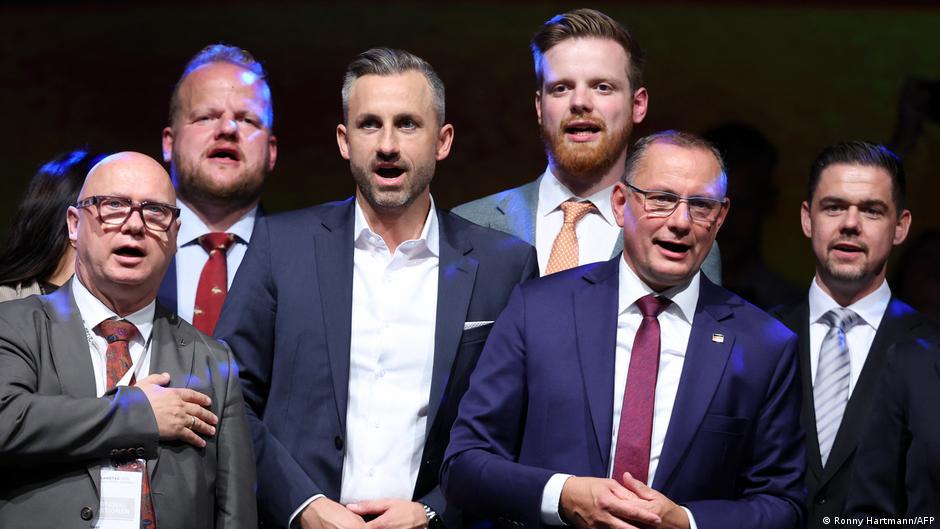
The AfD's election winners in Saxony-Anhalt celebrated their victory by singing the national anthemImage: Ronny Hartmann/AFPAdvertisementWith just under 44% of the vote, the far-right populist Alternative for Germany (AfD) emerged as by far the strongest party in the eastern state of Saxony-Anhalt on September 6. It fell only narrowly short of an absolute majority in the newly elected state parliament, and with it the opportunity to govern on its own.
From the outset, the AfD made clear that governing alone was its preferred outcome. Only by avoiding having to compromise with coalition partners, the party argued, could it fully implement its agenda, which included compulsory work schemes for asylum-seekers, citizen patrols monitoring migration-related issues, and the abolition of all public funding for democracy and civic engagement programs.
While Germany was debating whether the so-called "firewall" against the AfD was an appropriate means of protecting democracy, the party itself had long since built a wall of its own. For years, it has dismissed its political rivals as "cartel parties," effectively grouping them together with criminal organizations.
Teresa Haussmann of the University of Potsdam has been studying the AfD and other populist parties for years. In her view, the AfD sees "all other parties as part of a political elite that must be opposed."
On election night, at the height of the celebrations, the AfD's emerging star and lead candidate, Ulrich Siegmund, adopted a notably more conciliatory tone than he had done throughout his campaign.
"As a democrat, I extend my hand to all political forces willing to pursue a fundamental change of course with us," he said in an interview with German public broadcaster ARD.
Moments later, however, he qualified the offer: "There will be no bending on my part, no compromises."
Within the AfD, compromise is frequently portrayed as a sign of weakness or a betrayal of principle. According to Haussmann, this is typical of populist parties not only in Germany but in many other countries as well.
"The basic premise is that a clearly identifiable popular will exists. If that is the case, then there can be only one correct political course. Any compromise would call that premise into question, because it would mean acknowledging that more than one legitimate path exists," she said.
Little remains of the conciliatory tone struck on election night. As they did throughout the campaign, senior AfD politicians are once again targeting their political opponents with insults and inflammatory rhetoric.
In fact, the parties most likely to be considered potential coalition partners are often the ones the AfD attacks most fiercely. At present, the most obvious candidates are the center-right conservative Christian Democrats (CDU), led by Chancellor Friedrich Merz, and the smaller left-wing populist Sahra Wagenknecht Alliance (BSW).
Immediately after the election victory, AfD co-leader Alice Weidel launched a blistering attack on the chancellor's party, declaring: "The CDU/CSU will never be able to win another federal election. That's a fact."
The Christian Democrats were the big losers of the election in Saxony-Anhalt. Some conservatives believe the party has drifted too far to the left — and it's precisely those disillusioned voters that the AfD is hoping to attract.
At the same time, the AfD has adopted increasingly radical rhetoric and, in Saxony-Anhalt, is classified by the security authorities as a "confirmed right-wing extremist" organization. The primary reason is that the party questions the legal equality of Germans with an immigrant background.
Leading figures within the AfD have repeatedly described the CDU's "destruction" as a political objective. Torben Braga, a prominent lawyer, party strategist and AfD member of parliament, made the party's confrontational stance toward its political rivals clear during a panel discussion organized by the far-right publishing house Antaios.
According to Braga, the AfD's goal is to become strong enough either to govern on its own or to trigger such profound upheaval within competing parties that they are effectively transformed into entirely new political forces.
The AfD thus appears to be pinning its hopes on the CDU's gradual decline, focusing on attracting disillusioned conservative voters rather than working with the party.
For the moment, that leaves only one realistic partner: the relatively new Sahra Wagenknecht Alliance (BSW). The party was founded by former Left Party star Sahra Wagenknecht, who has achieved electoral success with a left-wing economic platform and a foreign policy stance widely seen as sympathetic to Russia.
For the first time, the BSW has entered the Saxony-Anhalt state parliament and could now emerge as kingmaker for the AfD. The party has signaled its openness to talks and potential cooperation. The two parties also share significant common ground on policy.
But shortly after its election victory in Saxony-Anhalt, the AfD also turned its fire on the BSW. Appearing on the far-right online channel Compact TV, AfD parliamentary group leader Oliver Kirchner referred to BSW politician Fabio De Masi as a "half-Italian." He went on to suggest that the BSW could not be relied upon if problems were ever to arise within a governing partnership.
The influential AfD leader in Thuringia, Björn Höcke, dismissed the BSW as the "latest cartel party." The signals coming from the AfD point neither to a willingness to compromise nor to any desire for rapprochement. On the contrary, even without a majority of its own, the party appears determined to stay the course and pursue its radical agenda.
But what if that still doesn't lead to an AfD-led government? "Then we'll simply have to hold another election. That's just how it is," Kirchner said on Compact TV.
That prospect, however, is unlikely to be welcomed by everyone within the party. "At the federal level, there is a strong interest in seeing the AfD lead the government in Saxony-Anhalt," observed political scientist Haussmann. Above all, the party's influential co-leader Weidel hopes to use an AfD-led state government as a stepping stone toward her long-term ambition of one day becoming chancellor.
DW also asked the AfD parliamentary group in the Saxony-Anhalt state parliament, as well as a member of the party's state executive board, how the AfD is currently conducting coalition negotiations. Neither responded to a request for comment.
Despite its ongoing electoral successes, the AfD continues to face considerable internal tensions between its fundamentalist and pragmatic factions. Even if the party were to enter government through a coalition, public skepticism toward it in Germany would remain substantial.
This article was originally written in German.