Putin’s Two Lines That Will Sound Alarms in NATO Capitals - Newsweek
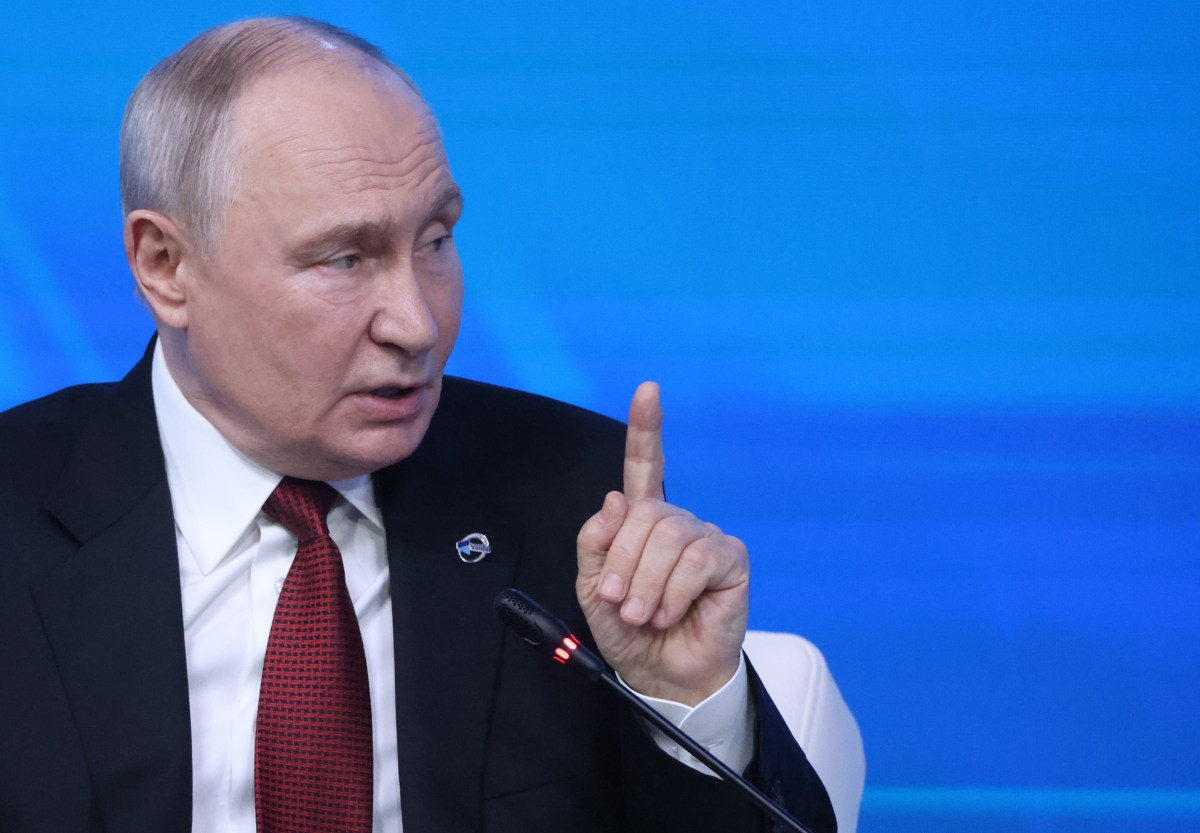
Russian President Vladimir Putin once again laid out the Kremlin’s understanding of the state of the world in a headline-grabbing address at the Valdai International Discussion Club on Thursday, sharing views that trigger furious indignation across the West.
It was, as is often the case, a nuclear warning that dominated much of the media coverage. If there is a “direct attack” on the Russian Federation, then “all the weapons at our country’s disposal will inevitably and immediately appear on the agenda.”
The context for this unsurprising position was mostly Kaliningrad, the strategically vital Russian exclave in the Baltic, though Putin said it applied to “other territories as well.”
But this is obvious and has been said by Putin many times before. It is two other lines that should cause the most alarm in NATO capitals, and they speak directly to the growing threat allies are concerned is coming to a disastrous crescendo.
Discussing the origins of Russia’s war against Ukraine, widely perceived in the Western world as imperial conquest, Putin claimed it was, in fact, his country that was attacked.
Putin pointed to, among other things, "aggressive nationalism and Russophobia in Ukraine," NATO's expansion after the collapse of the Soviet Union, and the popular uprising that ousted the Kremlin-allied Viktor Yanukovych regime in Kyiv in 2014.
"The truth is that we did not want to fight and we did not start fighting; war was started against us,” Putin said—the first line that needs close attention.
In this, Putin twists his invasion of Ukraine, begun in 2014 with the operation in the Ukrainian east and the annexation of Crimea, and then expanded as a full-scale invasion in 2022 with the goal of conquering the whole country, as inherently defensive.
It was the Kremlin’s playbook for Ukraine: aggression presented as defense against an attack. Simply put, it is the truth inverted. Soviet dezinformatsia lives on.
Moscow is, NATO says, escalating its hybrid warfare against allies over their ongoing support for Ukraine in its war against Russia, through weapons deliveries, intelligence sharing, training, sanctions, and more.
Putin is particularly aggrieved about NATO allies enabling Ukraine to strike deeper and harder into Russian territory with advanced Western weapons and targeting intelligence.
Kyiv is also rapidly developing its own ability to do this with domestically made drones, cruise missiles such as the FP-5, aka the "Flamingo"—which have wrought havoc on Russia’s lucrative oil sector as well as military targets like airfields—and even the latest FP-7 ballistic missiles, which has only recently been used in combat, according to Ukraine's president.
Mujtaba Rahman, managing director for Europe at Eurasia Group, said in a note on Friday that senior NATO officials make a distinction between three types of hybrid threat posed by Russia.
The first is drone incursions, seen as largely accidental and a product of the “sheer scale of drone and jamming activity by both Russian and Ukrainian forces,” Rahman said.
Second is the kind of intentional hybrid activities orchestrated by Russia’s military-intelligence GRU, such as sabotage attacks and assassinations, both of which have become regular occurrences in Europe. The Leipzig explosives are one big example.
“The third is a more direct intervention by Russia—'little green men’—closer to actual armed aggression. The risk of this last type of scenario is seen as low,” Rahman wrote.
Those “little green men” were the first to feature in Russia’s 2014 invasion of Ukraine, ambiguous and unmarked combatants who entered the territory as the Kremlin denied involvement. They were the vanguard for the eventual seizure of Crimea.
How NATO responds to these threats is under discussion. Article 4 prompts only consultations among allies, concerned about an incident. Article 5 applies when an ally comes under direct armed attack. But hybrid warfare is greyer.
The European Union is developing its National Security Strategy and wants to come up with its own defensive response to handle these hybrid attacks without needing NATO unless the situation drastically escalates.
And this is where Putin’s second line comes in. European allies have warned of a Russian attack on a NATO state within a short timeframe, perhaps months or a couple of years, to test the unity of the alliance.
But it is likely to occur, if it does, as a hybrid attack that falls in the grey area between Article 4 and Article 5. The “little green men” might make another appearance in the former Soviet Baltic states that neighbor Russia.
What could trigger that? A Russian calculation that NATO is not ready to respond to such an incursion, and that it can make a coherent enough claim to having been attacked—like NATO allies helping Ukraine to strike Russian territory, as they are.
“We have no intention of attacking anyone—not in 2029, not in 2030, not in 2050. But if we face aggression, we will be forced to respond,” Putin said at Valdai, the second line to scrutinize closely.
In those two lines we have a roadmap for Russia escalating into a confrontation with European NATO allies: the invention of an attack that justifies a “defensive” Russian incursion into a NATO state.
It is an event that would make or break the NATO alliance and risk World War III.
The strength and unity of NATO changes the calculation for Putin in either direction. He is signaling what he is considering. NATO must respond rapidly and forcefully before Putin does.