Putin’s New Warrior Class Is Coming for Russia’s Elections—and Maybe Him - Newsweek
Russians begin heading to the ballot box today to choose a new parliament for the first time since Vladimir Putin ordered his forces into Ukraine and sent them bearing down on Kyiv.
Five years on from the last State Duma elections, the so-called "special military operation," or SVO, has reshaped every facet of Russian society. Its industry, economy and legislation are all increasingly geared to sustain war, no matter what the public thinks. Now, Putin wants a government to match.
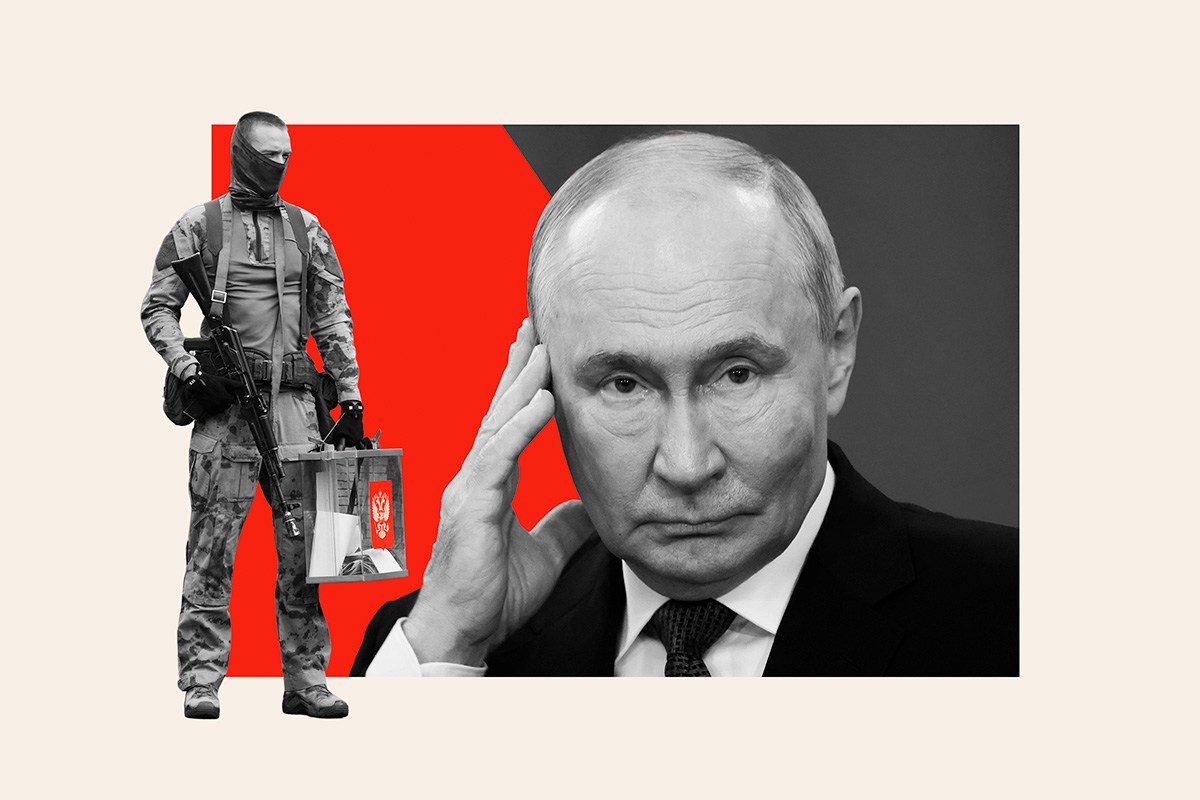
More than 180 party-backed candidates registered for this election are SVO participants. This is no coincidence—Putin has openly declared that war veterans should form the "leadership cadre" of Russia’s future, and created a program to fast-track Ukraine war veterans into senior political and state-linked corporate positions.
By creating a warrior class at the center of Russia’s political elite, the Kremlin is killing several birds with one stone. A parliament full of war veterans legitimizes the SVO and guarantees enduring support for whatever measures Putin sees fit to prosecute it. It also gives military members more social currency in a society whose veteran population is growing exponentially. But this is not a foolproof plan.
What if one day, they stop taking orders?
Spoiler alert: Putin’s United Russia party is going to win this election.
Candidates from Yabloko—the only nationally recognizable party openly opposing the war—were stripped from the federal party ballot, while United Russia has scarcely bothered campaigning. The party is highly likely to comfortably secure the 300 of 450 seats it needs to maintain a constitutional majority.
At first glance, public support for the war in Ukraine looks healthy. In August, 68 percent of respondents to independent Levada Center polling said they supported the actions of Russia’s armed forces in Ukraine. A month earlier, when Russians were asked to choose between making concessions to Ukraine and the West to end the war or ramping up attacks on Ukraine, 56 percent backed escalation, versus just 25 percent who would’ve preferred concessions.
But these numbers conceal a dangerous truth. Russians can broadly agree with Putin’s motivations and justifications for the war, while growing increasingly resentful of the consequences.
Polling by the New Eurasian Strategies Center (NEST) reveals that while a majority of Russians back the war, three-quarters believe it is damaging Russia’s economy. Forty-two percent said economic conditions had deteriorated over the previous three months, and more than a third advocate for shifting military spending toward healthcare, education and pensions.
This is the kind of discontent that even a man as powerful as Putin can only sustain for so long. His answer, according to Russian political scientist and head of Russia domestic policy research at NEST, is to create a pro-war "party of victory" that will back further military escalation abroad and repression at home.
The parliament elected this weekend will remain in office into the next decade, beyond the next presidential election in 2030.
"The Kremlin undoubtedly expects war participants to form the basis of the so-called ‘Putin majority’ in politics," Morozov told Newsweek. "Putin is counting on veterans now, and he will rely on veterans in the next period of peace as well because he intends to maintain deep conflict with Europe and the West, regardless of how the war in Ukraine ends."
The point of this weekend is not simply to secure another election victory—that is a foregone conclusion. It’s to build a political class capable of sustaining endless war, no matter the cost.
"In 2027, the new State Duma, working with the Presidential Administration, will actively pass laws to sustain the war effort under even the most grim of scenarios," Morozov said.
Signing up to fight in Ukraine is no longer just an act of patriotism, or a risky way for criminals to avoid a nasty jail sentence. It can open doors to a bigger, brighter future—that is, if you’re lucky enough to emerge suitably unscathed from the drone-plagued, blood-soaked trenches in Ukraine.
Putin’s Time of Heroes program, launched in March 2024, is the Kremlin’s most explicit mechanism to show this. Veterans compete for places on an elite training track designed to prepare them for senior roles in government, regional administrations and major state-linked companies.
"All state institutions are carrying out Putin’s direct instruction to actively bring military veterans into government and the education system," Morozov told Newsweek. Ahead of the Duma election, he said, every parliamentary party was expected to showcase as many candidates from the war as possible.
They seem to have got the message. Ella Pamfilova, chairwoman of Russia’s Central Election Commission, said in August that 1,586 SVO participants or veterans were registered candidates for elections at every level in Russia this year, including 186 in this weekend’s State Duma race, according to Russian outlet Vedomosti. Last year, more than a thousand SVO participants were elected to local and regional positions.
Russia, like the U.S., has a special kind of reverence for veterans and the armed forces baked into the collective memory. After more than four years of war in a society built to sustain it, these warrior-politicians carry a certain legitimacy and socio-political capital that career officials simply can’t replicate.
As if to prove the point, United Russia is promoting one of them on a par with some of Moscow’s most prominent politicians.
Vladislav Golovin, a former marine commander who fought on the front lines in Ukraine’s Donetsk region, was selected as part of the Time of Heroes program. He is now the chief of staff of Yunarmiya—Russia’s vast military-patriotic youth movement—and one of just five names chosen to headline United Russia’s national election list, alongside Foreign Minister Sergei Lavrov and Moscow Mayor Sergei Sobyanin.
Patriotic, loyal lawmakers like Golovin will come to serve another function beyond greenlighting any future pro-war policies at Putin’s behest. The SVO is creating a new, ever-growing population of veterans, many of them carrying the physical and mental scars of modern war, who will need to be reintegrated into society and feel their sacrifice is recognized and appreciated.
John Kennedy and Hanna Hodgetts, researchers in the Russia-Eurasia program at the RAND Europe think tank, told Newsweek that new veterans are already becoming a "crucial constituency" whose interests United Russia needs to represent and reward.
"The war against Ukraine is the most important issue in Russian politics and will remain so for the foreseeable future," they said. "Putin takes public opinion very seriously and has historically used the party to accommodate and reward key individuals and groups in this way."
But not all of these "SVO participants" need be heroes of the Russian war effort. That title, unlike "combat veteran," is not protected, and many of the candidates running on their involvement in the Ukraine war have far less experience than they’d care to admit.
"Many of them are people who earned veteran status through means not directly related to actual combat, like sending equipment to the front or making a brief trip to the front line on a humanitarian mission, things like that," Farida Rustamova, a Russian political journalist and founder of independent outlet Vlast, told Newsweek.
"Sure, there will be some actual soldiers included so the authorities can point to them and say, ‘look—these guys are the real deal,’ but they still won't make up the majority. It is an entirely symbolic arrangement to create the appearance of veterans being represented within the halls of power. But they won't hold any real power."
Putin’s plan awards veterans—and officials carrying veteran credentials—significant political and social status. But recent history contains examples aplenty of the danger that could befall the Kremlin should they begin cultivating a little too much support.
"Putin has grounds to fear veterans," Morozov told Newsweek. "Many combat veterans are critical of the Defense Ministry, the General Staff, and how military operations are planned. "The longer the war drags on, and the less clear the prospect of victory, the more dangerous this pro-war environment becomes for Putin."
The story of Yevgeny Prigozhin is perhaps the best cautionary tale. Once a failed businessman and criminal, he found himself catering for the Kremlin and struck up a relationship with Putin before going on to front the infamous private military company Wagner Group. Before long, he was leading a private army composed of mercenaries and criminals that proved instrumental in seizing key territories in Ukraine.
Those same mercenaries and criminals promptly made an about-face and began marching on Moscow with the intent of ousting Russia’s then Defense Minister Sergei Shoigu, and army chief Valery Gerasimov.
Putin took to state television, accusing them of treason and vowing to stamp out the uprising, but Wagner was not to be stopped. They seized the southern Russian city of Rostov-on-Don, continued up through Voronezh and got more than halfway to Moscow, fighting off Russian air attacks and making rapid progress, before Prigozhin ultimately called off the final assault in favor of a truce brokered by Belarus’ Alexander Lukashenko.
Two months later, Prigozhin was removed from the chessboard when his plane exploded midflight. But his armed uprising, and open rebellion against Russia’s Defense Ministry, was a serious shock to the Kremlin.
Prigozhin and his mercenaries never turned against the war. Their quarrel was with the men running it.
Some of this year’s veteran candidates are already voicing their displeasure. Communist Anton Shilov, seriously wounded in Ukraine at the battle of Hostomel, has accused United Russia of campaigning unfairly and attacked Russia’s growing billionaire class: "For some, it’s war; for others, it’s business," he says. A Just Russia candidate Konstantin Ryzhak says the ruling party acts as if "everything is fine," while New People candidate Alexander Zitser has spoken out about the "cognitive dissonance" disgruntled soldiers experience when they return from devastated war zones to a wealthy Moscow.
None of these men, and many other candidates like them, are campaigning against the war. They are challenging how it is fought, who benefits, and whether the sacrifice is shared fairly. Kennedy and Hodgetts told Newsweek that a politically legitimized military cadre "may harbor grievances" and that their resentment could grow as losses mount, and the lives of ordinary Russians grow harder under growing economic pressure.
Russia’s RBC reported in May that United Russia and Putin’s presidential administration were discussing concerns over "management risks" related to a large veteran population in Parliament.
Initial proposals to create a dedicated veterans committee or parliamentary grouping were shot down by Kremlin-linked sources, who reportedly argued such moves could divide parliament into "us versus them." Alexei Chesnakov, a political consultant who works with United Russia, warned that a separate veterans bloc could begin to resemble a political force distinct from the party itself.
Rustamova, however, believes the Kremlin has little reason to panic. Policy is dictated by Putin and the Kremlin; the Duma, she argues, is simply designed to carry out the bidding of the executive branch. A parliament full of veterans can be decorated, paid and paraded for propaganda purposes, without being allowed to build an independent power base.
As always, the pain will fall on the people they are supposed to represent.
"Over the last couple of months, especially leading up to the vote, the state put some harsh measures, like blocking websites, shutting down the internet, and other repressive initiatives affecting the general public, on a bit of a pause," Rustamova said.
"A huge number of unpopular decisions, including economic ones, have been postponed until after the vote," she added, citing tax increases, new levies and a deficit budget with little money available for public spending on anything that doesn’t serve the war.
Putin will succeed in filling parliament with politically obedient "war heroes." The harder test will come as more wounded and disillusioned soldiers return home to a country still demanding sacrifice, and decide whether the status and rewards they were promised were enough.