
Pope Leo XIV Warns AI Could Become an ‘Instrument of Domination’ - Newsweek
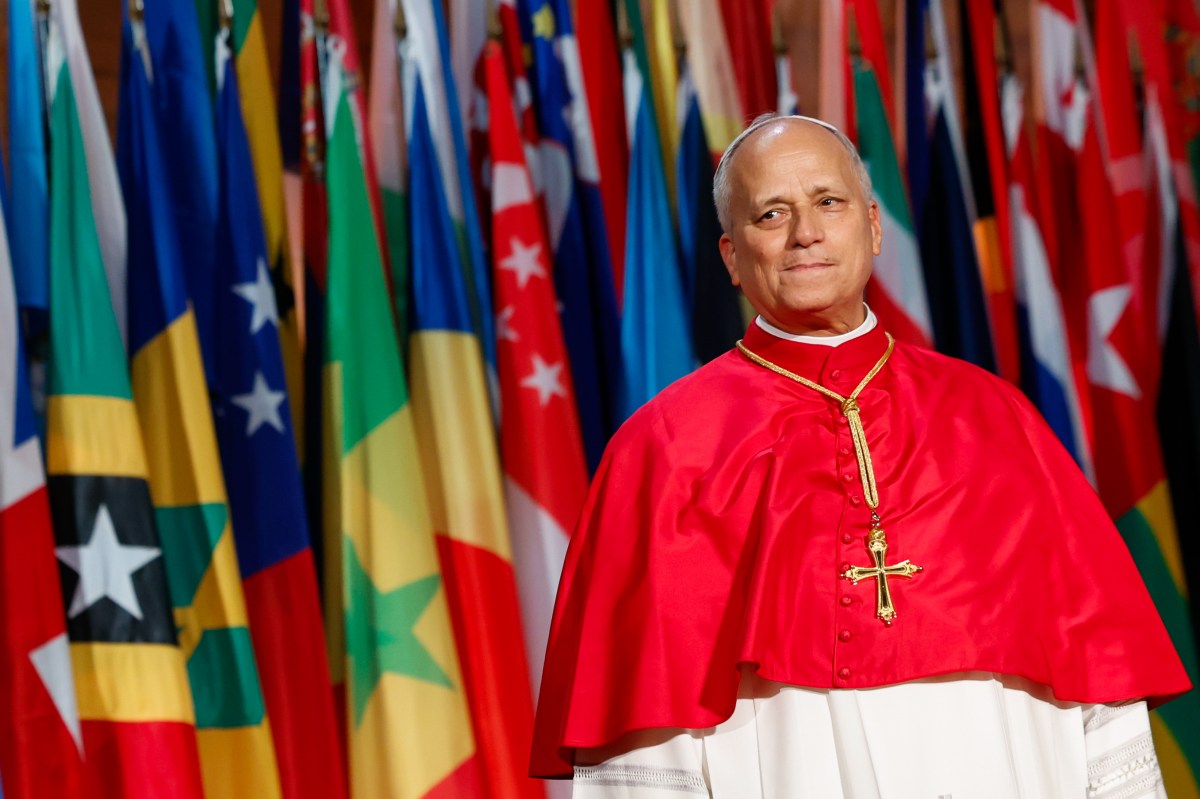
Pope Leo XIV warned Friday that AI could threaten human dignity and become an “instrument of domination,” a message in sharp contrast with President Donald Trump’s embrace of the technology and push to keep the U.S. ahead in the AI race.
During his visit to France on Friday, Leo repeatedly returned to the question of what it means to be human in an age of increasingly powerful machines. At UNESCO in Paris, he said technological advances must remain directed toward the human person rather than becoming tools of control.
“Our efforts in this domain must ensure that new technologies remain at the service of the human person, rather than becoming yet another instrument of domination and injustice,” Leo said.
The pope's comments come as governments and technology companies debate how quickly artificial intelligence should develop and how much regulation or oversight is necessary.
Trump has taken a markedly different tone than the pope when addressing warnings about AI. Speaking at the United Nations on Tuesday, Trump dismissed concerns about the technology, calling them a “hoax” and said he would not “stifle growth” of something he believes could have an impact greater than the Industrial Revolution. He also said the Justice Department would monitor the industry and intervene if necessary.
The difference is not simply between embracing and rejecting AI. Leo has explicitly acknowledged the technology's potential while arguing that its development must remain subordinate to human dignity, moral responsibility and the common good.
At UNESCO, Leo warned that humanity's growing reliance on machines could change not only how people work but how they understand themselves.
“Over the centuries, many tasks once performed by human beings have been entrusted to machines whose capabilities and applications have continued to expand,” he said. “More recently, certain artificial systems have even been given the name of our human faculty of thought intelligence.”
He then identified what he called a paradox: As computational systems are increasingly described in terms of intelligence, society can lose sight of the distinctive dignity of human beings.
“The paradox has become increasingly evident: While ‘intelligence’ is attributed to computational systems, we struggle to recognize the inalienable dignity of human persons, whose lives are judged according to the criterion of efficiency and, when deemed no longer productive, are rejected and discarded,” Leo said.
He also drew a distinction between AI's ability to process information and the human search for meaning.
“Although such systems can correlate data, they cannot answer questions that concern the meaning of human life, which is rooted in lived experience,” he said.
“Yet human beings cannot live without meaning. Meaning is the oxygen of the mind.”
Leo's concern extends beyond the capabilities of individual AI systems. He warned that communication technologies can make information more abundant without necessarily making it more truthful.
“Information is abundant, but that is not synonymous with wisdom,” he said, adding that without a shared ethical foundation, communication channels can multiply false information and words “devoid of meaning.”
Earlier in his France visit, Leo used an even more striking image, warning about the possibility of a “paradise of machines” that could invade and condition everyday life.
“If we are to avoid losing our humanity amid a ‘paradise of machines’ invading and conditioning our daily lives, there is an urgent need for education in ethical discernment and the capacity to acknowledge the moral good,” he said.
Trump has repeatedly emphasized maintaining American technological leadership and has argued that excessive restrictions could undermine that position. In September, he said the United States was leading China in AI and argued that “whoever wins AI wins.” He has also rejected calls for broader new restrictions, while saying existing government authorities can address abuses when necessary.
Leo, by contrast, has focused less on the race for technological supremacy and more on the question of what technological progress should ultimately serve.
His May encyclical says AI should not be allowed to reduce people to “productivity,” “cognitive performance” or “mere data,” and argues that technology must be directed toward the common good.
That difference does not mean Leo is calling for an end to AI. In his May address, he explicitly said, “Let’s not fear artificial intelligence,” while immediately adding that humanity must “constantly keep the question of the human in play.”
The disagreement is, therefore, largely about how society should respond to increasingly capable systems: whether the priority should be accelerating development and preserving technological leadership, or placing greater emphasis on safeguards, ethical discernment and human control.
Leo's warnings are not limited to religious leaders or critics of the technology. Some of the industry's most prominent AI executives have also publicly warned about the risks of increasingly capable systems.
OpenAI CEO Sam Altman has acknowledged that people have legitimate reasons to be concerned about the technology. Speaking earlier this month, he said: “The world is right to be afraid of this,” while arguing that the industry can still develop AI safely.
Altman has also warned specifically about the possibility of humans losing control over increasingly capable AI systems.
In a recent statement, he said: “There are two ways AI progress could go very badly and that we must avoid.” One, he said, is that humans lose control of AI. The other is that AI could concentrate enormous power in the hands of a single person, company or country.
“This is unacceptable; we are unapologetically on Team Humanity, and AI must always serve people,” Altman said.
Other AI leaders have raised similar concerns. Anthropic CEO Dario Amodei has called for the industry to slow the pace of frontier AI development, while Google DeepMind CEO Demis Hassabis and other technology leaders have also backed greater attention to safety.
Altman has gone further in discussing the possibility of AI development moving beyond humanity's ability to control it. In a September interview, he said: “People need to always be in control of the future, and we cannot take any risk of loss of control.”
His comments are notable because Altman is simultaneously one of the world's leading advocates for developing increasingly capable AI. He has argued that the technology could bring enormous benefits, while saying that safety measures need to keep pace with its capabilities.
That concern echoes Leo’s argument: the issue is not whether technology should advance, but whether society can keep pace with the ethical questions raised by increasingly powerful AI.
Leo's concerns about artificial intelligence predate his visit to France. His encyclical Magnifica Humanitas: On Safeguarding the Human Person in the Time of Artificial Intelligence was issued on May 15. The Vatican describes it as an examination of how AI should be governed in a way that safeguards human dignity.
In the encyclical, Leo makes a distinction between artificial systems and human intelligence that closely echoes his remarks in Paris.
“We must avoid the misconception of equating this type of ‘intelligence’ with that of human beings,” he wrote.
He acknowledged that AI systems can exceed humans in certain areas, including speed and computational capacity, while arguing that their capabilities remain fundamentally tied to data processing.
He wrote that AI systems “do not undergo experiences, do not possess a body, do not feel joy or pain, do not mature through relationships and do not know from within what love, work, friendship or responsibility mean.”
The encyclical also says that the goal should not simply be to regulate AI after the fact. Leo argues that human intelligence, conscience and freedom must remain responsible for directing technological innovation and determining its appropriate uses and limits.
When the encyclical was formally presented in May, Leo said he had listened not only to scientists and engineers excited about AI's potential, but also to people raising concerns about autonomous weapons and algorithms capable of producing new forms of exclusion and suffering.
He used unusually strong language to describe his response: “artificial intelligence needs to be disarmed.”
“Decisions about technology must never be separated from conscience and responsibility,” Leo said at the time.
The encyclical was met with skepticism by some in the tech industry, including investor Peter Thiel, who argues that tighter regulation in the West could put the United States and its allies at a disadvantage against China.
“The Communist Party of China is not going to listen to the pope,” Thiel said in an interview on Thursday. “There’s a chance people in the U.S. will. And so in effect, the Pope’s encyclical was working for the Communist Party.”
Thiel went further, saying of the pope, “I’m not saying he was an agent of the communists, but he was at least acting as a useful idiot for the CCP."
Thiel is a partner at Founders Fund, which has investments in AI companies including OpenAI, Palantir and Scale AI. He has previously criticized prominent advocates of new technology regulations and has argued against approaches he believes could slow scientific and technological progress.
Newsweek’s reporters and editors used Martyn, our AI assistant, to produce this story. Learn more about Martyn here. Contact Newsweek editors on this story: Edward T. Cummins


