Police questioning can shape a sexual assault case. Their approach is often wrong
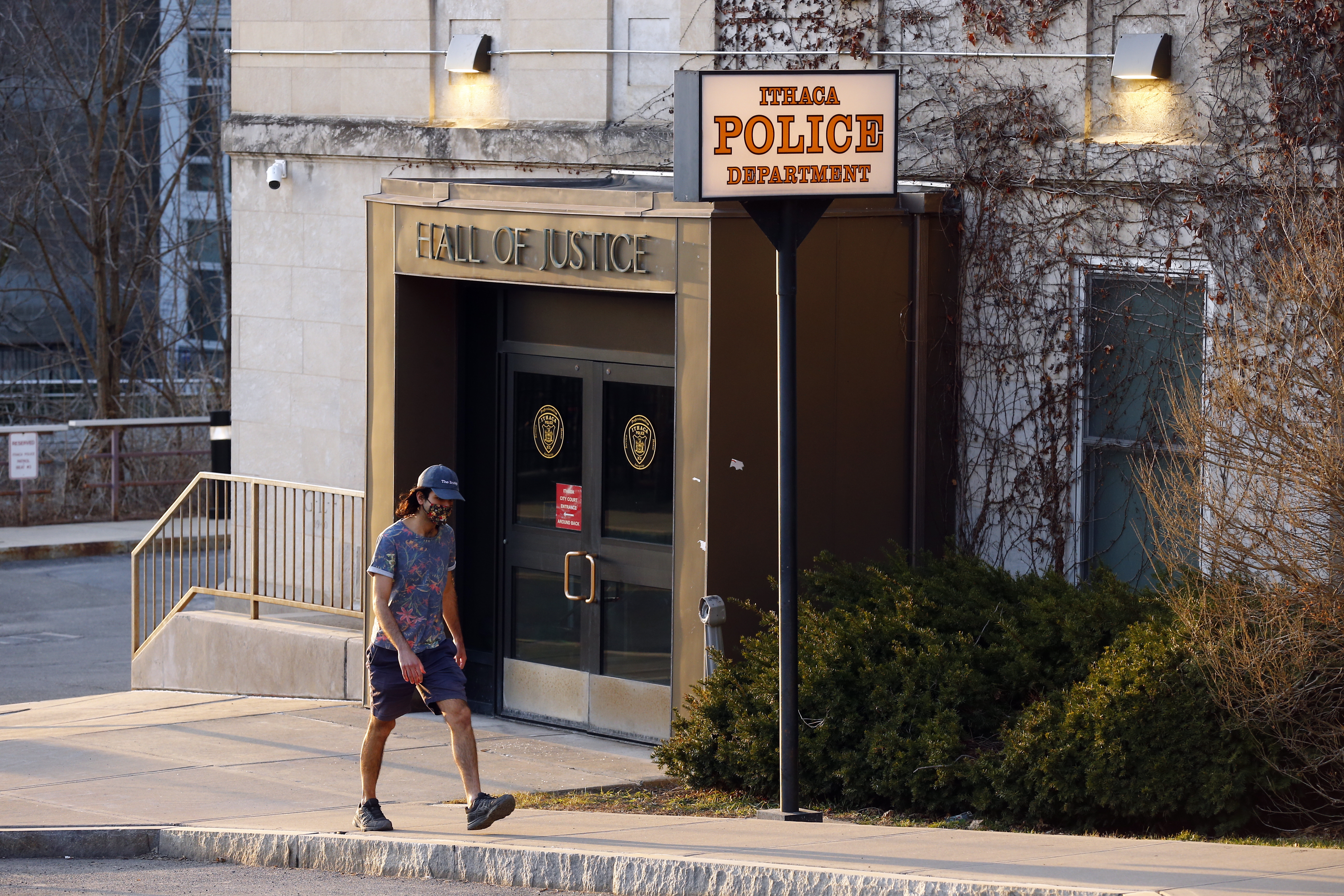
A person walks by the Ithaca Police Department headquarters on March 22, 2021, in Ithaca, N.Y. John Munson/AP hide caption
The allegations from a former Cornell University student who says she was drugged and gang-raped at the school in 2024 has led to widespread condemnation for the school and investigators.
National Cornell fraternity rape case is reopened, as Hochul calls for review of school response The case is also raising questions about how police handled the initial investigation.
Earlier this month, the woman, known as Jane Doe, filed a civil lawsuit detailing allegations against seven men she said assaulted her. Prosecutors have subsequently reopened the investigation.
Details in the lawsuit differed from a statement Doe provided to Cornell University Police following the alleged attack in 2024, according to excerpts shared by Tompkins County District Attorney Matthew Van Houten. The 2024 statement is central to why his office did not pursue criminal charges two years ago, he said.
Van Houten said that Doe's 2024 statement "did not allege that she was drugged against her will or gang raped" and "described her participation in drug use and sexual conduct as voluntary, conscious, and consensual."
There are, however, several instances in Doe's statement shared by Van Houten where she says she could not remember certain details, did not consent to certain activities and was increasingly intoxicated as the night continued.
Consider This from NPR Sexual assault on campus is a problem. Can laws help address it? Van Houten told NPR member station WSKG in an interview that Doe's statement was taken by "an experienced investigator" trained in sexual abuse investigations "over an extended period of time." Cornell University Police did not respond to questions about details of the length, time and place of the interview or other details of the manner of questioning before publication.
Trauma researchers and advocates for sexual assault victims say an initial statement like Doe's often cannot be taken at face value and more investigating needs to be done.
Gaps and inconsistencies in an assault survivor's police statement are often a product of a victim's trauma and of how officers question them – not evidence that she's unreliable, according to Dave Thompson, a certified forensic interviewer and a consultant who trains investigators in interrogation techniques.
"Anybody that interacts with survivors or victims or witnesses to crimes should be trained in a trauma-informed approach," he said.
That's an approach that trains investigators to act in a way that anticipates how trauma survivors might respond differently after an assault, which can include impacts to their behavior and memory. This approach centers a survivor and works to prevent approaches to questioning that could re-harm them.
Shots - Health News How Rape Affects Memory And The Brain, And Why More Police Need To Know About This Rebecca Campbell, a psychology professor at Michigan State University, said this is all done while understanding that their accounts may not initially be clear, complete or chronological.
But most U.S. police are not trained in this approach, Campbell said. For nearly 30 years, she's studied trauma and sexual assault.
A study by the Bureau of Justice Statistics for the Census of Law Enforcement Training Academies analyzed subject areas offered to police recruits during basic training. The average length of the core basic training program was 833 hours.
In nearly 94% of surveyed police academies that offered training on sexual assault, trainees received on average seven hours of training on the issue, according to the report. They received six hours of training on victim response in the nearly 88% of academies that offered instruction on this issue.
In lieu of meaningful training, Campbell explained, "What we see consistently in research is that responding officers and detectives will very often treat the victim as the subject to be interviewed and to be interrogated."
That impacts how comfortable victims are with sharing necessary information to investigators and ultimately affects an investigation.
Sources for this story were speaking generally about sexual assault investigations and are not involved in the Cornell investigation or questioning by police.
Scientists and researchers have examined how survivors of serious trauma and especially sexual assault can frequently struggle to remember the events leading up to, during and after the event.
"Our memories don't work like a video recorder that we can just rewind, hit play and remember from start to finish. We might remember the sound. The feeling of an impact. Maybe a scream. We remember bits and pieces," Thompson, the certified forensic interviewer, said.
It's important that investigators know that too, rather than dismiss memory lapses as falsified details or concluding that the story has too many inconsistencies, he said.
It's important "that we're not expecting memory to go from start to finish," he said. "And we're allowing that person a safe space to remember and recall and retrieve details that may be most relevant or present in their state of mind."
Tracy Matheson established a foundation, Project Beloved, to create special police interrogation rooms across the country to make the environment for victims reporting a traumatic event more calming and conducive to this approach.
Matheson's 22-year-old daughter, Molly Jane, was raped and murdered in 2017. Her killer, Reginald Kimbro, was sentenced to multiple life sentences for her daughter and another woman's killing and additional sexual assaults in 2022.
After this tragedy, Matheson educated herself on the impact of trauma to the brain. She learned that during those events the brain switches to survival mode.
"It's picking out things that may seem insignificant, but in the long run actually corroborate whatever it is that the victim is reporting happened," Matheson said.
Michigan State University's Campbell said she can't speak to how the Cornell case was handled. But she said that in her research, prosecutors and police often treat inconsistencies from traumatized victims as a reason to stop investigating, citing credibility concerns, rather than as something to follow up on.
"We actually don't see that same behavior in other types of crime," she said.
When there's a discrepancy, "That is something that merits more evidence, more follow up, more interviews to figure out why there is a discrepancy or is there really even a discrepancy? They don't do that in sexual assault cases."
This is part of the problematic dynamic for victims, who struggle with reporting sexual assaults already because they fear they won't be believed or helped, she said.
"And they're met with blame and skepticism," Campbell said. "And it becomes a vicious dynamic of more blame, more withdrawal." Eventually, police shrug their shoulders and say, "She didn't give me the information," she said.
Data shows that from January 2021 to December 2025, law enforcement documented an average of 127,798 reports of rape, according to RAINN, a nonprofit anti-sexual assault organization. FBI crime data shows that law enforcement clears 26% of the reported rape cases. (That can mean someone was arrested or a suspect died and not necessarily that they were charged or convicted.)
An even bleaker statistic shared by RAINN shows that from a 20-year review of reported sexual assault cases, 89% of cases were "founded," meaning that investigators determined the crime likely happened. But only 8% of those cases ended in a conviction.
Campbell said research she and other scholars have done shows that in a vast majority of cases, police make no effort to find or interview suspects.
"And in cases where it is an assault and that occurred between people who know each other for whom there could be text information and texts and social media. Again, research suggests about 80% of the time the police never go get that information," she said.
Part of that is due to the complexity of some of these cases, Campbell added. But during her decades of research, she said law enforcement personnel have told her repeatedly that resources and staffing are not prioritized to help solve these cases.
The Cornell case, unfortunately, highlights these longstanding and entrenched patterns, she said.
"We have tried through different policy initiatives and avenues to create change and to make things fair and equitable and trauma informed," she said. "It's like one step forward, two steps back."
NPR does not offer or accept money for coverage or interviews. Anyone who makes such an offer or request is not an NPR employee and does not represent NPR.